
BY:SpaceEyeNews.
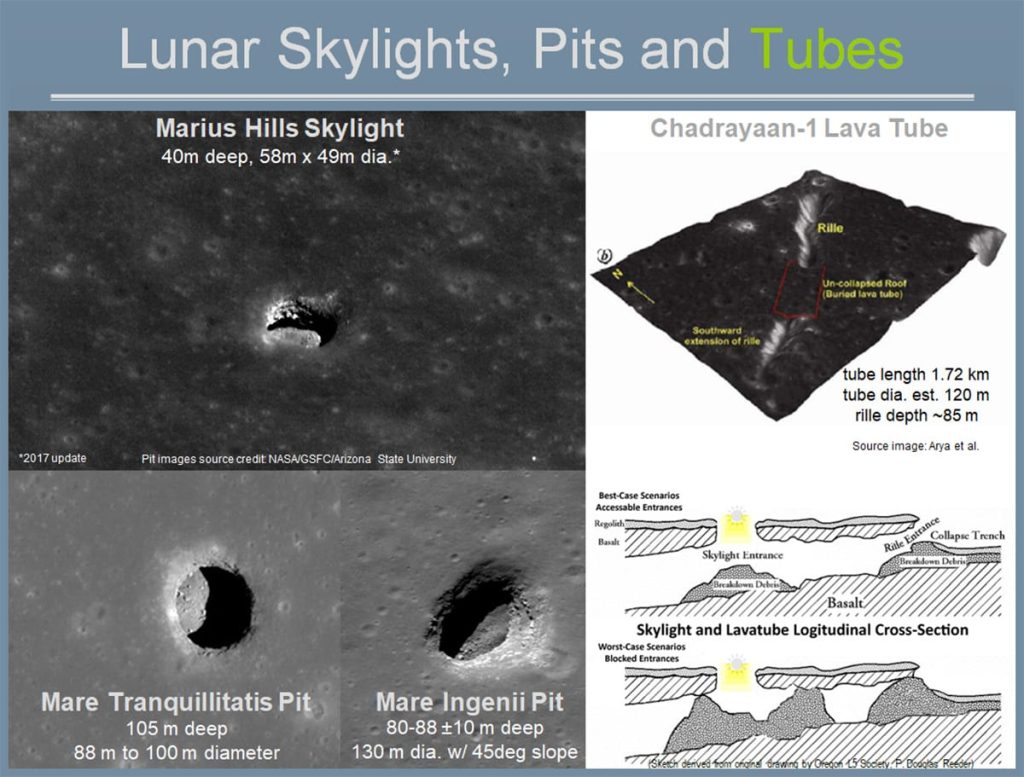
Future astronauts may find valuable protection beneath the Moon’s surface. At Marius Hills Pit, NASA’s newly selected GIMLI investigation will examine whether a visible opening connects to a larger underground lava tube. Such a structure could offer natural shielding and steadier temperatures for future explorers.
The possibility is compelling, but the central question remains unanswered. Scientists can see space beneath the pit’s overhanging walls. They still need to establish its extent and connection to any broader tunnel system.
Why Marius Hills Pit Draws Scientific Attention
The surrounding volcanic landscape contains clues that make this location especially interesting. Ancient lava flows shaped the region, leaving structures that researchers can investigate from orbit.
In 2017, scientists studying Japan’s Kaguya radar data identified echoes consistent with underground cavities near the pit. Candidate locations also corresponded with mass deficits in gravity maps from NASA’s GRAIL mission.
Together, those observations strengthened the case for buried spaces. However, they did not settle whether the visible opening provides access to an extensive tunnel. www.isas.jaxa.jp
Images reveal an overhang above a void wider than the opening itself. That geometry leaves two important possibilities: an isolated cavity or part of a larger cave system. GIMLI aims to distinguish between them.
NASA’s GIMLI Investigation Moves Closer
NASA announced GIMLI’s selection on September 30, 2026, through its PRISM programme. Its full name is Geophysical Instruments for Marius Lunar pit Investigation.
Nathaniel Putzig of the Planetary Science Institute leads the project. Commercial delivery will take place through NASA’s Commercial Lunar Payload Services initiative. The selection announcements do not specify a launch date or delivery provider. www.nasa.gov
PSI describes instruments operating from a lander and rover. Honeybee Robotics will build the seismic equipment, gravimeter, and cameras, while also managing the project. The Norwegian Space Agency will provide the radar. www.psi.edu
This approach brings complementary measurements directly to the surface, where researchers can investigate the structures suggested by orbital observations.
How GIMLI Will Examine Marius Hills Pit
Radar: Looking for Underground Boundaries
Ground-penetrating radar will send signals into the ground and measure returning echoes. A boundary between solid rock and an empty cavity should produce a strong reflection.
That response could help scientists identify underground space. However, researchers will compare it with other measurements before deciding what structure best explains the signals.
Seismic Sensors: Following Vibrations Through Rock
The active-source seismic system will generate vibrations and monitor their passage through the surrounding material. Rock transmits these waves, while an empty space interrupts their route.
Reflections and changes in wave paths could reveal a cavity’s boundaries. These measurements offer a separate way to investigate the same hidden structure.
Gravity and Cameras: Completing the Picture
A gravimeter will search for a local reduction in gravitational attraction. An underground void contains less mass than the surrounding rock, creating a potential clue.
Meanwhile, cameras will examine the surface and exposed pit walls. Together, these tools could establish whether a cavity extends beyond the opening and help estimate its dimensions.
Agreement across different instruments would strengthen the evidence considerably. One unusual signal alone would leave more room for alternative explanations.
Why a Lunar Lava Tube Could Help Astronauts
A substantial rock roof could reduce exposure to radiation and micrometeoroids. Underground spaces may also experience smaller temperature swings than exposed terrain.
Those advantages could influence future habitat design. Natural protection might help engineers decide where to place equipment and living quarters. However, GIMLI must first establish what underground space actually exists. www.nasa.gov
The Temperature Finding Needs Context
NASA reported research in 2022 indicating temperatures near 17°C in permanently shaded portions of a lunar pit. The detailed analysis focused on Mare Tranquillitatis, using orbital thermal observations and computer modelling.
That result supports interest in sheltered lunar environments. It does not establish the temperature inside an unexplored Marius Hills tunnel. www.nasa.gov
Likewise, researchers have not measured radiation shielding inside this potential shelter on site. Its practical benefits will depend on conditions that future investigations must assess.
From Underground Cavity to Lunar Habitat
Finding a tunnel would only begin the engineering challenge. Crews would need safe access, reliable equipment, and a protected living environment.
In an interview with Space Daily, Putzig describes a steep descent from the rim. He suggests that future operations might eventually require an elevator for people and cargo.
Published depth estimates differ, so a single precise figure would imply more certainty than the available descriptions support.
Pressurization Presents Another Challenge
Putzig also discusses sealing a section of tunnel to retain breathable air. Fractures could allow leaks, potentially requiring additional sealing along the walls.
These ideas describe possible future solutions. They do not represent an approved construction plan for Marius Hills Pit.
A natural cavity offers potential protection, but it cannot replace life-support systems. Engineers would still need to assess the site’s suitability before designing a lasting habitat.
What If GIMLI Finds No Extensive Tunnel?
An isolated cavity would still provide useful scientific results. Researchers could test alternative explanations for the pit’s formation, including local volcanic and tectonic processes.
The exposed walls also preserve layers that usually remain underground. Cameras will help scientists examine their thickness, number, and possible origins.
Comparing those observations with subsurface measurements could clarify how volcanic activity shaped the site. Even without an extensive lava tube, GIMLI could improve our understanding of the Moon’s geological history. www.psi.edu
Marius Hills Pit and the Next Step Underground
Marius Hills Pit offers a concrete opportunity to investigate a possible natural shelter. GIMLI will bring radar, seismic, gravity, and imaging measurements together to test that possibility.
The outcome could inform future habitat planning or reveal a different explanation for this striking opening. Either result would replace uncertainty with evidence. Before astronauts consider living beneath the lunar surface, scientists need to understand what lies there.
Main sources:
- NASA — NASA Adds New Science Investigations for Moon Base
- Planetary Science Institute — PSI-led team selected for NASA PRISM program to explore potential lunar cave
- JAXA — Detection of intact lunar lava tubes in Kaguya radar data
- NASA — Lunar Pits Harbor Comfortable Temperatures
- Space Daily — Marius Hills Pit and GIMLI investigation
You Might Also Like:
Marius Hills Pit: NASA Targets a Hidden Moon Cave
What Happens If the Sun Disappears: A Scientific Simulation Reveals Earth’s Fate.