
BY:SpaceEyeNews.
Mars volcanic activity may have left an unexpected clue above Alba Mons: hydrogen chloride appearing where its usual seasonal pattern falls short. The gas could point toward a source beneath the surface, raising questions about heat within the planet. Nearby fractures add another piece to the puzzle.
The implications reach beyond geology. If underground heat interacts with water, it could help create environments suitable for microorganisms. However, researchers have found neither living organisms nor a confirmed underground habitat. Their findings offer a reason to investigate this volcanic region more closely, with atmospheric chemistry guiding the search.
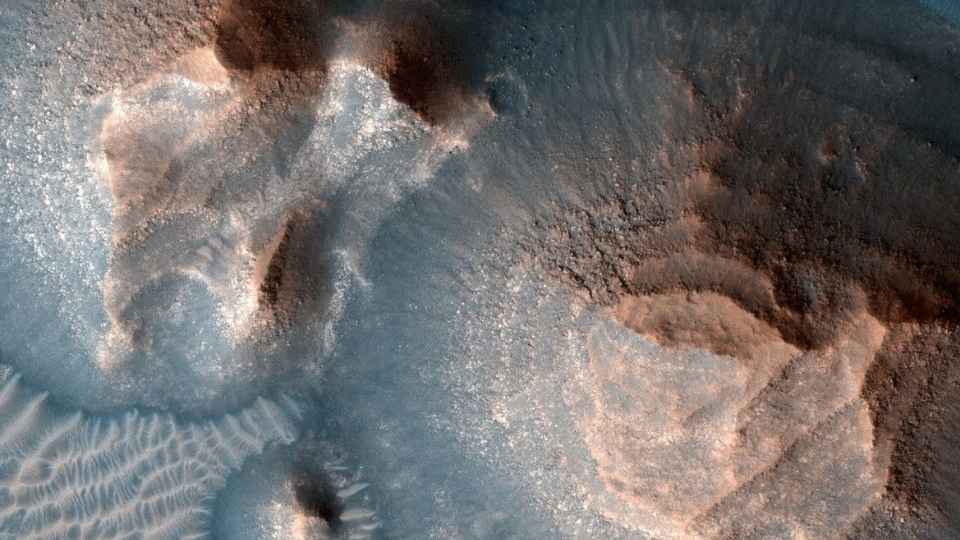
This image shows several craters in Arabia Terra that are filled with layered rock, often exposed in rounded mounds. The image was taken by a camera, the High Resolution Imaging Experiment, on NASA’s Mars Reconnaissance Orbiter. Credit: NASA/JPL-Caltech/University of Arizona.
An unusual gas signal above Alba Mons
The ExoMars Trace Gas Orbiter first reported hydrogen chloride in the Martian atmosphere in 2021. Detecting the molecule alone did not establish a volcanic source. Its broader behaviour appeared closely connected to the planet’s dust and water cycles.
Normally, atmospheric concentrations peak during northern winter and largely disappear during summer. Yet observations around Alba Mons broke that pattern. Researchers identified unusual detections during early northern summer, repeatedly associated with the same volcanic region.
That combination makes the signal interesting. A seasonal increase across a broad area would suggest one kind of process. A recurring exception near volcanic fractures raises a different possibility: gas escaping from below.
The spacecraft’s Atmospheric Chemistry Suite supplied the infrared measurements behind the investigation. Researchers then compared the atmospheric evidence with images of the terrain. Together, these observations offered a way to examine whether the gas and surface features share an underground connection.
Fractures strengthen the case for Mars volcanic activity
Images from the orbiter’s CaSSIS camera show narrow fissures around Alba Mons. Some extend for hundreds of metres. Changes in surface colour appear alongside them, adding interest to features that might otherwise attract less attention.
Scientists propose that gases could travel upward through these fractures. On Earth, volcanic gas vents can leave mineral deposits around their openings. A similar process could help explain the Martian discoloration.
However, appearance alone cannot establish that explanation. The images reveal surface features, while the atmospheric instruments detect gas. Connecting both observations to a specific underground source requires interpretation.
A possible magma connection
The team suggests that a dormant magma chamber could supply the gas. Under this interpretation, Mars retains enough internal heat to support continuing processes beneath its crust.
That does not mean researchers watched magma rise or measured a chamber directly. Instead, the geological setting gives the unusual atmospheric signal a plausible explanation. The strength of the argument comes from combining different clues, while recognising what each instrument actually observes.
Why the suspected release follows the seasons
An underground source might seem difficult to reconcile with seasonal gas detections. The researchers propose that ice could control when gas reaches the atmosphere.
During winter, ice may seal the fractures. As conditions warm, sublimation could reopen those pathways. Sublimation changes ice directly into vapour, without requiring an intermediate liquid stage. Gas could then escape through openings that previously remained blocked.
This mechanism would help explain why the unusual detections occur during early summer. It also separates two questions: what produces the gas, and what controls its release.
For now, the ice mechanism remains a proposed explanation. Scientists have not directly followed gas travelling from a magma chamber through these cracks. Nevertheless, it provides a specific seasonal process that further observations could test.
Could hidden heat create habitats for life?
The possible connection to life begins with heat and water. If warm rock or magma interacts with groundwater, the resulting hydrothermal environment could provide useful chemical ingredients and energy.
Such locations would also place potential microorganisms below the exposed surface. Researchers therefore consider the Alba Mons fractures interesting targets for investigating habitability.
The important question concerns the surrounding environment, rather than hydrogen chloride alone. The gas is a possible clue to geological processes. It does not demonstrate biological activity or establish that liquid water currently exists beneath these particular fractures.
Habitability requires more than a warm location
Several conditions would need to coincide. Heat would have to interact with available water, and the resulting environment would need suitable chemistry. Researchers would also need to establish whether those conditions persist.
This distinction keeps the discovery in perspective. A possible heat source can strengthen the case for further investigation without proving a functioning habitat. Likewise, a habitable environment would not automatically mean that life ever developed there.
The findings sharpen a search question: could this volcanic region contain sheltered environments worth examining more closely?
What the evidence still cannot confirm
The study does not report a newly observed eruption or lava flow. Its proposed source remains beneath the surface, beyond what these observations directly reveal.
Mars also had signs of internal activity before this investigation. Marsquakes and relatively young volcanic terrain already challenged a simple picture of an entirely inactive planet. The new contribution is a possible atmospheric connection to underground processes near Alba Mons.
Nor does the gas establish that Mars recently supported widespread surface water. Volcanic emissions could have influenced its ancient atmosphere and climate. However, this study’s local observations cannot independently reconstruct a recent global period of warm, wet conditions.
Future investigations could examine whether gas detections consistently align with particular fractures. They could also assess the proposed deposits and look for independent evidence of underground heat or water. These are ways to test the interpretation, rather than announced discoveries or confirmed mission plans.
Ultimately, the source, escape route and surrounding conditions remain separate questions. Resolving one would strengthen the investigation, but it would not automatically resolve the others.
The same caution applies to the fractures themselves. Newly identifying a feature in orbital imagery does not establish when it formed. Dating the terrain and determining its relationship to the gas would help distinguish an active escape pathway from a nearby geological feature.
Mars volcanic activity offers a sharper search target
Mars volcanic activity could explain a distinctive gas signal above Alba Mons, with nearby fractures offering a possible route from below. That connection makes this region scientifically compelling even without an eruption or a biological discovery.
The next challenge is to establish what drives the signal and whether water plays any role underground. If further evidence supports a warm, chemically active environment, researchers would gain a stronger reason to investigate its habitability. For now, the discovery identifies a promising mystery: an atmospheric clue that may reveal something important about the hidden conditions beneath Mars.
Main sources:
European Space Agency — European orbiter detects hints of volcanic activity on Mars, November 5, 2026:
https://www.esa.int/ga/articles/news-media/news/european-orbiter-detects-hints-of-volcanic-activity-on-mars
University of Oxford, Department of Physics — European orbiter detects hints of volcanic activity on Mars, November 4, 2026:
https://www.physics.ox.ac.uk/news/european-orbiter-detects-hints-volcanic-activity-mars
Science Advances — Enigmatic HCl detections as a potential signature of igneous activity on Mars:
https://www.science.org/doi/10.1126/sciadv.aeb9422
Original coverage supplied by the reader — Universe Space Tech:
https://universemagazine.com/en/mars-heart-is-beating-life-may-exist-in-hot-spots/
You Might Also Like:
Rare Martian Meteorite Reveals Mars’ Hidden History
Metallic Dunes on Mars Reveal a Dynamic Landscape
Perseverance Mars Marathon Reaches 42 Kilometers
Zhurong Rover Water on Mars: Radar Evidence Mars Stayed Wet Much Longer-Video