
BY:SpaceEyeNews.
Metal-rich gas near Sagittarius A* offers a fresh clue to a familiar puzzle at the Milky Way’s center. Our galaxy’s central black hole has material circulating nearby, yet it consumes relatively little. Now, James Webb Space Telescope observations reveal more about the chemistry of that potential fuel.
Researchers have examined distinct gas structures and traced elements that record earlier stellar activity. Their findings help connect today’s environment with its past. However, they also highlight an important limit: knowing what surrounds a black hole does not explain how much material reaches it.
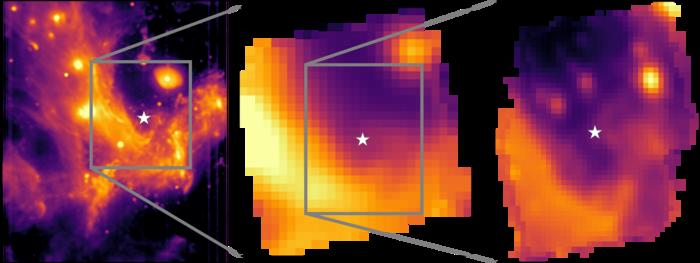
What Webb Found in Metal-Rich Gas Near Sagittarius A*
Nicole Ford and colleagues investigated the minispiral, a network of ionized gas streams near the Galactic center. Their study focused on structures within the central 0.1 parsec, approximately one-third of a light-year.
The paper reports metallicity around one to 2.5 times the Sun’s. Here, metallicity describes the abundance of elements heavier than helium. It does not mean that the clouds consist mainly of metallic material.
Researchers examined neon, argon, sulfur, nickel, and iron. They also distinguished parts of the minispiral’s Northern Arm and Bar from more compact structures.
This matters because the region contains overlapping material with different motions and physical conditions. Treating everything as one uniform cloud would hide those differences. arxiv.org
A Detailed View of Individual Structures
Some compact features appear extremely close to Sagittarius A* on the sky. However, their projected positions do not reveal their complete three-dimensional distances.
Webb’s measurements therefore provide a detailed view of the surroundings, rather than a direct record of gas crossing the black hole’s boundary.
How Webb Read the Gas’s Chemistry
The team used Webb’s Mid-Infrared Instrument, including its Medium Resolution Spectrometer. This instrument separates infrared light into wavelengths while preserving information about where the emission originates.
Different ions produce distinctive emission lines. Researchers compare those signals with models to investigate elemental abundances and the radiation affecting each structure.
The result goes beyond a colorful image. Spectroscopy allows astronomers to distinguish features that might otherwise blend together.
Nearby Stars Shape the Signals
The study identifies radiation from Wolf-Rayet stars as a major influence on the gas. These massive stars help keep the surrounding material ionized.
Some compact structures also show evidence for an additional source of higher-energy ionization. Possible explanations include local shocks associated with stellar winds or interactions with surrounding material.
The researchers also consider a hypothetical outflow from Sagittarius A*. That possibility remains an interpretation, rather than a confirmed detection of an outflow. arxiv.org
What the Chemistry Reveals About Stellar History
McGill University’s October 19 announcement links the enrichment to material released by earlier generations of stars. Supernovae probably contributed heavy elements to the surroundings over time.
The gas also resembles many nearby stars in composition. That similarity raises the possibility that both share a formation history. Newsroom – McGill University
However, chemical resemblance alone cannot establish an exact birth date. It supports a connection without proving that every cloud and star formed simultaneously.
The distinction keeps the discovery in perspective. Webb did not observe the ancient events that supplied these elements. Instead, researchers use present-day chemistry to investigate their likely origin.
Metal-rich gas near Sagittarius A* therefore offers a record of stellar recycling. Material produced inside stars can later become part of the environment around a black hole.
Why Gas Chemistry Matters for Black Hole Feeding
Heavy elements influence how efficiently gas releases energy. Their atoms and ions can emit radiation through many spectral lines, helping the material cool.
As gas loses thermal energy, its pressure support can decrease. That change can make inward movement easier under suitable conditions.
However, cooling does not automatically deliver material to a black hole. A chemical measurement describes one part of a much larger physical process.
Available Material Is Only Part of the Story
Sagittarius A* remains faint compared with actively feeding supermassive black holes. The new observations do not explain that contrast on their own.
Instead, they improve the starting information for investigating it. Researchers can now test models against more detailed measurements of the surrounding material.
The key question concerns the gas’s evolution. How does its temperature, motion, and exposure to nearby stars affect its eventual path?
Why Individual Flares Left No Clear Signature
A separate study led by Mayura Balakrishnan examined whether infrared emission lines respond to Sagittarius A*’s brief flares.
The researchers found no statistically significant changes in the lines they monitored. That result does not show that flares were absent.
Light takes time to cross the emitting region. Meanwhile, the gas’s cooling and recombination responses unfold more slowly than individual flares.
Those delays smooth short events into a steadier signal. Weak emission lines and broadening from rapid gas motions further limit what astronomers can detect.
Consequently, these infrared lines cannot reliably measure the black hole’s instantaneous ultraviolet output. They reveal surrounding conditions more effectively than they preserve individual flashes. arxiv.org
The distinction also prevents an easy misunderstanding. A stable gas signal does not imply an inactive black hole. It means this particular measurement cannot resolve activity on such short timescales. Researchers must match each observing method to the question it can answer. In this case, the surrounding gas provides a clearer picture of persistent conditions than of rapid changes.
What Comes Next for Metal-Rich Gas Near Sagittarius A*?
The next step involves comparing observations with simulations that follow gas over longer periods. Such comparisons could help connect chemical properties with the movement of material. Newsroom – McGill University
Together, the studies sharpen both the evidence and its limits. One examines the available gas; the other explains why certain signals cannot track brief activity.
Metal-rich gas near Sagittarius A* brings researchers closer to understanding the black hole’s surroundings. Future work must connect these local measurements with changes over time. That link will help researchers assess possible routes toward the black hole. The larger mystery remains: why does so little nearby material ultimately become its fuel?
Main sources:
- McGill University — Official research announcement, October 19, 2026
- Nicole M. Ford and colleagues — Ionization Structure and Metal Enrichment of the Galactic Center Minispiral Observed with JWST
- Mayura Balakrishnan and colleagues — Infrared Line Diagnostics Fail to Constrain Sgr A*’s UV Output
You Might Also Like:
Sagittarius A Dark Matter Theory Challenges the Milky Way’s Biggest Mystery
S2 Star Orbit Around Sagittarius A*: Hidden Black Hole
S301 star: A New Clue to Black Hole Spin