
BY:SpaceEyeNews.
On October 31, four volunteers stepped out of NASA’s Mars simulation in Houston and could finally talk with their families in real time. For 378 days, even a message from home had arrived by delayed email. The people they wanted to hear from lived on the same planet. Inside the habitat, the rules of a much more distant world applied.
The Halloween reunion marked the end of CHAPEA Mission 2 at NASA’s Johnson Space Center. It also gave researchers their first chance to sit down with the crew and ask follow-up questions without a wait. One question runs through the experiment. When a crew needs help, how much can its members do before Earth replies?
© Credit: NASA
Inside NASA’s Mars simulation, four people kept a habitat running
Ross Elder, Ellen Ellis, Matthew Montgomery, and James Spicer entered the 1,700-square-foot, 3D-printed habitat on October 19, 2025. Elder commanded the mission. Ellis served as medical officer, Montgomery led the science work, and Spicer took responsibility for flight engineering. Their workplace doubled as their home for the next year.
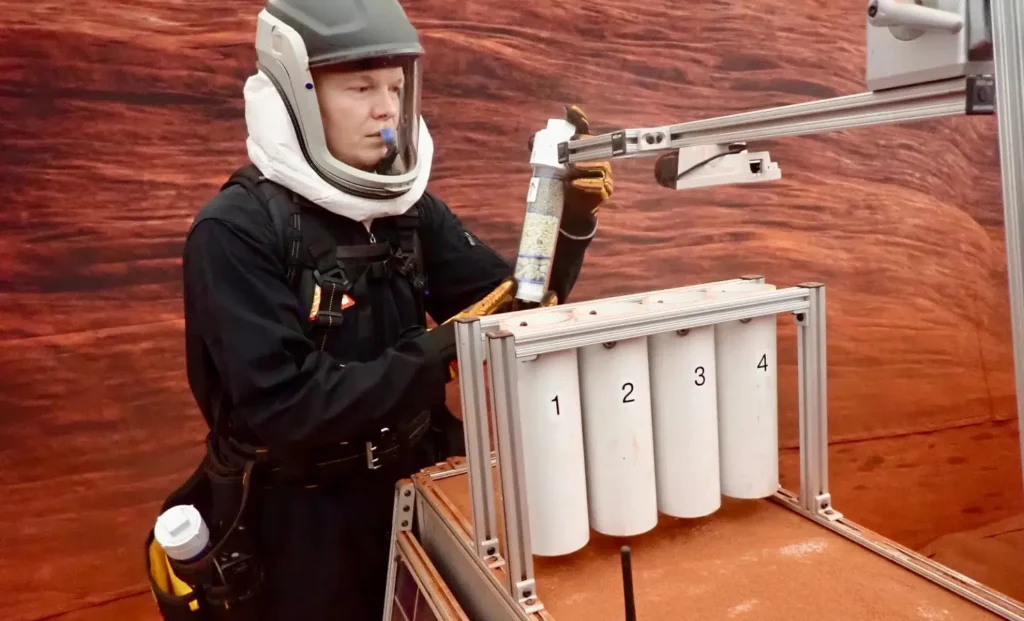
NASA’s photographs capture the range of jobs that fit inside that space. In one, Montgomery reaches into a glovebox to examine an experiment on how seeds sprout. In another, he stands beside Elder in the airlock, ready for a simulated excursion. A third shows Spicer doing maintenance outside the habitat during a practice spacewalk.
That last image gets at a question anyone who has stopped halfway through a repair will recognize. If a part looks different from the instructions, do you carry on or ask someone to take a look? In Houston, an expert might work a few buildings away. Under the rules of the simulation, that expert could take an inconveniently long time to answer.
What goes into the first message home?
Consider what a crew member might send from that repair site. A photo would show the part. A wider shot could show how it fits into the equipment. A short note could identify the steps already complete and explain whether the crew could safely leave the job unfinished. Forget one detail, and the person in Houston might have to write back for it.
Each extra exchange costs time at both ends. Meanwhile, someone in the habitat has to decide whether to wait, switch tasks, or bring a colleague over. A procedure that works well with an engineer on the phone might need clearer pictures or a different stopping point on Mars.
NASA wants to understand which decisions crews can make independently and what support they need for the rest. That question also applies to medical care. A crew medical officer can ask for specialist advice. The practical challenge is knowing what to examine and record while that advice is still on its way.
What the crew ate before the next Marswalk
Food gave NASA’s Mars simulation a different kind of deadline. Crops need attention on their own schedule. So do people preparing for a demanding day in a suit. NASA wants to know how limits on food and exercise might affect a crew’s ability to carry out work on the surface.
The volunteers harvested radishes, lettuce, and kale during their stay. Yet one of the things Ellis most looked forward to was a stroll through a supermarket produce section. In a crew audio log, she described wanting to experience the colors and smells of fresh food and the pleasure of choosing from what lay in front of her.
Her answer gives mission planners something a harvest tally can miss. A garden can produce fresh greens, and the same people who grew them can still long for variety. On a yearlong menu, getting enough food into the habitat answers only the first question. Someone also has to want to eat it, including on days when the schedule leaves little time for a meal.
The time it takes to eat
Meal preparation makes that trade-off concrete. A dish that needs hot water puts a demand on the habitat’s equipment. A meal that takes both hands to prepare also claims part of someone’s working day. NASA food researcher Grace Douglas has raised both concerns when discussing menus for future crews. For planners weighing two equally nutritious options, the deciding factor might be which one a tired explorer can prepare between an excursion and the next equipment check.
A haircut and a year without driving
One of NASA’s most revealing crew photographs shows Elder getting a haircut. Ellis and Montgomery share the job. In the lab or the airlock, each had a formal role. Here, two housemates were helping a third with something he might ordinarily have stepped out to do on his own.
By the time the crew recorded one of its final audio logs, the outside world had begun to sound unfamiliar in small ways. Nobody had driven a car in more than a year. A trip to buy groceries would soon appear on the calendar again. Spicer had already picked out two foods he wanted back in his life. His picks were cheese and avocado.
Those details help explain what researchers can learn from listening to the crew. A list of completed tasks can tell NASA that four people kept up with a demanding schedule. It takes a different kind of conversation to discover which choices they missed and which everyday routines they looked forward to getting back.
What NASA can learn now that the door is open
NASA set aside two weeks after the exit for evaluations and debriefings. Scientists can now put their measurements alongside the crew’s recollections. If a task took longer than expected, for instance, the people who did it can explain where the time went. Researchers can ask another question while the answer is still fresh.
They also have a second crew’s experience to compare with the first CHAPEA mission. The research team deliberately kept the two missions similar. If both crews describe trouble with the same procedure, planners have a reason to look closely at its design. If their experiences differ, that matters too, especially before NASA writes instructions that future crews will have to follow.
NASA’s Mars simulation ended when the volunteers walked outside. Its value for a future crew may show up in something as modest as a better maintenance drawing. For an explorer standing beside an unfamiliar part, one clear picture could settle a question that would otherwise take two messages and a long wait.
Main sources:
NASA — CHAPEA Mission 2
https://www.nasa.gov/humans-in-space/chapea/chapea-mission-2/
NASA — NASA’s Simulated Mars Crew Marks One Year Inside Habitat
https://www.nasa.gov/humans-in-space/nasas-simulated-mars-crew-marks-one-year-inside-habitat/
NASA — CHAPEA 2, Audio Log 4
https://www.nasa.gov/podcasts/houston-we-have-a-podcast/chapea-2-audio-log-4/
Reuters — Crew from NASA’s simulated Mars mission emerges after 378 days in isolation
https://www.reuters.com/science/crew-nasas-simulated-mars-mission-emerges-after-378-days-isolation-2026-11-01/
The Daily Galaxy — After 378 Days Cut Off From the World, NASA’s Mars Crew Finally Steps Outside
https://dailygalaxy.com/2026/11/378-days-nasa-mars-crew-steps-outside/
You Might Also Like:
AI-planned drive on Mars: How NASA Proved Perseverance Can Navigate Smarter-Video
NASA lost contact with MAVEN: What the Silent Mars Orbiter Really Means-Video
Orion Spacecraft Problem: NASA Faces Critical Fixes Before Artemis III