
BY:SpaceEyeNews.
Quark-gluon plasma may hold some of its most revealing clues in the movements that scientists least expect. New calculations suggest that heavy quarks experience rare, powerful jolts as they travel through this primordial fluid. Those jolts occur more often than a familiar mathematical model predicts. They also favor one direction over the other.
That uneven pattern offers a possible new route into the substance that filled the universe during its first microseconds. By examining unusual momentum changes, researchers hope to learn more about how its constituents interact. The challenge now involves connecting those predictions to experimental measurements.
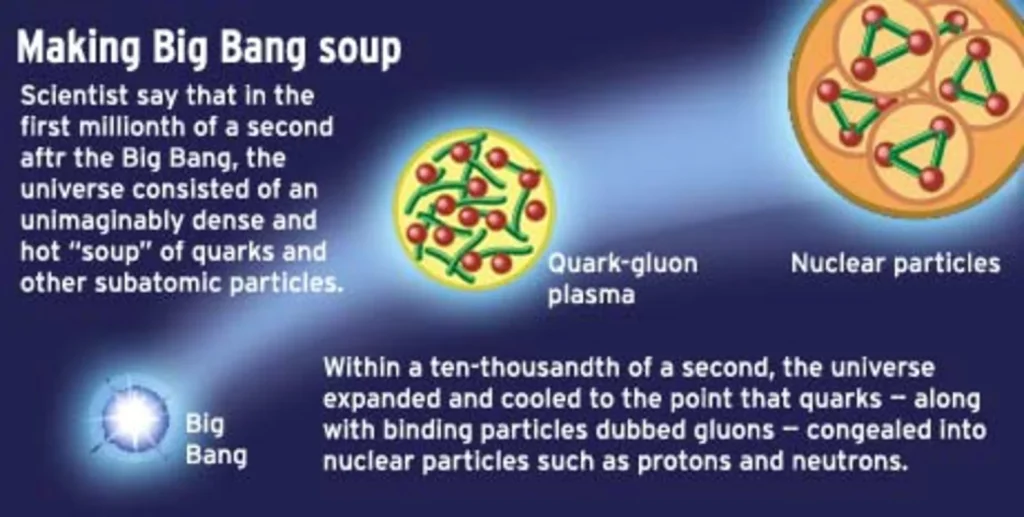
What the new quark-gluon plasma study investigated
Physicists at MIT and the University of California, Santa Barbara developed the calculations. Their study appeared in Physical Review Letters on November 5, 2026. It examines how heavy quarks exchange momentum with a surrounding plasma while moving near light speed.
Heavy quarks provide useful probes because their motion responds to interactions within the medium. Tracking how they lose momentum or fluctuate around an average can therefore expose properties of their surroundings.
For this study, the researchers began with a theoretical plasma whose constituents interact weakly. That choice made the calculations more manageable. They calculated the probabilities of different momentum transfers, including unusually large changes.
This was a theoretical investigation, rather than a new collider experiment. Its contribution lies in a more complete description of particle motion. Researchers can use that description to develop predictions for comparisons with laboratory data.
Where the familiar Brownian picture falls short
Beyond average drag
Einstein’s explanation of Brownian motion provides the starting point. A particle moving through a fluid experiences drag alongside random microscopic kicks. Together, these processes help it approach thermal equilibrium with its surroundings.
Many practical models simplify those fluctuations using a Gaussian distribution: the familiar symmetrical bell curve. This approach captures the effects of numerous small exchanges. However, it can miss important features of larger momentum transfers.
For a heavy quark moving near light speed, those missing details become especially relevant. Average slowing alone cannot describe every possible change in its motion.
A broader description of particle motion
The new work extends this simplified framework by retaining information beyond average drag and the spread of small fluctuations.
That distinction matters when interpreting the result. The study does not overturn quantum mechanics or invalidate Einstein’s explanation of ordinary Brownian motion. Instead, it addresses the limits of a particular approximation under extreme conditions.
The researchers’ question is practical: what information disappears when a model compresses complex interactions into a simple bell curve?
Rare particle kicks reveal an uneven pattern
The answer emerges most clearly at the edges of the predicted distribution. Its central region resembles the familiar Gaussian pattern. Farther from that center, however, the probabilities behave differently.
Scientists call these outer regions the distribution’s tails. They describe events that depart substantially from the typical outcome. In this case, they represent unusually large changes in a heavy quark’s momentum.
The calculations produce exponential tails, which decline more slowly than Gaussian tails. Consequently, large changes remain more likely than the simpler approximation suggests. Rare events still occur infrequently, but the model should not dismiss them too readily.
Direction adds another distinction. A large kick that slows the quark more than average drag predicts is more likely than a comparable speeding kick.
This asymmetry concerns fluctuations around the expected behavior. It adds information beyond the established tendency of an energetic particle to lose energy in a medium.
Consider two journeys with similar average slowing. One might involve mostly gentle disturbances; another might include occasional substantial jolts. Their averages could look alike while concealing different underlying interactions.
For quark-gluon plasma, that extra information could prove useful. The likelihood of exceptional momentum changes offers another quantity for theorists to calculate and experimentalists to investigate.
Why different plasma models share the pattern
The team also examined how the result changes across theoretical plasmas with different particle content. Related behavior persisted despite those differences.
Furthermore, earlier calculations for a strongly coupled plasma contained the same qualitative structure. That agreement connects results from very different mathematical descriptions of interacting matter.
However, a common structure does not mean every plasma produces an identical curve. The detailed probabilities can still carry information about the medium. Similar overall shapes can coexist with meaningful differences in their parameters.
Nor does the asymmetry alone establish strong coupling. The new calculation starts from weak coupling, while the comparison includes a strongly coupled model.
The broader implication is that asymmetric tails may represent a robust feature of heavy-quark motion. Their appearance in different settings strengthens the motivation to investigate them in physical plasma.
What experiments could reveal about the first fluid
Turning calculations into measurable signals
Heavy-ion facilities recreate tiny droplets of primordial matter for extraordinarily brief periods. Scientists infer their properties from the particles that emerge after each event.
Connecting the new calculations to those measurements requires additional work. Laboratory plasma expands and cools, so realistic predictions must account for changing conditions. Researchers must also relate heavy-quark motion to the particles their detectors actually record.
A useful comparison must examine more than whether a curve looks uneven. Researchers need predictions for how frequently particular outcomes occur. They must then assess whether measurements distinguish those predictions from existing descriptions. This makes quantitative testing essential.
These steps will determine whether rare momentum changes provide a useful additional probe. A promising theoretical pattern becomes experimentally valuable only when its consequences survive that translation.
Building on established fluid behavior
The study does not mark the discovery that this material behaves like a liquid. CERN describes its remarkably low viscosity and collective fluid behavior as established findings.
Instead, the research could sharpen our picture of what happens inside that fluid. Laboratory droplets cannot reproduce the entire early universe. Nevertheless, they allow scientists to investigate matter under conditions relevant to its earliest evolution.
Quark-gluon plasma and the value of rare events
Quark-gluon plasma research increasingly asks what average measurements might conceal. This study points toward exceptional momentum changes as a potentially valuable source of information.
Its central lesson is precise: a symmetrical bell curve can overlook rare, directional features of relativistic particle motion. Including those features gives researchers a richer framework for studying primordial matter.
The next step is to connect that framework with realistic experimental predictions. If measurements support the proposed pattern, unusual particle jolts could help reveal the internal workings of the universe’s first fluid.
Main sources:
MIT News — Pinning down the structure of quark-gluon plasma, the universe’s first fluid: https://news.mit.edu/2026/pinning-down-quark-gluon-plasma-structure-1105
Physical Review Letters — Jean F. Du Plessis and Bruno Scheihing-Hitschfeld, Heavy Quark Transport Is Non-Gaussian beyond Leading Logarithm: https://journals.aps.org/prl/abstract/10.1103/7fd5-1kq5
CERN — Heavy ions and quark-gluon plasma: https://home.cern/science/physics/heavy-ions-and-quark-gluon-plasma/
You Might Also Like:
CERN Little Big Bang Experiment Reveals Tiny Plasma
CERN Primordial Plasma Reveals Nuclear Shapes
Primordial Helium Reveals the Big Bang’s First Minutes