
BY:SpaceEyeNews.
NASA’s latest RS-25 engine test ended after three minutes and 20 seconds. Four weeks earlier, the same engine had run for eight minutes and 20 seconds on the same stand. Why stop five minutes sooner this time? On November 18, 2026, engineers reached the shutdown point they had chosen before ignition. The difference between those two runs reveals something the clock alone can’t tell us about preparing a rocket engine for flight.
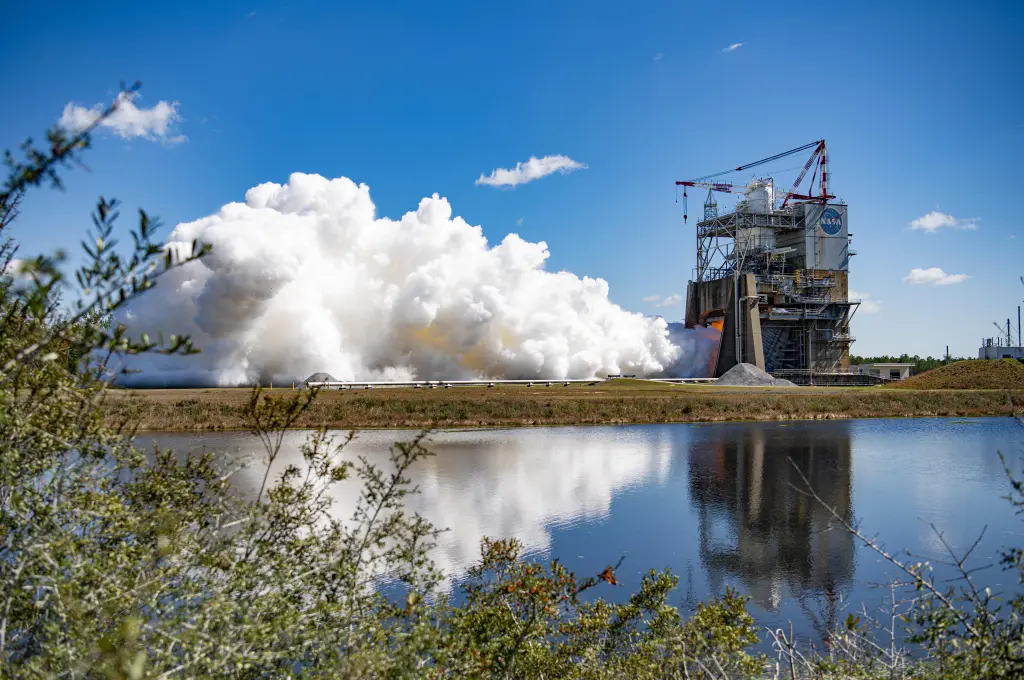
November’s RS-25 engine test
At NASA’s Stennis Space Center near Bay St. Louis, Mississippi, engine No. 10001 occupied the Fred Haise Test Stand. Operators from NASA, engine contractor L3Harris Technologies and Nova Space Solutions carried out the firing. Their engine will spend its working life on Earth. That gives engineers a place to test hardware destined for space and return to it after shutdown.
NASA confirmed that the engine completed all 200 planned seconds. The agency described the purpose in broad terms. Engineers can use the data to improve the performance and reliability of engines for future Artemis missions. NASA left two details open in its November update. It did not specify which measurements the team prioritized or why it chose that duration.
For a more detailed picture of what the stand can do, look back one month. NASA identified the hardware under study in October and the conditions engineers wanted it to experience. One of their questions concerned a part visible in almost every photograph of the engine.
October’s nozzle test
On October 21, operators ran No. 10001 for 500 seconds, roughly the time an RS-25 fires during a Space Launch System ascent. One objective concerned the engine’s broad, bell-shaped nozzle. Hot exhaust flows through its interior. During launch, heat around the base of the rocket also reaches the nozzle from outside. Engineers wanted to validate a new system that protects it from that external heat.
The team also used the October firing to check components intended for future flights. That detail explains how an engine that stays in Mississippi can contribute directly to flight hardware. Engineers can install a component on the developmental engine and see how it behaves while the whole assembly runs.
What the 111 percent figure means
During the October run, operators brought the engine up to 111 percent power. The percentage uses the original space shuttle main engine rating as its reference. NASA uses that older rating to describe the higher thrust its new production engines must deliver. The agency published the October power figure alongside the run time. Its November announcement confirmed only the duration, so the October figure belongs with the October test.
Testing a production engine
Another engine, No. 20001, tells a different part of the Stennis story. It was the first newly built RS-25 in the production series. In June 2025, operators fired it for 500 seconds on the Fred Haise stand and took it up to 111 percent power. Here, engineers could evaluate a particular production engine before clearing it for flight.
That run followed a series NASA completed in April 2024 to certify the design for new production. Across that earlier campaign, engineers could vary the duration, move the engine during a firing or change the hardware between runs. Each choice gave them a way to answer a specific question before the new engines entered service.
One firing in November 2023 lasted 650 seconds. During that run, operators pivoted the engine on the stand, exercising the motion a rocket uses to steer. Other tests took an engine to 113 percent of its original rating. Going above the planned flight setting gave engineers a way to explore how much margin the design offered. Neither number would make much sense on its own. The steering check and the power check each had a reason to take the engine beyond a typical ascent profile.
Changing nozzles at Stennis
In February 2024, crews used specially adapted tools to exchange nozzles while the certification engine remained on the stand. A subsequent firing let engineers collect data on a second production nozzle and compare its performance with the first. Keeping the engine in place gave the team a common starting point for examining two examples of the same part.
That nozzle swap also puts November’s shorter firing in perspective. To understand a test result, engineers need to know which hardware ran, what conditions it experienced and what question prompted the run. Elapsed time supplies just one piece of that record.
Four engines for Artemis IV
NASA lists early 2028 as its target for launching Artemis IV. Four astronauts would leave Kennedy Space Center in Florida aboard Orion, with four RS-25 engines working beneath the rocket’s core stage. Together, those engines can generate up to two million pounds of thrust. Two solid rocket boosters contribute additional thrust during the opening part of the climb.
The engine work at Stennis spans more than one generation of Artemis hardware. NASA assigned modified shuttle engines to the first four Artemis missions. Its certification program for newly manufactured engines looked ahead to missions beginning with Artemis V. That places the November firing in a wider effort that extends beyond the next crewed lunar landing.
By the time Orion reaches lunar orbit, the RS-25s will have finished their work. NASA’s Artemis IV plan calls for Orion to dock with a lander there. Two astronauts would descend to the lunar South Pole region to collect samples and carry out experiments before returning to orbit.
After the RS-25 engine test
After its November firing, engine No. 10001 stayed in Mississippi. The lasting result of the RS-25 engine test is a record engineers can consult alongside earlier runs. October gave them a full ascent’s worth of operating time to examine flight components and nozzle protection. November added 200 seconds of data from a separate run. Long before four engines lift a crew from Florida, a single engine at Stennis gives the people responsible for that flight something concrete to work from.
Main sources
NASA — November 2026 engine test
ScienceDaily — Original coverage
You Might Also Like:
Artemis II atmospheric disturbances: New GPS Concerns
Artemis III SLS Rocket Assembly Begins at Kennedy
Artemis III Mission: Why NASA Changed Its Path Back to the Moon