
BY:SpaceEyeNews.
The Swift Andromeda image offers a remarkable view of our galactic neighbor following the end of NASA’s pioneering observatory. Thousands of ultraviolet sources trace its disk, highlighting stellar populations that look less prominent in familiar visible-light photographs. The spacecraft has now returned to Earth, but this portrait preserves a vivid part of its scientific legacy.
NASA confirmed Swift’s atmospheric reentry over North Sumatra, Indonesia, on November 4, 2026. That event ended almost 22 years in orbit. The Andromeda observations, however, date to 2008. Their renewed attention celebrates an enduring achievement rather than a newly captured scene.
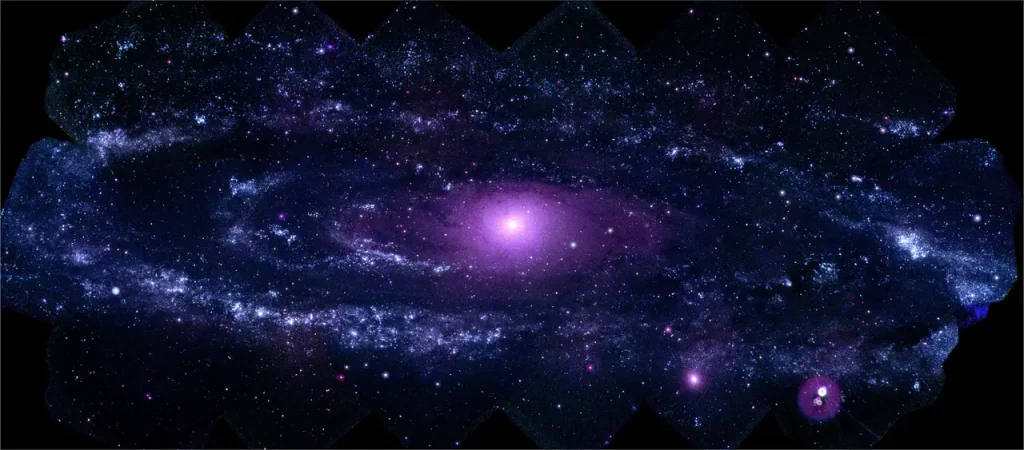
The Swift Observatory’s ultraviolet view of the nearby Andromeda galaxy reveals thousands of light sources that ground-based telescopes miss.(Image credit: NASA/Swift/Stefan Immler (GSFC) and Erin Grand (UMCP))
How Swift Created Its Andromeda Portrait
Andromeda, also called M31, lies approximately 2.5 million light-years away. Swift assembled its ultraviolet portrait through a sustained observing effort spanning two months.
Between May 25 and July 26, 2008, its Ultraviolet/Optical Telescope collected 330 images. Together, these observations supplied 24 hours of exposure time. The finished mosaic therefore combines many separate views rather than one uninterrupted exposure.
NASA released the portrait in September 2009. Its original presentation emphasized the exceptional ultraviolet detail that Swift achieved across this neighboring spiral galaxy.
Three Wavelengths, One Detailed View
The telescope observed at wavelengths of 192.8, 224.6, and 260 nanometers. Combining these ultraviolet bands helped produce the detailed view that NASA shared.
The displayed colors translate measurements beyond human vision into a picture we can examine. They should not be mistaken for Andromeda’s appearance through an ordinary telescope. Instead, the image highlights how differently its stellar populations contribute at ultraviolet wavelengths.
What the Swift Andromeda Image Reveals
Around 20,000 ultraviolet sources appear in the mosaic. These include hot stars, dense stellar clusters, and the companion galaxy M32. The number describes detected sources, rather than a count of newly discovered individual stars.
Across Andromeda’s disk, bright concentrations create a richly textured pattern. Hot, young populations stand out, while the central bulge appears smoother. This contrast gives the portrait much of its scientific value and visual character.
A Vast Ring of Stellar Clusters
NASA identifies especially abundant star clusters along a ring approximately 150,000 light-years across. That measurement describes the ring, not the full extent of Andromeda.
Its clustered structure shows that young stellar populations do not spread evenly through the galaxy. Some regions contribute much more strongly to the ultraviolet view than others. Following their distribution helps researchers examine the geography of recent star formation.
Meanwhile, M32 appears as a compact luminous feature near Andromeda’s center in the projected image. Although it shares the frame, it is a separate galaxy. Its presence also illustrates why every bright source requires careful identification.
Why Andromeda Looks Different in Ultraviolet
Visible-light photographs often emphasize Andromeda’s bright central region and broad spiral structure. Ultraviolet observations bring greater prominence to hot stellar populations across its disk.
The difference comes from how stars emit light at different wavelengths. A population that dominates one view may contribute less strongly to another. Comparing the images therefore gives astronomers complementary information about the same galaxy.
Reading the Galaxy’s Recent History
Young, hot stars help trace relatively recent star formation. Their locations provide clues about where the galaxy has produced new stellar populations.
However, a colorful mosaic alone cannot establish the age or nature of every source. Researchers must analyze measurements and compare them with additional observations. Dust, overlapping populations, and the properties of individual objects can complicate interpretation.
That distinction matters when describing the image. Its beauty comes from real observations, but its deeper scientific meaning depends on careful analysis. The portrait offers a starting point for investigation, with many regions available for closer study.
Swift’s Legacy Beyond the Andromeda Image
Swift launched in November 2004 with a planned two-year prime mission. It continued working far beyond that original goal, observing a broad range of cosmic objects.
Its instruments covered gamma rays, X-rays, ultraviolet light, and visible light. This combination allowed the observatory to follow rapidly changing events and provide information for other telescopes. Three complementary instruments made that approach possible: the Burst Alert Telescope, X-Ray Telescope, and Ultraviolet/Optical Telescope. Each supplied a different part of the observational picture. The ultraviolet camera that mapped Andromeda also contributed to studies of transient sources. Consequently, this galaxy portrait reflects the versatility of equipment designed to respond quickly to changing conditions across the sky.
The Light Echoes Around GRB 221009A
One celebrated observation involved GRB 221009A, the gamma-ray burst nicknamed the “brightest of all time.” Swift recorded striking rings around its X-ray afterglow.
Those rings require a precise explanation. Dust layers inside the Milky Way scattered X-rays from the distant event toward Earth. The resulting light echoes formed the apparent expanding pattern.
They were not physical shells spreading outward from the distant source. This example shows how Swift could reveal both a remote event and intervening material along our line of sight.
Why the Observatory Returned to Earth
Recent solar activity increased atmospheric drag on Swift, accelerating its orbital decline. A servicing mission ended in August 2026 without attempting to raise the observatory’s orbit.
NASA announced the end of operations on October 23. Reentry followed on November 4. The agency expected most of the spacecraft to burn up, although some components may have survived.
The loss ended new observations from Swift. It did not remove the measurements already collected and preserved for further research.
Andromeda’s Future Remains Uncertain
The galaxy’s possible future encounter with the Milky Way often accompanies discussions of Andromeda. However, current research does not establish an inevitable merger.
A 2025 study highlighted by ESA/Hubble found roughly even odds of a merger within the next 10 billion years. Uncertainties in galactic motions and masses allow different outcomes. Neighboring galaxies also influence the possible paths.
That uncertainty belongs alongside the image’s more firmly established details. Swift recorded ultraviolet sources across Andromeda; the portrait itself does not determine our galaxies’ eventual relationship.
Swift Andromeda Image: A Legacy That Continues
The Swift Andromeda image preserves a detailed look at young stars, clustered populations, and structure across a familiar galaxy. Its value extends beyond the circumstances that brought it back into the spotlight.
Future researchers can revisit existing observations, compare them with other datasets, and ask questions that earlier studies did not address. Such work cannot guarantee discoveries, but it keeps the scientific record useful.
Swift’s mission has ended. The portrait remains an accessible reminder of what its instruments achieved: a view of Andromeda that connects visual wonder with measurable information about its stars.
Main Sources:
NASA — Swift’s ultraviolet portrait of the Andromeda Galaxy: https://svs.gsfc.nasa.gov/10485
NASA — Swift Observatory reentry confirmation: https://science.nasa.gov/blogs/swift/2026/11/02/nasas-swift-observatory-to-re-enter-atmosphere/
NASA — Swift mission ends ahead of reentry: https://science.nasa.gov/blogs/swift/2026/10/23/nasas-swift-mission-ends-ahead-of-re-entry/
NASA — The Swift spacecraft and instruments: https://science.nasa.gov/mission/swift/spacecraft/
NASA — Swift and Fermi observations of GRB 221009A: https://www.nasa.gov/universe/nasas-swift-fermi-missions-detect-exceptional-cosmic-blast/
ESA/Hubble — Uncertainty over the Milky Way–Andromeda encounter: https://esahubble.org/news/heic2508/
You Might Also Like:
Swift Observatory Nears Its End After Stunning Galaxy Reveal
NASA Swift telescope Nears Reentry After Failed Rescue
GRB 220706A: The Mystery of Its 27-Day Activity