
BY:SpaceEyeNews.
A dark galaxy candidate has given astronomers an intriguing puzzle: a compact hydrogen cloud with no detectable stars. China’s FAST radio telescope found the object, J1351+0039, while optical images revealed no corresponding galaxy.
Its apparent isolation makes the discovery especially interesting. Without obvious neighboring galaxies or connecting gas structures, researchers have fewer reasons to interpret it as discarded galactic material.
Instead, the cloud may occupy a dark matter halo that never formed stars. However, an extremely faint galaxy remains another possibility. The distinction matters because this object could help reveal where galaxy formation stops.
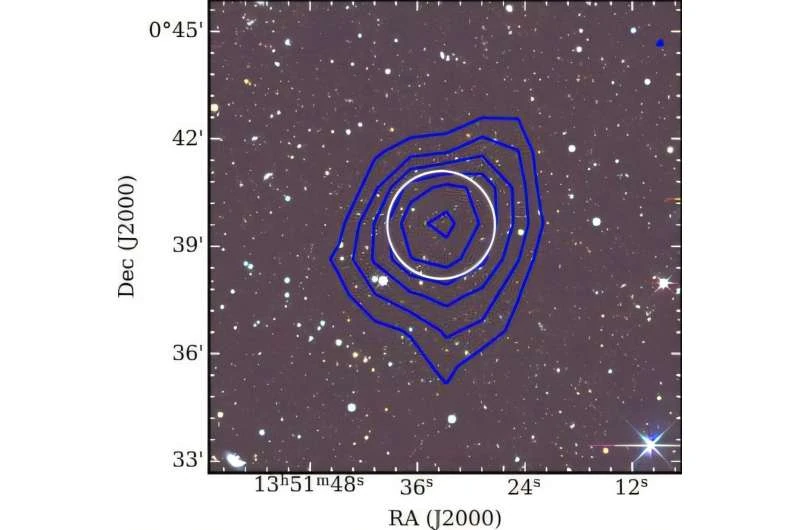
Dark Galaxy Candidate J1351+0039: FAST Hydrogen Map.
What FAST Found in the Darkness
Jin-Long Xu and colleagues describe the discovery in a preprint posted to arXiv on September 24, 2026. Their team used FAST observations alongside images from the DESI Legacy Survey.
The researchers observed the cloud three times during July and August 2026. Repeated detections helped establish that the signal came from a real astronomical source rather than radio interference.
Its neutral hydrogen contains approximately 480,000 times the Sun’s mass. Radio observations trace that gas through its characteristic 21-centimeter emission.
Meanwhile, DESI images show no associated stellar component. That combination makes J1351+0039 worth investigating, although optical darkness alone cannot establish that it lacks stars entirely. arxiv.org
Why This Dark Galaxy Candidate Stands Out
Isolation Offers an Important Clue
Gas clouds can resemble independent objects even when interactions between galaxies created them. Gravitational encounters sometimes pull material away from its original home.
For J1351+0039, the team found no obvious gaseous bridges, comet-like tails, or nearby massive companions. Those missing features strengthen the interpretation that the cloud represents a separate system.
Nevertheless, isolation describes its observed surroundings. It does not provide a complete record of everything that happened during its history.
A round appearance adds to the interest, but shape alone cannot settle the question. Several lines of evidence must agree before the team can confidently distinguish a long-lived system from a misleading gas concentration. Here, the combination of environment, internal motions, and missing starlight carries more weight than any single observation.
The useful distinction is therefore practical: this environment reduces some complications that affect other candidates. Researchers can examine the cloud with less concern about obvious ongoing interactions.
Gas Motions Reveal a Hidden Gravitational Influence
The cloud’s internal motions offer another clue. The researchers estimate weak observed rotation of roughly 4.2 kilometers per second.
By comparison, its velocity dispersion reaches about 11.6 kilometers per second. This measures the spread of gas velocities around the system’s average motion.
Consequently, the team interprets the cloud as mainly pressure-supported. Internal gas motions provide pressure that balances gravity, while rotation contributes relatively little.
Why the Mass Estimate Matters
From those motions, the researchers estimate an enclosed dynamical mass of approximately 130 million solar masses. That figure applies within the measured gas radius, rather than necessarily describing the entire dark matter halo.
The inferred mass greatly exceeds the detected gas contribution. Under the team’s gravitational interpretation, dark matter supplies most of the missing mass.
However, FAST has not directly detected dark matter particles. The conclusion depends on how researchers interpret the cloud’s structure, motions, and equilibrium. arxiv.org
How Could a Cloud Never Form Stars?
The proposed explanation involves a reionization-limited H I cloud, usually shortened to RELHIC. These predicted systems retain gas without developing a detectable stellar population.
Ultraviolet radiation provides a possible reason. By heating diffuse gas, the cosmic radiation background can prevent it from cooling enough to collapse into stars.
The team finds the cloud’s properties consistent with warm gas near 10,000 kelvin. Its weak rotation and largely pressure-supported structure also fit the proposed interpretation.
Still, consistency does not establish its entire past. Researchers cannot yet demonstrate that J1351+0039 never formed even a small population of stars.
That uncertainty makes deeper observations essential. They must test whether the object truly remained dark or simply shines below current detection limits.
Cloud-9 Provides a Useful Precedent
J1351+0039 joins a developing search rather than introducing the first possible starless system. Cloud-9 already offers an important comparison.
In January 2026, NASA and ESA reported Hubble observations of that gas-rich object near the spiral galaxy M94. Their releases described it as the first confirmed example of this predicted class.
Hubble’s search for stars strengthened the case that Cloud-9 represents a relic of incomplete galaxy formation.
The comparison highlights why follow-up matters. Radio data reveal the gas, while sensitive optical observations test whether a stellar population accompanies it.
Those earlier results do not confirm J1351+0039. Instead, they provide a useful example of how astronomers can investigate its nature. science.nasa.gov
Could an Ultra-Faint Galaxy Still Be Hiding?
The most important caveat is straightforward: no detected starlight does not necessarily mean no stars.
Existing images have limits. A sufficiently faint or diffuse stellar population could escape detection, leaving an ordinary but extremely dim galaxy looking apparently starless.
The discovery team explicitly retains that alternative. It identifies J1351+0039 as a candidate for either a RELHIC or an ultra-faint galaxy.
What Hubble or Webb Could Clarify
Deeper space-based imaging could search for individual stars associated with the cloud. The researchers identify Hubble and the James Webb Space Telescope as possible instruments for that work.
Finding stars would change the classification and clarify the system’s history. Another non-detection would tighten the limits on how many stars could remain hidden.
The paper calls for those observations; it does not establish that a follow-up campaign has already secured telescope time.
What This Dark Galaxy Candidate Could Teach Us
J1351+0039 offers a promising opportunity to examine the boundary between gas-bearing halos and luminous galaxies.
If deeper observations strengthen the starless interpretation, researchers could study gas and dark matter with fewer complications from stellar activity.
For now, this dark galaxy candidate remains an unresolved discovery. Its importance lies in a testable question: did this isolated cloud never form stars, or have astronomers simply not seen them yet?
Main sources:
- Original research: Discovery of an isolated RELHIC Candidate: J1351+0039
- Phys.org: Lone, starless cloud may be a “dark” galaxy
- NASA: NASA’s Hubble Examines Cloud-9, First of New Type of Object
- ESA/Hubble: Hubble examines Cloud-9, first of new type of object
You Might Also Like:
JWST galaxy cluster discovery reveals a dark matter mystery
Cloud-9 dark galaxy: New Evidence of Missing Stars
Oyashio Stellar Stream Maps Dark Matter in a Distant Galaxy
Dark Matter Free Galaxy Discovery Reveals a Growing Cosmic Pattern