
BY:SpaceEyeNews.
The Lumina simulation follows how early galaxies and their radiation transformed the young universe. Its enormous digital landscape connects developing galaxies with changes unfolding across intergalactic space. Researchers can examine where light emerged, how it traveled, and how it altered surrounding gas.
Scientists from MIT, Harvard, and partner institutions developed Lumina to investigate the universe’s first two billion years. Their work combines galaxy formation with detailed calculations of radiation. The result offers a powerful framework for testing how cosmic structures and their environments evolved together.
Why the Lumina simulation’s scale matters
Lumina covers a cube measuring 500 megaparsecs along each side, equivalent to approximately 1.6 billion light-years in comoving coordinates. These coordinates account for cosmic expansion. The figure therefore does not describe a fixed physical width throughout the simulation.
That enormous volume gives researchers a broader sample of cosmic environments. It includes crowded regions, relatively empty spaces, and rare objects that smaller simulations might miss.
The Smithsonian describes Lumina’s volume as more than 100 times larger than previous comparable simulations. The distinction matters because different simulations prioritize different scientific questions.
Here, size supports a specific goal: connecting individual galaxies with the larger patterns of radiation surrounding them. Researchers can study local development while tracking changes far beyond any single galaxy.
A wider sample also helps scientists assess cosmic variance, the natural differences between regions of the universe. arxiv.org
Following light from galaxies into cosmic gas
Lumina begins around 45 million years after the Big Bang. From there, it calculates how matter gathers and structures develop.
Dark matter forms concentrations that attract gas. Within growing galaxies, stellar populations produce radiation that travels outward. Lumina follows that radiation as it interacts with material between galaxies.
This connection makes the simulation more useful than a sequence of attractive images. Scientists can investigate how the sources of radiation relate to the regions they transform.
Matter and radiation evolve together
The calculation builds on the IllustrisTNG galaxy-formation model and adds radiation transport. This tracks the movement and interactions of light through the simulated environment.
Radiation changes the ionization and temperature of gas. Those conditions, in turn, influence how the gas evolves.
Following these processes together helps researchers connect causes with consequences across cosmic time. They can examine developing galaxies alongside the changing environments those galaxies help create.
Stars reshape hydrogen across the universe
Hydrogen reionization forms one of Lumina’s central research targets. In the model, stellar radiation supplies most of the energy driving this transformation.
Ultraviolet photons remove electrons from neutral hydrogen. Ionized regions expand around luminous sources, while other areas retain neutral gas.
The process unfolds unevenly. Different regions contain different populations of galaxies, gas densities, and radiation levels. Lumina’s large volume helps capture that variation.
This patchwork matters when scientists compare simulations with observations. A single region cannot necessarily represent the entire universe’s progress through reionization.
The dark ages need careful wording
The early universe did not become completely opaque when neutral atoms formed. Around 380,000 years after the Big Bang, their formation actually allowed light to travel more freely.
The following dark ages lacked stars. Neutral hydrogen also absorbed particular wavelengths, especially ultraviolet radiation.
Reionization therefore changed how cosmic gas interacted with radiation. Describing it simply as removing a blanket that blocked all light misses an essential distinction. science.nasa.gov
Black holes drive helium’s later transition
Lumina also tracks helium reionization alongside galaxy growth. The later helium transition requires more energetic photons than hydrogen reionization.
Here, active galactic nuclei take a leading role. Material falling toward supermassive black holes releases energetic radiation as it heats up.
That radiation removes the remaining electron from singly ionized helium. It does not break apart atomic nuclei.
In Lumina, this transition approaches completion by redshift three, around two billion years after the Big Bang.
The scientific advance lies in following these changes alongside the evolving sources responsible for them. Hydrogen and helium provide complementary ways to investigate how galaxies and active black holes influenced intergalactic gas. arxiv.org
Frontier powers the Lumina simulation
Such a large calculation requires exceptional computing resources. The team ran Lumina on Frontier at Oak Ridge National Laboratory in Tennessee.
Its initial setup contains 432 billion resolution elements, often rounded to roughly half a trillion. These elements represent components such as dark matter particles and gas cells.
MIT reports that peak calculations used more than 100,000 CPU cores and around 15,000 graphics processing units.
Coordinating those processors presents a major engineering challenge. The calculation must continually update matter, radiation, and their interactions across vastly different scales.
However, enormous computing power does not eliminate resolution limits. Lumina models stellar populations and galaxy-scale processes; it does not individually resolve every star.
What the cosmic visualizations reveal
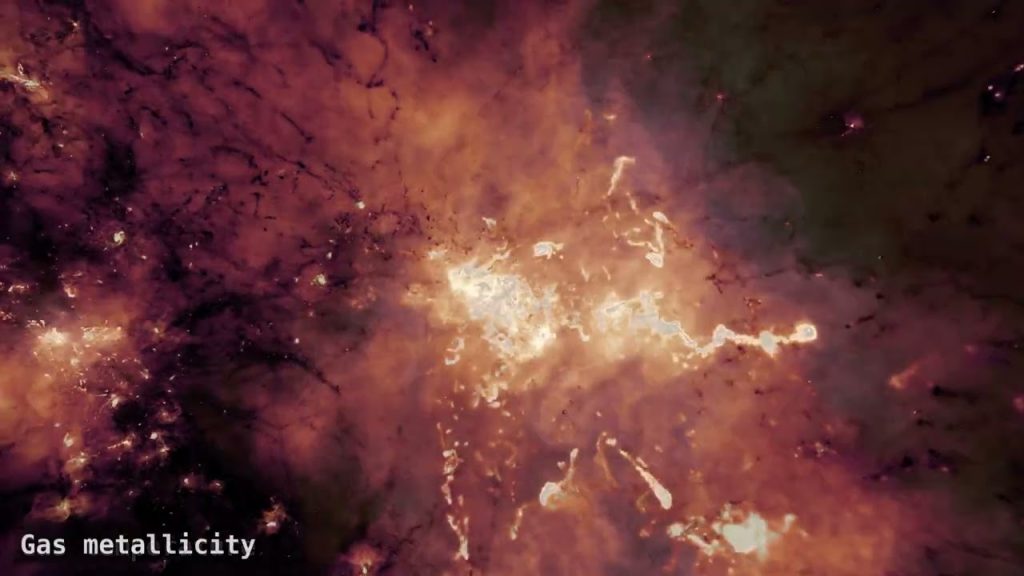
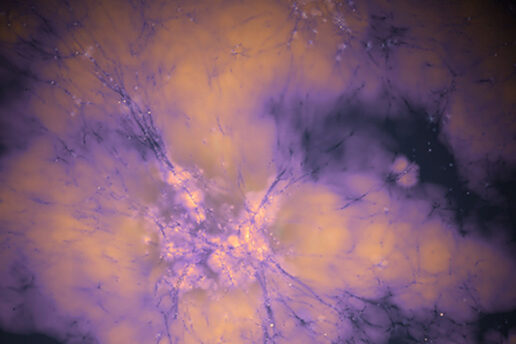
The project’s videos let viewers move from sprawling cosmic structures toward individual galaxies. Different layers display dark matter density, gas temperature, chemical enrichment, and stellar light.
These views help communicate relationships that would otherwise remain buried in numerical outputs. A bright region can represent a particular physical quantity rather than a galaxy’s natural appearance.
The colors and camera movements serve scientific visualization. They show calculated structures and conditions, rather than telescope footage of the ancient universe.
How observations will test Lumina
Lumina’s value ultimately depends on comparisons with observations. Researchers can test predicted galaxy populations, radiation patterns, and gas conditions against astronomical measurements.
The research paper already identifies a significant challenge. Lumina underpredicts some very massive galaxies at high redshift compared with observational estimates.
That mismatch gives scientists something concrete to investigate. It does not automatically establish which physical assumption or observational interpretation needs revision.
Model assumptions remain important
Some processes occur below the simulation’s resolution. Researchers therefore use prescriptions to represent their effects.
The model also includes calibrated parameters. Its results should consequently support careful testing, rather than claims that cosmic history is now settled.
The paper schedules the full public dataset for 2028. Some figure data are already available, with additional data accessible through reasonable requests. academic.oup.com
Lumina simulation offers a clearer cosmic history
The Lumina simulation connects galaxy growth with the radiation that transformed intergalactic gas. Its scale allows researchers to investigate both individual systems and their wider cosmic setting.
Future comparisons will show where its predictions succeed and where they need refinement. For astronomy, that makes Lumina valuable: it turns ideas about the early universe into detailed predictions that observations can test.
Main sources:
- MIT News: Watch the universe emerge from the dark ages, with Lumina
- Smithsonian: Scientists Create Most Detailed Simulation Yet of the Early Universe
- Monthly Notices of the Royal Astronomical Society: Introducing the Lumina project
- Lumina collaboration: Media gallery
- NASA Science: Overview of the Universe’s History
You Might Also Like:
Observable Universe Size: The 93-Billion-Light-Year Puzzle
Webb Lion Nebula Image Reveals a Dying Star’s Final Act
Seagull Nebula: Rubin’s Stunning View Reveals a Bigger Story