
BY:SpaceEyeNews.
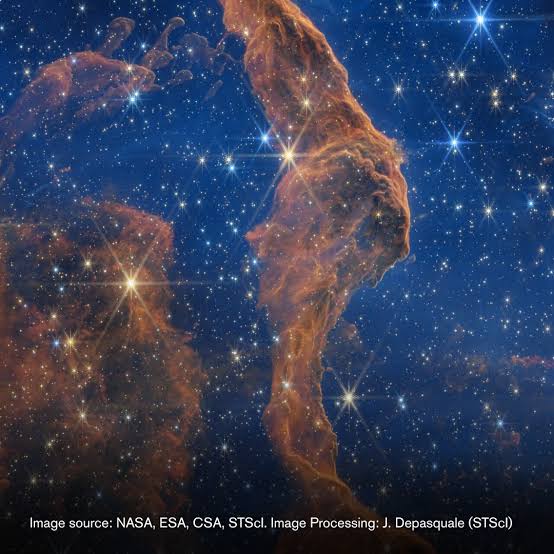
The Cat’s Head Nebula looks like a dark silhouette until James Webb changes the view. Intricate strands emerge around the dusty pillar, while bright sources hint at young stars within its surroundings. The familiar shape remains, but its details tell a richer story.
NASA’s latest image release brings together Hubble’s visible-light observations and Webb’s infrared views. Each highlights a different part of this star-forming environment. Together, they reveal how dust, radiation, and emerging stars share the same crowded space.
The strongest clues lie beyond the striking outline. They include delicate structures beside the pillar and light sources whose identities still require careful interpretation.
Where the Cat’s Head Nebula Fits Within Carina
This distinctive feature occupies a small part of the much larger Carina Nebula. NASA’s news release places that stellar nursery roughly 7,500 light-years from Earth. Its image archive gives a broader distance range of 7,500–8,500 light-years.
The nickname comes from the cloud’s apparent resemblance to a seated cat facing away from the viewer. Its head turns right, presenting a conspicuous glowing eye. That resemblance provides a memorable landmark when comparing the telescope images.
NASA released the observations on October 29, 2026. However, Webb collected its data on May 27, while Hubble observed the region on January 15. The publication date therefore marks the public release, rather than a fresh observation that day. science.nasa.gov
What Webb Reveals Around the Dusty Pillar
Fine Strands and Small Clumps
Webb’s Mid-Infrared Instrument, or MIRI, brings surrounding dusty material into sharper focus. Fine strands and small globules stand out especially well to the left of the main pillar.
These features give the scene texture that a simple silhouette cannot convey. Instead of one smooth cloud, the image shows a complicated distribution of material. Following those structures across different views helps separate the pillar’s appearance from the emission around it.
The image does not provide a complete three-dimensional map. Features that appear close together can occupy different positions along our line of sight. Their projected shapes offer clues, but those clues need interpretation.
Dust and Molecules Trace the Structure
Warm dust and carbon-based molecules contribute to the mid-infrared scene. Starlight excites these molecules, helping outline features within the nebula. Differences in local conditions and composition influence the resulting brightness and colors.
That distinction matters when reading the image. A brighter patch does not automatically mean a larger concentration of material. Temperature, composition, and illumination can affect what the telescope records.
Scientists assign visible colors to MIRI’s infrared measurements. These colors distinguish selected wavelength bands; they do not reproduce a view that human eyes could see directly. Nor should readers treat every color change as a direct temperature reading. science.nasa.gov
Three Views of the Cat’s Head Nebula
Hubble Highlights the Dark Outline
Hubble shows an opaque brown pillar against a luminous background. Its view emphasizes the cloud’s outline and the bright gas along its edge.
The visible-light image also captures surrounding emission and scattered starlight. Together, these features establish the environment around the dark material. Hubble therefore contributes essential context for interpreting Webb’s more detailed infrared views. science.nasa.gov
Near-Infrared Light Reveals More Stars
Webb’s Near-Infrared Camera, NIRCam, exposes additional surface structure and a dense field of stars. Some stars remain partly obscured, even at these longer wavelengths. Faint background galaxies also appear beyond our own galaxy.
The near-infrared view makes the pillar more transparent in places. Meanwhile, wispy material on its left becomes easier to examine. These details complement MIRI’s emphasis on emission from dust and molecules. science.nasa.gov
All three views show broadly the same structure. Their different appearances reflect wavelength sensitivity, rather than a sequence of the cloud changing shape. Comparing them lets readers follow the same features through several kinds of light.
This comparison also helps prevent a common visual misunderstanding. A region that looks faint in one image may stand out in another. That difference does not necessarily mean material has moved or vanished. Instead, each instrument records a particular portion of the light reaching the telescope.
For readers examining the images side by side, the pillar provides a useful reference. Start with its outline, then compare the surrounding strands and points of light. This approach makes the scientific differences easier to follow than judging each picture by its colors alone.
The Glowing Eye and a Separate Stellar Candidate
The apparent eye draws attention in both Hubble and Webb imagery. NASA describes it as a possible young star still embedded in dust. Its conspicuous appearance makes it an intriguing target, but the interpretation remains tentative.
A separate bright source appears to the right of the pillar in MIRI’s view. NASA considers this source likely to be an infant star within dusty material. It appears yellow against reddish surrounding emission.
A narrow filament seems to cross that source. However, the image alone cannot establish whether the filament and source physically connect. Their apparent alignment could reflect their positions along the same viewing direction. science.nasa.gov
These distinctions keep the science accurate without reducing its interest. The observations identify promising features and possible stellar sources. They do not settle every question about the objects’ identities or relationships.
How Nearby Stars Reshape the Cloud
Dense Material Resists Erosion
NASA suggests that ultraviolet radiation and winds from massive stars likely shaped the recognizable pillar. Denser regions resist erosion longer, helping preserve an uneven outline as surrounding material disperses.
The bright rim offers another clue. Its appearance fits gas that nearby massive stars illuminate and ionize. That radiation may also drive photoevaporation, a process in which heated gas escapes from a cloud’s surface.
The key point is that the surrounding stars influence the material around them. Their radiation helps determine how the cloud looks and how its exposed regions evolve. science.nasa.gov
A Temporary Shape With Lasting Scientific Value
The feline outline will not remain unchanged forever. As stars form and evolve, the surrounding material will continue to disperse. NASA does not establish a specific disappearance date for this feature.
For astronomers, the value lies in examining the cloud during this stage. Comparing dense material, illuminated edges, and possible young stars helps frame questions about its evolution.
Why the Cat’s Head Nebula Matters
The Cat’s Head Nebula rewards a closer look beyond its memorable silhouette. Webb reveals intricate dusty structures, while Hubble supplies complementary information about the surrounding gas. Possible young stars add further questions for investigation.
Together, these observations show how much a single view can leave unclear. The result is a richer picture of a changing stellar nursery, with both compelling details and clearly defined uncertainties.
Main Sources:
- NASA — Ghostly Cat’s Head Nebula Lurks Within Sight of NASA’s Hubble, Webb
- NASA — Cat’s Head Nebula: Webb MIRI Image
- NASA — Cat’s Head Nebula: Webb NIRCam Image
- NASA — Cat’s Head Nebula: Hubble WFC3 Image
- The Daily Galaxy :Webb’s Latest Infrared View of the Cat’s Head Nebula Reveals a Hidden Side of the Cosmos
You Might Also Like:
Helix Nebula Discovery Reveals Cosmic Recycling
Webb Lion Nebula Image Reveals a Dying Star’s Final Act
Seagull Nebula: Rubin’s Stunning View Reveals a Bigger Story