
BY:SpaceEyeNews.
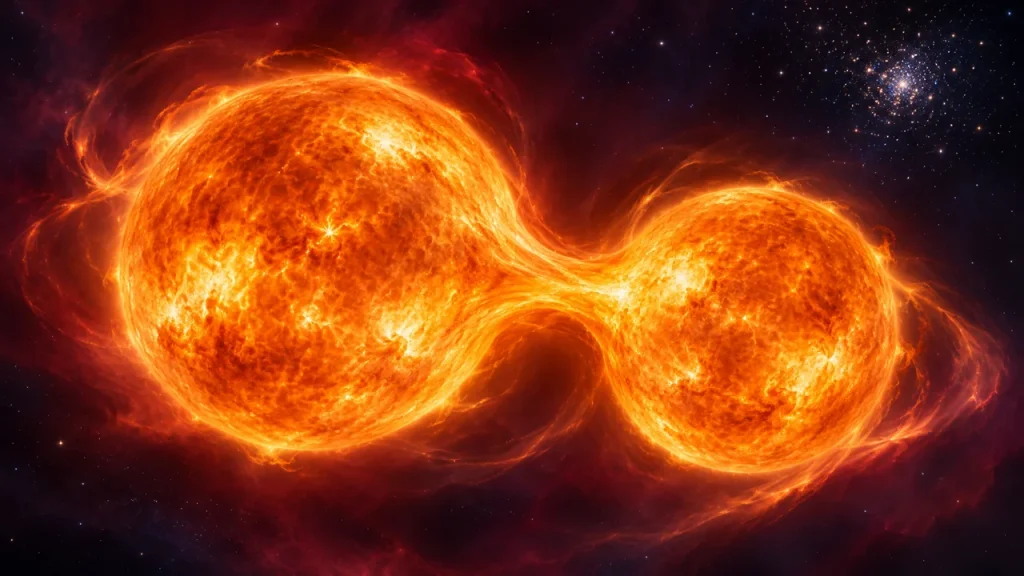
Little Red Dots could hold clues to how the universe built enormous black holes surprisingly early. A new study explores whether crowded stellar environments helped those black holes begin life with a substantial advantage. Within sufficiently dense clusters, repeated stellar mergers could assemble exceptionally massive stars. Some could then collapse into large black hole seeds.
The idea also reaches beyond their formation. After a black hole emerges, encounters between nearby stars could supply dense surrounding gas. Together, these processes offer a possible connection between early black hole growth and JWST’s puzzling red sources.
Little Red Dots: Could Merging Stars Seed Giant Black Holes?
Why Early Black Holes Need a Head Start
Some early black holes already contained millions or billions of solar masses when the universe was remarkably young. Building such objects from small stellar remnants presents a difficult timing problem. Their growth depends on available material, feeding rates, and how efficiently infalling matter releases energy.
A larger starting mass changes that calculation. Instead of growing from a modest remnant, a black hole could begin much further along. It would still need additional material, but the required increase would be smaller.
This does not make early giants physically impossible. Nor must every black hole take exactly one billion years to become supermassive. Different starting conditions allow different growth histories. The new research examines one possible route to a more substantial beginning.
Other pathways remain under investigation, including black holes forming directly from collapsing gas. Different objects could follow different routes. The challenge is determining which process operated in each environment, rather than assuming one explanation fits every early giant.
When Crowded Stars Begin to Merge
Density Creates Opportunities
The UCLA-led study explores stellar systems with unusually high densities. Such environments increase the likelihood of close encounters during a star’s lifetime. However, crowding alone does not guarantee the same result everywhere. A cluster must maintain suitable conditions long enough for repeated mergers to matter. This makes its evolution as important as its initial density.
Speed matters too. Under suitable conditions, relatively slow encounters allow stars to combine. Repeated mergers can build a much larger object than the stars that started the process.
This creates a potential sequence: a dense cluster supports mergers, a massive star develops, and eventual collapse produces a black hole. Each stage depends on the system’s physical conditions.
A Larger Stellar Starting Point
The researchers find conditions that could support this repeated growth. In extreme modeled cases, a single star could accumulate a substantial share of the cluster’s mass.
That outcome should not imply that every crowded cluster produces one enormous star. Stellar evolution and mass loss influence what remains. Nevertheless, the mechanism offers a plausible way to assemble unusually massive precursors to black holes.
A Black Hole Changes What Happens Next
Once a massive black hole occupies the cluster, its gravity changes nearby stellar motions. Stars moving close to it can reach higher speeds. Their encounters may then remove stellar material instead of building larger stars.
The released material adds gas to the surrounding environment. This introduces a second role for stellar encounters. They could help create a massive seed earlier, then contribute gas around an existing black hole later.
Yet producing nearby gas does not automatically establish how quickly the black hole grows. Material must still move inward, while radiation and other processes can carry some away.
The paper does not explicitly follow all subsequent gas accretion or expulsion. Its findings therefore support a potential supply mechanism, rather than a complete prediction of the black hole’s final mass.
Connecting Stellar Mergers to Little Red Dots
Dense Gas Offers a Possible Link
Little Red Dots combine compact appearances with unusual light signatures. Many researchers suspect that at least some contain growing black holes within dense gas. Such surroundings could alter the light that eventually reaches our telescopes.
The new framework offers a possible source for that material: frequent stellar encounters. This connects the cluster’s internal activity with a gas-rich environment resembling proposed explanations for these objects.
However, resemblance does not establish identity. The research does not prove that all Little Red Dots share this history.
Observations Provide Another Clue
NASA has described an unusual source nicknamed the “X-ray dot.” It shares several characteristics with Little Red Dots but also emits detectable X-rays.
Researchers suggest it could represent a transition toward a more familiar growing black hole. Gaps in surrounding gas might let some radiation escape.
That interpretation supports interest in dense gas around black holes. It does not establish that stellar mergers created the black hole or supplied its surroundings. Those remain separate questions that astronomers must test.
Why Little Red Dots Became Less Common
These objects appear far more common in the early universe than in later cosmic history. NASA describes a sharp decline in their abundance, with only a handful of later examples.
Changing environments could help explain that pattern. As galaxies developed, some compact systems may have lost the conditions that sustained their unusual appearances.
However, astronomers also consider how observations shape the apparent population. NASA’s discussion of another study highlights that distant systems can hide features current instruments cannot resolve.
Consequently, the decline may involve both physical evolution and observational limitations. Claiming that every object disappeared at an exact cosmic birthday would overstate the evidence.
What the Research Still Needs to Establish
The researchers combine an analytical framework with conditions drawn from cosmological simulations. They also check its predictions using Monte Carlo simulations, which explore outcomes through repeated statistical sampling.
Agreement between these approaches strengthens the model’s internal consistency. It does not replace observations of real systems.
Several uncertainties remain, including stellar mass loss, changing stellar populations, and the influence of gas. These factors affect how much material can collect in a massive star or around a black hole.
Further observations must help distinguish competing explanations. Measurements of gas, stellar populations, and black hole activity could clarify which environments match the proposed pathway. A successful explanation must account for the observed light as well as plausible stellar behavior.
Little Red Dots and the First Cosmic Giants
Little Red Dots may connect two stages of an important cosmic process: forming massive black hole seeds and surrounding them with gas. Stellar mergers offer a possible route between those stages, although the full sequence remains unconfirmed.
The study’s value lies in connecting processes that researchers can investigate together. If future evidence supports this picture, these compact red sources could reveal how crowded stellar neighborhoods helped shape the universe’s earliest giant black holes.
Main Sources
- UCLA Newsroom: Stellar collisions may have been common when the universe was young
- Original research: A cosmological framework for stellar collisions at high redshift in proto-globular clusters, nuclear star clusters, and Little Red Dots
- NASA: NASA Connects Little Red Dots with Chandra, Webb
- NASA: NASA Webb Explores Family Tree of Newly Discovered Distant Objects
- NASA: The Impact of Webb on Our Understanding of Black Holes
You Might Also Like:
Little Red Dots: Hidden Galaxies Offer New Clues
Little Red Dots Black Hole Stars: JWST Finds Strongest Evidence Yet
Little Red Dots May Hide Growing Black Holes