
BY:SpaceEyeNews.
Bright early galaxies may owe part of their surprising appearance to radiation that cleared away surrounding gas and dust. New calculations suggest that hydrogen light could help reveal young stars while leaving their densest birthplaces largely intact. That combination offers a promising explanation for one of the James Webb Space Telescope’s most intriguing findings.
The key lies in where the radiation acts. Dense filaments can hold their gas through gravity. Meanwhile, thinner material between stars responds more easily to outward pressure. Early galaxies could therefore keep producing stars while becoming easier to see.
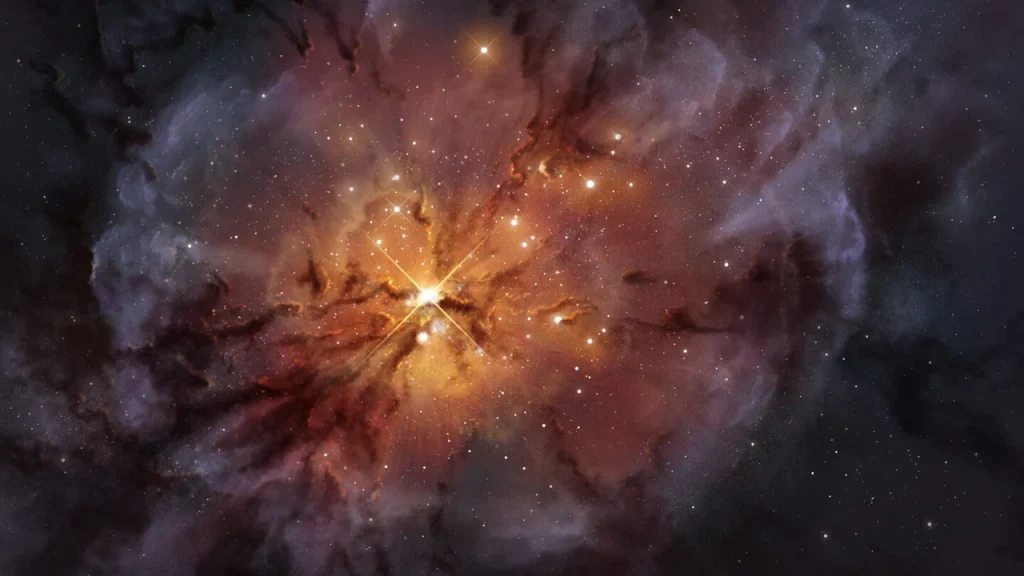
Artist’s illustration of hydrogen radiation clearing gas around a star-forming region in bright early galaxies.Credit: Matt Twombly for the Simons Foundation.
Why Bright Early Galaxies Raised Questions
Webb found more luminous galaxies in the early Universe than earlier models had predicted. Their abundance challenged expectations about how quickly galaxies could become so bright during the first few hundred million years.
Two explanations attracted attention. Early galaxies might have converted gas into stars unusually efficiently. Alternatively, relatively little dust might have obscured their light. Both processes could contribute, but connecting them raised a difficult question.
If radiation clears material from a galaxy, could it also remove the gas needed to make stars?
Some simplified calculations suggested that hydrogen radiation could seriously limit star formation. The new work explores that concern using a more realistic, uneven distribution of gas. Its findings suggest that strong radiation pressure and productive stellar nurseries can coexist.
How Hydrogen Light Can Clear the View
Repeated Scattering Adds Pressure
Young stars release ultraviolet radiation that ionizes nearby hydrogen. As electrons recombine with hydrogen ions, the gas can emit Lyman-alpha photons. Collisions involving electrons and hydrogen atoms can also generate this radiation.
Lyman-alpha light has a wavelength of about 122 nanometers. Its importance here comes from repeated scattering through neutral hydrogen.
A photon can interact with many atoms before escaping. Each interaction transfers momentum, allowing countless small pushes to create substantial outward pressure. The radiation does not need to create additional stars to increase their visibility. Instead, it can help remove material along the paths their light follows.
A Force That Is Difficult to Calculate
Following these interactions requires demanding computations. Researchers therefore calculated Lyman-alpha pressure at selected moments from an existing simulation of a collapsing gas cloud.
The cloud contained approximately one million solar masses of gas. This approach let the team examine how radiation and gravity competed across different environments within a developing stellar cluster.
Why Star Formation Could Continue
Dense Filaments Keep Their Gas
The calculations revealed a crucial distinction between dense filaments and the more diffuse gas surrounding them.
Within the densest structures, gravity remained stronger than the outward pressure. These filaments supply much of the material that builds stars. Keeping them bound allows star formation to continue even when radiation strongly affects nearby regions.
Across the modeled conditions, Lyman-alpha pressure exceeded other ultraviolet and infrared radiation pressure by roughly three to 500 times. That comparison sounds dramatic, but stronger radiation pressure does not automatically mean stronger pressure than gravity.
The local balance determines whether gas stays or leaves.
This distinction helps explain why simpler models reached different conclusions. Treating a cloud as a smooth structure can miss its dense pockets and thinner pathways. Realistic gas arrangements matter because radiation does not encounter the same resistance everywhere within a stellar nursery.
High Efficiency Remains Possible
The researchers inferred that even dust-free environments could convert around 25% or more of their gas into stars. Some conditions containing dust could retain efficiencies of roughly 60% or higher. These estimates exceed the typical values below 10% in present-day star-forming regions.
Crucially, those percentages describe modeled clouds, not measurements of entire galaxies. They also do not establish a universal range with 60% as its maximum. arxiv.org
In the lower-density material, radiation could overcome gravity. This selective response offers the central insight: a cluster can preserve its main star-forming structures while clearing more diffuse surroundings.
Why Dust and Timing Matter
Dust Changes More Than Visibility
Dust has two important roles in this picture. It can obscure starlight, but it also absorbs Lyman-alpha photons. That absorption interrupts repeated scattering and weakens the resulting pressure.
Consequently, less dust does not simply mean an unobstructed view. It can also allow hydrogen radiation to exert a stronger influence on gas. This helps explain why estimated star formation efficiencies vary with dust abundance.
Understanding the earliest galaxies therefore requires more than counting their stars. Researchers must also consider how surrounding material changes the light that escapes.
Young Stars Could Emerge Earlier
The calculations suggest that radiation could help clear surrounding material on timescales of roughly four million years or less. Such rapid clearing could reveal clusters while their most massive stars still shine intensely.
It might also open paths for ionizing radiation to escape into surrounding space. That possibility connects the mechanism to reionization, when radiation transformed hydrogen between galaxies.
However, Lyman-alpha photons are distinct from the higher-energy photons that ionize hydrogen. Their proposed role here involves moving gas and potentially helping those other photons escape.
What the Calculations Still Cannot Prove
Snapshots Cannot Show the Whole Evolution
The study offers a plausible mechanism, but it does not establish a complete explanation for Webb’s observations.
Researchers calculated Lyman-alpha forces after running the underlying simulation. They did not continuously update the gas motion with those additional forces included. As gas moves, its changing arrangement could alter how photons travel and where pressure builds.
A fully coupled simulation must follow those effects together. Until then, estimates of clearing and star formation remain informed predictions.
From Stellar Clusters to Whole Galaxies
Dust properties create another uncertainty. Early galaxies may contain different amounts and types of dust, which would change radiation trapping and pressure.
Scale matters, too. A mechanism operating around individual clusters does not automatically explain the brightness distribution of an entire galaxy population. Researchers still need to establish its broader contribution.
Future calculations that combine radiation, gas motion, and star formation in three dimensions should help test that connection.
Bright Early Galaxies May Reveal Two Processes Together
Bright early galaxies could reflect both efficient star formation and the rapid removal of obscuring material. Hydrogen radiation offers a physical link between those processes. It may clear diffuse surroundings while gravity protects the dense structures where stars grow.
The evidence remains computational, and important uncertainties persist. Nevertheless, the work sharpens the question raised by Webb: how much of early galaxies’ surprising brightness comes from producing light, and how much comes from letting it escape? Answering that question will help explain why the young Universe looks so luminous.
Main sources:
- Simons Foundation / Flatiron Institute: Light-Propelled Winds Help Explain Early Universe’s Bright Galaxies — institutional announcement, November 4, 2026.
- Original research: Lyman-alpha Radiation Pressure in Dense Star Clusters — Shyam H. Menon and Aaron Smith.
- Universe Magazine: Mystery of Bright Early Galaxies Linked to Hydrogen Radiation — supplied source coverage.
You Might Also Like:
Lumina simulation Reveals the Universe’s Early Transformation
Three Black Holes Reveal an Early Galaxy’s Growth Secrets
Black hole jets may shape galaxies’ futures