
BY:SpaceEyeNews.
Earth’s new mini-moon is small enough to fit in a truck bed, yet identifying it required an international observing effort. Named 2026 QQ8, the object measures an estimated one to two meters across. Astronomers discovered it in August 2026, after it had already become a temporary companion to our planet.
The intriguing part extends beyond its size. Researchers initially faced a familiar problem: was this a natural visitor or discarded space hardware? Follow-up observations changed that assessment. They also revealed why a faint point of light can tell scientists more than its appearance suggests.
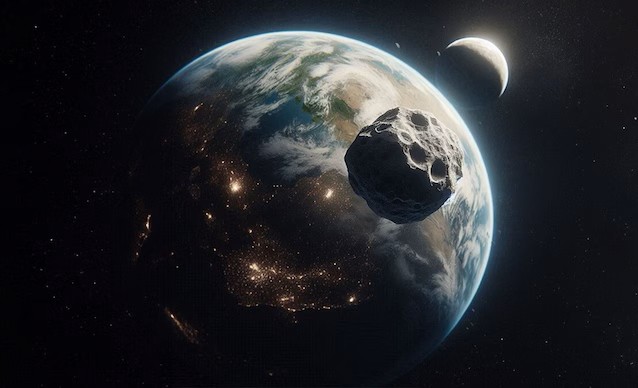
Earth gets a new mini-moon as asteroid is pulled by gravity.
Earth’s New Mini-Moon: From Detection to Designation
Hungarian astronomer Krisztián Sárneczky detected the object during the night of August 19–20 at Piszkéstető Station. Observatories across several countries then contributed measurements, helping researchers investigate its motion.
However, detection did not immediately settle its identity. Under the earlier tracking label Sar2901, the object attracted competing explanations. Its Earth-like trajectory could fit a natural companion or an artificial object.
Why the announcement took time
In September, the Minor Planet Center explained that it would delay assigning a designation while uncertainty remained. Scientists needed additional positional measurements to assess forces beyond gravity.
By October 29, the center had published its circular identifying 2026 QQ8 as a temporarily captured object. Its October 30 newsletter then described the evidence supporting a natural origin.
These dates mark different stages of the investigation. August brought the detection; October brought the published designation and updated interpretation. Neither announcement date marks the moment Earth captured the object. That distinction prevents a discovery headline from becoming a misleading arrival date.
Why 2026 QQ8 Became a Temporary Companion
The visitor follows a solar orbit remarkably similar to Earth’s. That geometry matters because an object approaching at modest relative speed can enter a temporary gravitational relationship with our planet.
Instead of passing rapidly through the neighborhood, it can remain nearby as Earth alters its trajectory. Yet the resulting path does not resemble the tidy circle often shown in simple illustrations.
The Sun continues to influence its motion, while the wider gravitational environment changes the conditions of capture. Consequently, a temporary companion can follow a complicated path before moving away again.
The original coverage gives a solar orbital period of roughly 359 days. That figure describes its journey around the Sun, rather than a revolution around Earth. Confusing those two reference frames would give readers the wrong picture.
For Earth’s new mini-moon, the essential point is its close orbital match with our planet. That resemblance helps explain both the encounter and its temporary nature.
How Sunlight Helped Resolve the Identity Question
Astronomers cannot identify every small object through a detailed photograph. Sometimes, its response to sunlight provides a better clue.
Light transfers momentum when it strikes a surface. Although this pressure is weak, repeated measurements can reveal its influence on an object’s path.
A subtle difference between rock and hardware
A hollow rocket casing presents considerable surface area compared with its mass. Therefore, sunlight can alter its motion more noticeably than that of a compact rocky body.
Researchers examine this relationship through an object’s area-to-mass ratio. The measurement helps test whether its behavior fits lightweight debris or a denser natural object. It does not provide a photograph, a mineral inventory, or a complete account of its origin.
For 2026 QQ8, additional observations extended the measured trajectory. The Minor Planet Center then estimated solar radiation pressure and said the evidence ruled out an artificial origin. Its October update described the object as natural and most likely a temporary mini-moon.
The earlier case of 2020 SO
A previous visitor explains why scientists took the alternative seriously. In 2020, astronomers investigated an object called 2020 SO that resembled a potential temporary natural satellite.
NASA later confirmed it as a Centaur rocket booster from the 1966 Surveyor 2 mission. Orbital analysis and infrared observations helped establish that identification.
The comparison highlights a practical challenge: familiar-looking motion alone cannot settle an object’s identity. Multiple kinds of evidence make the conclusion stronger.
Why This Tiny Visitor Is Difficult to Track
Finding a meter-scale object at astronomical distances requires sensitive instruments and favorable observing conditions. Its small surface reflects little sunlight, while distance further reduces the light reaching a telescope.
For that reason, the discovery delay does not imply an unexpected failure. Small, faint visitors can remain undetected even when they occupy Earth’s broader neighborhood.
Nor does discovery guarantee continuous visibility. Changing distance, viewing geometry, and observing conditions can limit opportunities for follow-up work.
Every additional position matters
Repeated observations allow researchers to compare predicted positions with measured ones. Over time, discrepancies help refine the trajectory and reveal subtle influences such as radiation pressure.
This process explains why international cooperation mattered. Different observatories contributed to an investigation that required more than spotting a moving dot once.
It also explains why published distance and brightness values need dates. Both can change as the object moves. Treating an earlier measurement as a permanent property would distort its situation.
When Will Earth’s New Mini-Moon Leave?
The temporary capture will end as gravitational interactions reshape the visitor’s path. It will then continue traveling around the Sun without remaining bound to Earth.
However, a precise departure date requires calculations specific to this object. An average lifetime for other mini-moons cannot establish its individual schedule.
The original coverage suggests January 2027 using a typical capture duration. Readers should therefore treat that timing as approximate, rather than a confirmed deadline.
Further tracking can sharpen estimates of its trajectory and clarify the capture interval. The important distinction is between a broad expectation and a well-constrained orbital prediction.
Leaving Earth’s temporary gravitational companionship also does not mean leaving the solar system. The object remains part of the Sun’s surrounding population of small bodies.
A Small Companion With Scientific Value
Earth’s new mini-moon offers more than an unusual headline. Its discovery shows how scientists can investigate tiny objects through their movement, even without detailed surface images.
The strongest result concerns identity: follow-up measurements supported a natural origin after an initial period of uncertainty. The remaining work concerns a clearer understanding of its path and temporary stay.
For readers following 2026 QQ8, those distinctions make the story more interesting. A small visitor can expose the limits of first impressions while demonstrating the value of patient observation. Its time near Earth may be brief, but the measurements provide a lasting scientific record.
Main sources:
Universe Space Tech — Earth’s new moon spotted later than expected: https://universemagazine.com/en/earths-new-moon-spotted-later-than-expected/
Minor Planet Center — September 2026 newsletter: https://buttondown.com/MPC_newsletter/archive/newsletter-september-2026/
Minor Planet Center — October 2026 newsletter: https://buttondown.com/MPC_newsletter/archive/newsletter-october-2026/
NASA — Confirmation of 2020 SO as a Centaur rocket booster: https://www.nasa.gov/science-research/planetary-science/new-data-confirm-2020-so-to-be-the-upper-centaur-rocket-booster-from-the-1960s/
NASA JPL — Solar radiation pressure and the investigation of 2020 SO: https://www.jpl.nasa.gov/news/earth-may-have-captured-a-1960s-era-rocket-booster/
You Might Also Like:
Three-Lobed Asteroid 44 Nysa Reveals a Tiny Moon
Marius Hills Pit: NASA’s Search for a Hidden Moon Shelter
BREAKING: Earth’s New Second Moon 2024 PT5!