
BY:SpaceEyeNews.
Why does a black hole weighing ten Suns turn up so often in merging pairs, while one weighing fourteen is surprisingly rare? Failed supernovae may explain the difference. Astronomers suspect that some massive stars collapse into black holes with little outward sign of what happened. A study in Physical Review D found a clue to those quiet endings in signals that reached Earth much later. By then, the stars had long since vanished. What the detectors picked up was the moment their black holes finally merged.
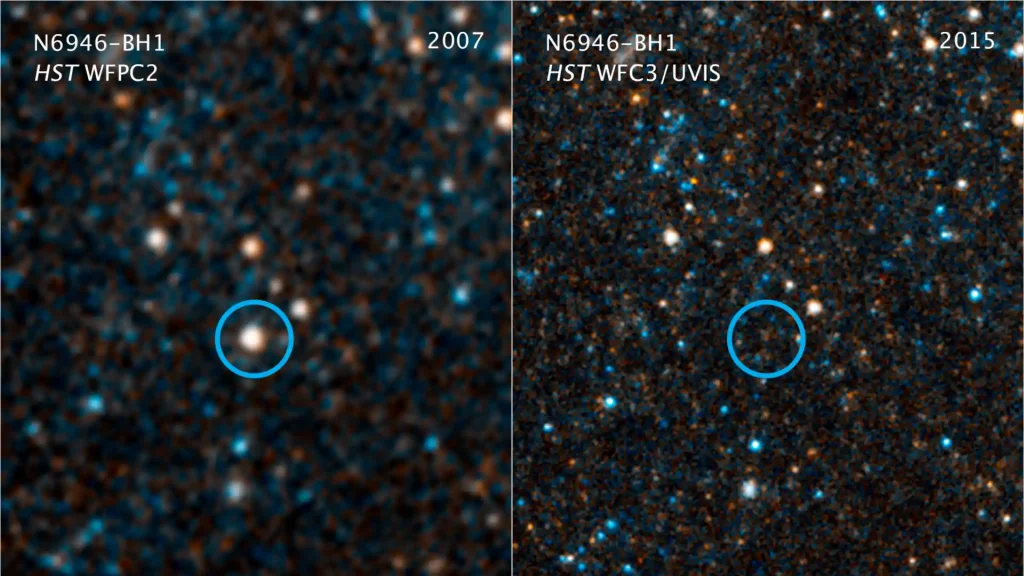
Hubble images of N6946-BH1 show a bright star inside a blue circle in 2007 and a much fainter spot at the same location in 2015. Image credit: NASA, ESA, and C. Kochanek (OSU).
The missing middle in black hole mergers
The clue comes from the heavier member of each black hole pair. Its mass gives astronomers a consistent way to compare systems, even when the two partners differ considerably in size. A pair containing black holes of ten and six solar masses, for example, belongs in the ten-solar-mass group. The distinction matters because adding the two masses would put that same pair right in the middle of the apparent shortage.
Around ten solar masses, the researchers found a pronounced peak in the merger rate. By fifteen solar masses, their estimate had fallen roughly a hundredfold. Above about sixteen, the rate climbed again. That recovery is the intriguing part. If heavier black holes simply grew rarer with every extra solar mass, the decline would continue. Instead, black holes on both sides of the dip appear in merging pairs more often than those in between.
The team inferred those rates from the signals the observatories could detect. A louder signal can register at a greater distance, so a simple count would favor some pairs over others. Accounting for that difference lets the researchers ask how common each kind of merger is across the same volume of space.
What changed when the catalog grew?
The team first analyzed 153 mergers from the LIGO–Virgo–KAGRA catalog. During the study’s review, a new catalog gave them 257 qualifying mergers with which to repeat the analysis. The dip persisted, with its edges close to twelve and sixteen solar masses. Astronomers can still find individual black holes in that interval. The finding concerns how rarely they appear as the heavier partner in a merger.
Why failed supernovae could favor ten solar masses
A star’s inner structure helps determine what happens when its core collapses. In some stellar models, stars born within a narrow range of masses develop particularly compact cores. The outward shock can stall, allowing material to fall inward and form a black hole. A distant observer might see the star fade after a modest brightening. The brilliant display usually associated with a supernova could fail to appear.
Ten solar masses refers to the black hole that remains. A ten-solar-mass black hole alone tells us little about its parent’s initial weight. The original star began life with more material, and its history shapes how much it retains by the time its core collapses. That distinction gives the simulations a specific task. They must explain how stars with different histories can leave remnants that cluster around a similar mass.
Why the neighboring masses matter
Producing a ten-solar-mass black hole in a simulation answers only half the question. A model could produce many such black holes and nearly as many weighing fourteen Suns. It would succeed at explaining the peak while missing the steep decline beside it. The researchers explored whether direct collapse becomes especially efficient over a narrow range. That would give one group of remnants a common route to formation and help explain why its neighbors appear so rarely.
Black hole spins offer a second clue
If the black holes near the peak share an origin, does that resemblance extend to their spins? The team examined effective spin. This quantity describes how the two spins line up with the pair’s orbital motion, giving more weight to the heavier partner. Two black holes can each rotate appreciably even when the pair’s effective spin is close to zero.
Both the lighter and heavier groups clustered around a small positive value. The difference lay in the spread. Among the lighter pairs, effective spin stayed within a narrower range. The heavier pairs showed more variation around a similar center. In other words, picking a pair from the lighter group gave researchers a better idea of what spin value to expect. That resemblance adds weight to the possibility of a shared history, although several combinations of spin speeds and directions can yield the same value.
What a fading star can tell us about failed supernovae
In 2007, Hubble could clearly see a bright star at the site astronomers call N6946-BH1. By 2015, the prominent point of light had faded from view. Those two images illustrate why astronomers search old observations for stars that quietly disappeared. They also leave a question that a visible-light image alone struggles to answer. What, if anything, still shines at that position?
The James Webb Space Telescope picked up an infrared source there. Dust can absorb visible starlight and radiate that energy at longer wavelengths, where Webb can detect it. Researchers have considered whether a merger between two stars could explain the observations. N6946-BH1 therefore remains a candidate for a failed supernova, and its changing brightness gives astronomers something concrete to track.
The gravitational-wave study approaches the same question from the other end of a star’s history. Telescopes can follow a particular source across decades and wavelengths. A merger signal lets researchers estimate the masses of two remnants, even when no telescope recorded the stars that produced them. The catalog also has a natural limit. An isolated black hole never contributes a pair to this tally, however quietly its parent star disappeared.
Will the gap in black hole masses hold up?
The next black hole weighing fourteen Suns could be especially informative, provided it is the heavier member of its pair. One such discovery would fit within the uncertainties. A steady stream of them would change the shape of the dip. Future catalogs can also test whether the lighter pairs continue to share a narrow range of effective spins as the sample grows.
For now, failed supernovae offer a way to connect a star’s fading light with the properties of its remnant. A telescope may record the last light from a massive star. Long afterward, a merger can reveal how much mass its core left behind. The telling detail may be why nature so often arrives at ten Suns and so seldom at fourteen.
Main sources:
- Physical Review D — https://journals.aps.org/prd/abstract/10.1103/mnzq-w1b5
- Full research paper, including the expanded sample — https://arxiv.org/html/2604.01420v2
- Caltech research news — https://www.caltech.edu/about/news/astronomers-find-hints-of-star-population-that-failed-to-explode
- NASA Hubble images of N6946-BH1 — https://science.nasa.gov/asset/hubble/n6946-bh1/
- Caltech/IPAC summary of the Webb observations — https://www.ipac.caltech.edu/publication/2024ApJ…964..171B
- Original Space.com coverage — https://www.space.com/astronomy/black-holes/astronomers-discover-rare-black-holes-that-formed-when-stars-failed-to-go-supernova
You Might Also Like:
Neutrino Flavor Conversion May Explain Missing Supernovas
Dark Energy Acceleration Confirmed After Nobel Laureates Refute Cosmic Slowdown Claim
Why Some Stars Explode While Others Quietly Collapse