
BY:SpaceEyeNews.
Dark energy and the strong nuclear force seem to belong at opposite ends of physics. One shapes the expansion of the universe. The other binds quarks inside each proton and neutron. Yet the equations that describe those quarks also describe the space between galaxies. A team from the University of Sheffield and the University of British Columbia has asked what happens to that space as the universe expands.
Their study, published in The Astrophysical Journal, explores a specific possibility. A slight change in the energy of empty space could account for the acceleration astronomers measure today. The researchers put that idea up against observations spanning much of cosmic history.
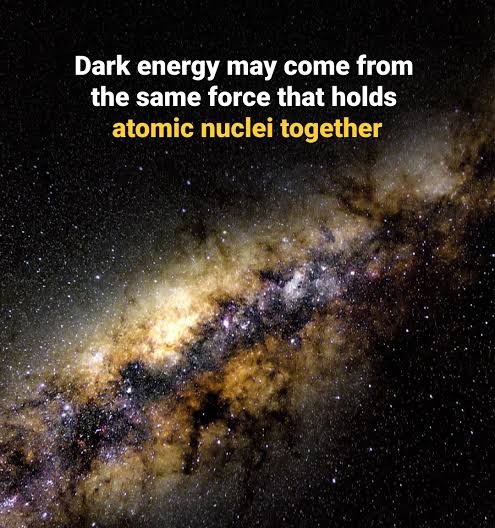
What connects dark energy and the strong nuclear force?
Consider a region of space so remote that it contains no atoms. The quantum fields that govern the strong force still exist there. Physicists call their lowest-energy state the quantum chromodynamics vacuum, or QCD vacuum. Its properties matter because gravity responds to energy even where there are no stars, gas clouds or galaxies.
The team focused on a property called topology. In QCD, fields can settle into distinct configurations. A quantum process called tunnelling allows transitions between them. Those transitions contribute to the energy of the vacuum. The open question is how that contribution behaves in a universe whose geometry changes over time.
To investigate, the researchers compared the vacuum in expanding space with its counterpart in flat, non-expanding space. Their proposal assigns physical significance to the small energy difference between the two. Across the universe, that difference could influence how quickly galaxies recede from one another. The familiar role of the strong force inside a nucleus provides the starting theory. The proposed cosmic effect arises even in the space between nuclei.
Why the size of the effect caught physicists’ attention
Any explanation for dark energy has to account for its measured strength. Knowing that a vacuum can carry energy leaves a difficult numerical question. Why should its contribution have the particular value astronomers infer from the expansion of the universe?
According to the team, combining the characteristic scale of QCD with gravity gives an estimate close to today’s dark-energy scale. The calculation draws on known physics and requires no additional fundamental particle. That agreement gives researchers a concrete reason to pursue the idea. It also gives them a second question to address. Can the same mechanism explain how the influence of dark energy changed over billions of years?
Timing the transition
To make that comparison, the team introduced two adjustable quantities. One sets when the vacuum contribution becomes significant. The other describes how gradually that transition occurs. Predicting the approximate strength of dark energy and reconstructing its history are therefore distinct achievements. The researchers can estimate the first from physical scales. For the second, their model still draws on observations.
Three measures of cosmic expansion
Each set of observations brings a different piece of cosmic history into view. The cosmic microwave background preserves a pattern from the early universe. The researchers used measurements from Planck, the Atacama Cosmology Telescope and the South Pole Telescope to anchor their calculations at that early epoch.
Much later in cosmic history, a related pattern appears in the distribution of galaxies. Galaxies show a slight preference for a particular separation, a legacy of sound waves in the young universe. Astronomers use that separation as a standard ruler. The Dark Energy Spectroscopic Instrument, or DESI, measures how large the ruler appears at different distances.
Type Ia supernovae provide a separate distance check through their brightness. For this part of the analysis, the team repeated its calculations with two collections of supernova measurements, Pantheon+ and DES-Dovekie. Trying both matters because the strength of the apparent trend can shift with the choice of supernova sample.
Where the QCD model gained ground
The standard cosmological model treats dark-energy density as constant even as space expands. The researchers compared their QCD model with that benchmark and with another model that allows dark energy to evolve. Looking separately at early- and late-universe measurements, they found that the QCD model performed about as well as the standard one.
The balance shifted when the team combined measurements from both eras. Its Bayesian comparison gave the QCD model a mild to moderate edge over the constant-density model. That comparison weighs how well each model accounts for the observations across its range of possible parameter values. A model gains little from flexibility alone if only a narrow choice of values works.
One way to understand the combined result is to think about the standard ruler. The early universe sets its length. Galaxy surveys then show how that length looks across a range of distances. A successful model must connect those measurements through one continuous expansion history. Supernovae offer a further check along the way. Agreement at either end leaves room for differences in how a model gets from one to the other.
DESI’s independent clues
Berkeley Lab reported that DESI’s three-year analysis used nearly 15 million galaxies and quasars. Several combinations of its measurements with other observations showed a preference for evolving dark energy. The strength varied with the data combination and fell below the conventional threshold for a discovery. Those measurements trace the expansion history. Several physical explanations could still produce a similar pattern.
Testing the nuclear connection
The next challenge is to calculate more precisely how the QCD vacuum responds as space expands. A sharper prediction for when its contribution grows significant would give astronomers a particular stretch of cosmic history to examine. More precise distance measurements could then reveal whether the universe followed that predicted course.
For now, the proposed link between dark energy and the strong nuclear force offers something astronomers can investigate from two directions. Particle physics supplies an estimate of the energy involved. Galaxy surveys and supernova observations reveal how expansion changed over time. The most telling result would come if calculations of the vacuum predicted a feature in that history before astronomers measured it.
Main sources
The Astrophysical Journal — https://doi.org/10.3847/1538-4357/aeb9cc
University of Sheffield — https://sheffield.ac.uk/mps/news/dark-energy-mystery-could-be-solved-physics-we-already-know
University of British Columbia — https://news.ubc.ca/2026/11/could-standard-physics-explain-the-mysterious-energy-driving-the-universe-apart/
Berkeley Lab, DESI results — https://newscenter.lbl.gov/2025/03/19/new-desi-results-strengthen-hints-that-dark-energy-may-evolve/
Interesting Engineering, original coverage — https://interestingengineering.com/science/dark-eneegy-source-atomic-nuclei
You Might Also Like:
Dark Matter and Dark Energy: The Universe’s 95% Mystery
CHIME hydrogen signal opens a new dark energy window
Dark Energy Debate: Is Expansion Slowing?!