
BY:SpaceEyeNews.
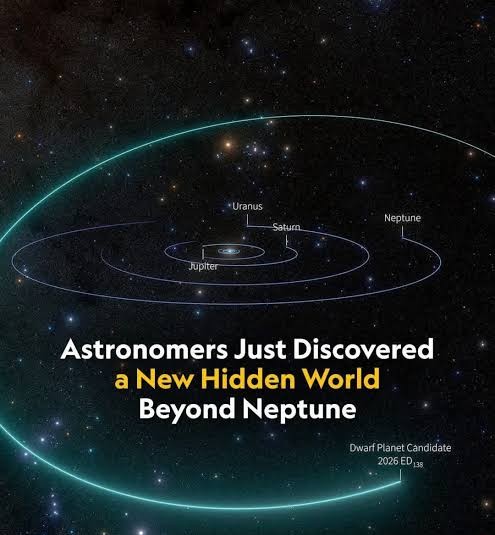
At its closest approach to the Sun, Sedna still lies more than twice as far out as Neptune. How did this icy world get onto a path that keeps it so far from the planet that shaped its neighborhood? A new study offers one possibility. A hypothetical world called Planet X2 could have gradually shifted Sedna’s orbit over billions of years. Astronomers have yet to see the proposed planet, but they can test the idea by looking for much smaller objects.
Clues beyond Neptune
Sedna comes within about 76 astronomical units of the Sun. Neptune orbits at roughly 30. That gap matters most when Sedna rounds the inner end of its long orbit. Other icy bodies swing close enough to Neptune for its gravity to change their course. Sedna spends even this part of its journey well beyond such encounters. Another distant body, 2012 VP113, stays farther out still, coming no closer than about 80 astronomical units.
Then there is 2015 BP519. What sets this object apart is the steep angle of its orbit relative to the plane of the planets. An explanation for Sedna alone might offer little insight into how a body acquired such a tilt. Patryk Sofia Lykawka and colleagues set out to explain how the outer Solar System came to contain both kinds of world.
What changed when researchers added Planet X2
The team simulated 4.5 billion years of Solar System history. Each simulation accounted for Neptune’s early outward migration, which rearranged the orbits of nearby icy bodies. That migration helps explain the structure astronomers see across much of the Kuiper Belt. Farther out, the researchers tested what would happen if another planet kept exerting a gravitational pull long after Neptune settled into place.
They tried planets ranging from one to two times Earth’s mass. A world at the heavier end produced the closest overall match. Here, the comparison with Earth refers strictly to mass. The orbital evidence tells astronomers little about the planet’s surface or what kind of atmosphere it might have.
The hidden planet’s orbit
In the preferred models, Planet X2 followed an elongated orbit with a semimajor axis of 350 to 500 astronomical units. That figure describes the size of the orbit. The distance from the Sun would change throughout each circuit, reaching roughly 200 astronomical units at closest approach. Even there, sunlight would take more than a day to reach the planet.
Over many circuits, its gravity could gradually lift the closest point of a smaller body’s orbit away from Neptune. For other objects, that influence could gradually increase the orbital tilt. By the end of the simulations, the team found icy bodies on paths resembling those of Sedna and 2015 BP519.
The near-level orbits helped narrow the possibilities for the unseen planet itself. Some simulations gave the planet an orbital tilt of 30 degrees. When the team also required the model to produce distant objects with modest tilts, those runs lost ground. A planet orbiting closer to the plane of the Solar System offered a better fit.
How Planet X2 differs from Planet Nine
Planet Nine grew out of a different observation. Several distant objects appeared to follow elongated orbits that pointed in similar directions. Researchers proposed that a massive planet could help maintain that alignment. Its significance remains a matter of debate because telescopes have searched some parts of the sky more thoroughly than others.
The new study included a Planet Nine model with 6.2 times Earth’s mass, roughly three times the mass of the preferred Planet X2. To compare the models, the team examined which orbits each planet could produce. Even if future observations weaken the case for alignment, Sedna’s distant closest approach and the steep tilt of 2015 BP519 still need an explanation.
A planet that left long ago
A planet could, in principle, leave evidence of its influence long after its departure. The researchers explored that possibility with young planets ranging from the mass of Mars to that of Earth. These bodies started much closer to the Sun. Encounters with giant planets then sent them outward, where their gravity could alter the paths of icy neighbors.
Timing proved decisive. Most of the young planets left the Solar System within a few tens of millions of years. Only three of 200 simulations came close to producing the observed range of orbits. Even those runs yielded too few objects with steep tilts. In this comparison, a planet that stayed in the outer Solar System had time to shape a wider variety of orbits.
Rubin’s test for Planet X2
Existing observations already reveal one weakness. The researchers compared their results with objects recorded by the Dark Energy Survey. For orbits with semimajor axes between 60 and 250 astronomical units, the model produced too few objects near the upper end. The survey also found relatively few bodies that far out, so additional discoveries could change the comparison.
A fair comparison also has to account for what a telescope can see. An icy body on a long, narrow orbit brightens as it approaches the Sun. Astronomers therefore have a better chance of spotting it during that brief stretch of its journey.
The Vera C. Rubin Observatory offers a way to investigate. Among the most revealing discoveries would be distant bodies whose orbits stay relatively level with the planets. The simulations predict a population of them, alongside objects on steeply tilted paths. Rubin’s repeated observations can help astronomers trace those paths and measure how often each kind occurs. The survey could also turn up the proposed planet itself.
Sedna’s next clue
The next test of Planet X2 may begin with a faint point of light that moves between exposures. Once astronomers trace its orbit, they can ask where it fits among the worlds beyond Neptune. A growing sample that matches the predicted mix would strengthen the case for a hidden planet. A different mix could reveal which part of Sedna’s story astronomers still need to explain.
Main sources
Original research, Monthly Notices of the Royal Astronomical Society
https://doi.org/10.1093/mnras/stag2033
Royal Astronomical Society, official research announcement
https://www.ras.ac.uk/news-and-press/research-highlights/could-astronomers-be-closing-hidden-planet-beyond-neptune
Carnegie Science, Sedna and 2012 VP113 orbital measurements
https://carnegiescience.edu/sedna-body-perihelion-80-astronomical-units
Universe Space Tech, original coverage
https://universemagazine.com/en/scientists-will-search-for-a-new-earth-like-planet-beyond-
You Might Also Like:
Planet Nine Mystery Deepens as New Discovery Challenges Hidden Planet Theory
Circumbinary Planets Discovery: 27 New Worlds Around Two Stars
James Webb hidden planet: Giant Emerges From Stellar Glare