
BY:SpaceEyeNews.
The James Webb hidden planet breakthrough began with observations that seemed to offer no clear planetary signal. Within those images, a giant world remained concealed beneath its star’s glare. A new processing method has now recovered that signal, revealing information earlier analysis could not extract.
The planet, 51 Eridani b, was already familiar to astronomers. Its discovery dates to 2015. This latest achievement concerns a different milestone: detecting it in Webb observations at a previously inaccessible infrared wavelength. The result raises an intriguing possibility. Other valuable planetary signals could await discovery in data telescopes have already collected.
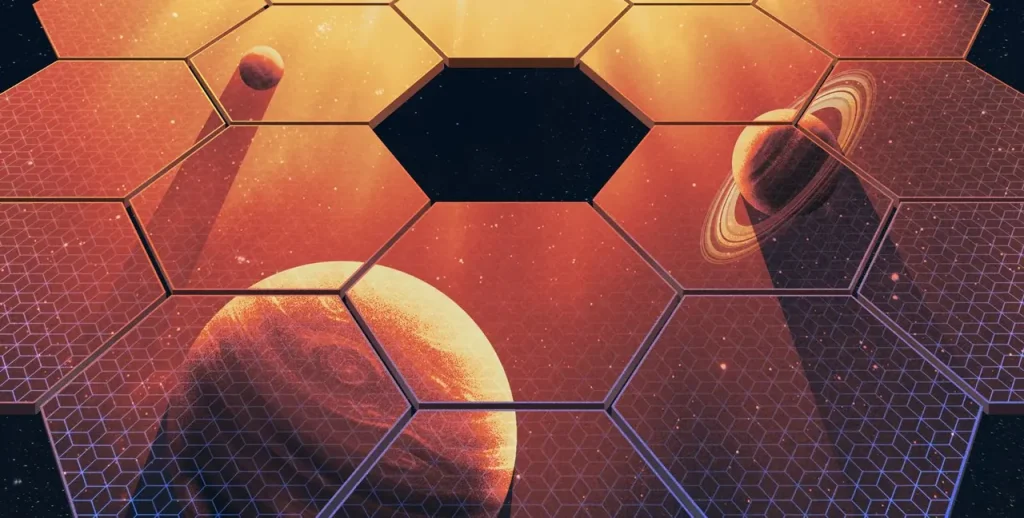
Illustration of planets against Webb’s hexagonal mirror pattern, representing hidden exoplanets revealed through stellar glare removal.Credit: Avesta Rastan / Caltech. Artist’s illustration.
Why the James Webb hidden planet escaped detection
51 Eridani b orbits a star roughly 97 light-years away. Despite its size, the giant planet struggles to stand out beside its much brighter host.
Webb’s coronagraph blocks much of the star’s light. However, residual glare still spreads across the image. Astronomers must remove that remaining pattern before they can distinguish some faint companions.
Conventional processing often uses another star as a reference. Researchers subtract its glare pattern from the target observation. This works best when both patterns closely match.
Tiny optical changes create a difficult mismatch
Even exceptionally stable telescopes experience subtle physical changes. Small shifts in optical alignment can alter how scattered starlight reaches a detector.
Consequently, a reference image may leave unwanted light behind. Those leftovers can overwhelm a planet’s signal, even when the original observation contains useful information.
For 51 Eridani b, the challenge also involved wavelength. The observations targeted a region where atmospheric carbon dioxide strongly absorbs infrared light. That makes an already faint planet harder to recover.
How FLIP removes the stellar glare
Researchers developed Physics-based Learning for Imaging Planets, or FLIP, to tackle this mismatch. Their approach models the telescope’s behavior during an observation.
The team creates a digital counterpart of Webb’s imaging system. This model simulates how light travels through its optics and reaches the detector. Researchers then adjust its parameters until the simulated glare closely matches the real image.
These adjustments account for tiny optical imperfections and other uncertainties. Instead of accepting a reference image’s remaining errors, FLIP seeks a more accurate representation of the unwanted starlight.
A physics model guides the calculation
The method uses computational optimization tools associated with machine learning. However, its foundation is the physics of light traveling through an instrument.
That distinction matters. The software calculates a stellar glare pattern; it does not simply generate a convincing picture of a planet.
Once the model matches the observation sufficiently well, researchers subtract the simulated glare. Fainter features can then emerge from the remaining signal. No replacement mirror or new detector is necessary for this reanalysis.
What the recovered planet actually demonstrates
The researchers tested FLIP using observations of three stellar systems. HIP 65426 and 51 Eridani contain known planets. A third target, TYC 5899, had no known planetary companions.
Across these tests, the method improved sensitivity by two to 15 times compared with conventional processing. That range describes the tested observations. It does not mean every Webb image suddenly gains the same improvement.
The standout result came from 51 Eridani b. FLIP recovered the planet in roughly two-year-old Webb data that earlier processing could not reveal.
Reading the comparison images correctly
The published comparison shows the difference clearly. Standard processing leaves the expected location without a convincing planetary detection. FLIP reveals a source there, while a separate simulated image illustrates its expected appearance.
The simulation serves as a comparison, rather than an additional observation. The scientific result comes from recovering the signal in real telescope data.
This makes the James Webb hidden planet result a processing breakthrough with a concrete observational test. Astronomers knew where to look, yet still needed better analysis to distinguish the planet.
Why the infrared wavelength matters
The study presents the first image of 51 Eridani b at 4.3 micrometers. Carbon dioxide absorbs strongly around this wavelength, giving it particular relevance for atmospheric research. www.nature.com
A planet’s brightness changes across infrared wavelengths as different gases absorb and emit radiation. Measurements in additional bands therefore help researchers test atmospheric models.
Recovering a faint signal expands the evidence available for those comparisons. It can help scientists evaluate whether their models reproduce the planet’s observed brightness.
However, one filtered image does not provide a complete atmospheric inventory. Researchers must interpret it alongside other observations and physical models. Nor does this detection indicate life. Its immediate value lies in accessing a difficult wavelength and improving the study of a known giant planet.
Could telescope archives contain more hidden worlds?
FLIP creates a reason to revisit observations that previously delivered disappointing results. Some datasets may contain signals that older processing could not separate from stellar glare.
Recovering a known planet offers a useful demonstration. Finding an unknown companion would require additional checks to establish that the signal represents a real object.
That distinction keeps the promise grounded. The present result supports further searches, but it does not establish how many undiscovered planets await detection.
This also changes how readers should understand a non-detection. An unsuccessful search can reflect the limits of a particular dataset or analysis. It does not automatically establish that a planet is absent. Here, the known companion provides a direct example of that difference, because two processing approaches produced different outcomes from the same observations.
A possible contribution to future observatories
The broader ambition reaches beyond Webb. NASA’s planned Habitable Worlds Observatory aims to directly image potentially habitable planets and examine their atmospheres. NASA Science
Such observations demand extremely effective separation of planetary light from stellar glare. Better computational correction could complement the precise optics that future instruments need.
Still, recovering a giant planet does not demonstrate the ability to photograph an Earth analogue. Researchers must establish how well these methods transfer to different instruments and more demanding targets.
James Webb hidden planet: More science from existing light
The James Webb hidden planet breakthrough shows how analysis can change what astronomers recover from an observation. Webb had collected a useful signal, but stellar glare prevented earlier methods from revealing it.
FLIP provided a more precise way to model and subtract that interference. The result opens a valuable infrared window on 51 Eridani b and encourages fresh scrutiny of archival observations.
Future discoveries will depend on careful testing and confirmation. Nevertheless, this demonstration gives astronomers a practical reason to look again. Some of the next insights into distant planetary systems may begin with light already stored in telescope archives.
Main sources:
- Northwestern University: Hidden planet emerges from the glare
- Caltech: Erasing the Stars to Find Exoplanets
- Nature: Imaging exoplanets below the telescope stability limit
- NASA: Habitable Worlds Observatory
- NASA: 51 Eridani b
You Might Also Like:
Gomez’s Hamburger May Hide a Giant Planet Taking Shape
WASP-17b’s Uneven Atmosphere: Webb Reveals a Strange Giant
WISE 0855 water clouds: Webb Tracks a Sunless World