
BY:SpaceEyeNews.
The most distant quasar known to astronomers holds a black hole roughly 360 million times the mass of the Sun. It had already reached that size when the universe was just 630 million years old. Yet the light reaching Earth shows a black hole feeding at a surprisingly modest pace. If it had always grown that slowly, how did it get so big?
Astronomers call the quasar J1504+6252 and have nicknamed it Dún Aonghasa. Its light gives them a date, a mass estimate and a glimpse of how much gas the black hole was consuming. Together, those clues let researchers work backward to ask what kind of beginning could explain it.
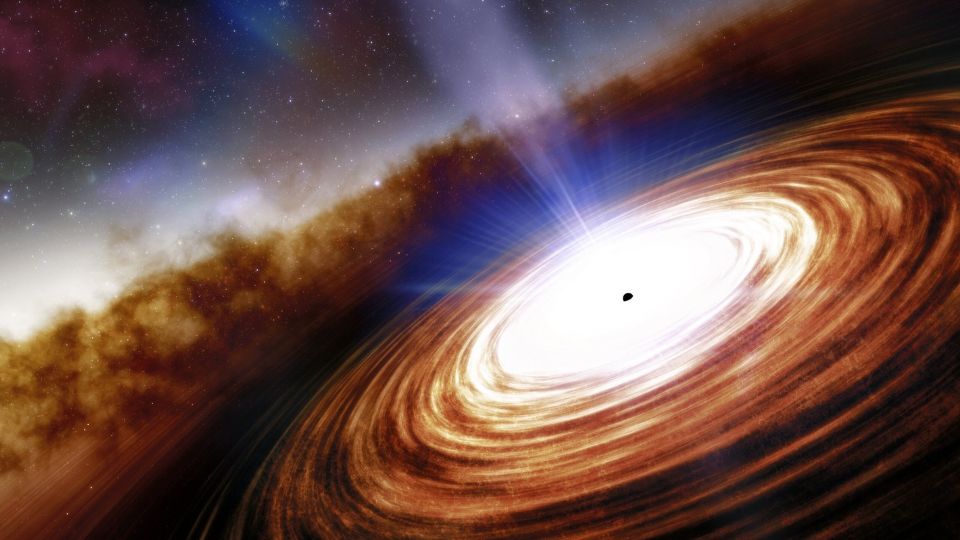
An international team of astronomers have discovered the most distant quasar in the Universe, fully formed around 670 million years after the Big Bang. Credit: NOIRLab/NSF/AURA/J. da Silva
How Euclid found the most distant quasar
In an image from the European Space Agency’s Euclid telescope, Dún Aonghasa looks like a tiny red dot. Astronomers picked it out among millions of objects in about 18 months of survey data. Euclid combines a wide view of the sky with sensitivity to infrared light. Both matter when the objects in question are rare and cosmic expansion has stretched their light to longer wavelengths.
The dot’s color caught the team’s attention. Confirming its identity took several telescopes. Observations from the Keck Observatory and the Hubble Space Telescope supplied the first clues. The Large Binocular Telescope and then the James Webb Space Telescope helped establish a redshift of 8.13.
That measurement puts Dún Aonghasa about 40 million years earlier than the previous record holder, another Euclid discovery. It also makes this the first confirmed quasar beyond redshift eight. For astronomers studying how black holes grow, those extra 40 million years matter. A model that could just account for the earlier record now has a shorter window to produce another giant.
How Webb estimated its mass
Webb spread the quasar’s infrared light into a spectrum. Within it, astronomers identified broad emission lines from hydrogen and magnesium. Gas moving at different speeds around the black hole shifts some of that light to slightly different wavelengths. The resulting width of a line gives astronomers a way to estimate how fast the gas moves.
The team combined that information with the quasar’s brightness to estimate the central mass. Different ways of calibrating the calculation give somewhat different answers. The figure of 360 million solar masses captures the scale of the result. Even allowing for uncertainty, the gas orbits an object hundreds of millions of times more massive than our Sun.
What the quasar’s brightness reveals
With a mass estimate in hand, astronomers could ask how brightly the quasar shone for a black hole of that size. They compared its output with the Eddington limit. At that luminosity, outward pressure from radiation balances the inward pull of gravity on ionized gas.
Dún Aonghasa shone at a fraction of that level. The quasar was bright enough for Webb to study across billions of light-years. Even so, a black hole of its mass could have sustained a much brighter phase. That distinction matters when astronomers try to reconstruct its history.
The feeding-rate puzzle
Consider what happens if the black hole spent its entire life feeding at the same modest fraction of its Eddington limit. Working backward from its observed mass, the researchers found that it would need an exceptionally heavy starting seed. Even the full 630 million years overstates the time available. A seed that arose from a gas cloud could only begin growing once the cloud itself had formed and collapsed.
A faster feeding phase changes the calculation. As a black hole gains mass, its Eddington luminosity rises. Sustained growth early on therefore gives later growth a larger starting point. The team considers it possible that the black hole once accumulated gas fast enough to exceed the usual Eddington benchmark. Its light records a later moment, leaving the duration and intensity of any earlier episodes open.
Could direct collapse explain the black hole’s size?
One possibility begins with a massive cloud of gas. Under the right conditions, gravity can draw the cloud inward to form a black hole directly. Astronomers call this process direct collapse. It gives the black hole a substantial initial mass and reduces the amount of gas it must acquire afterward.
A heavy seed and rapid feeding can both figure in the same history. A cloud might have produced a large seed that grew quickly for a time before settling into the quieter phase Webb observed. Julien Wolf and his colleagues found that direct collapse fits the discovery under plausible growth assumptions. The team also points to the rarity of suitable gas clouds. If only a small share of early clouds could produce heavy seeds, their descendants should be scarce too. That could help explain why so few quasars have turned up beyond redshift 7.5, even as surveys cover larger areas of the sky. How much mass came from the original cloud remains an open question.
The search for earlier quasars
Euclid has already identified 12 new quasars beyond redshift seven. Finding one as massive as Dún Aonghasa at a much earlier epoch would give researchers a sharper test. With only a few hundred million years on the clock, even a seed born through direct collapse might struggle to gain enough mass.
Such a discovery would give astronomers a reason to examine more exotic starting points. One possibility involves primordial black holes, hypothetical objects that could have formed shortly after the Big Bang. Their appeal here comes from timing. They could have started accumulating matter before the first large gas clouds collapsed.
For now, the most distant quasar gives astronomers something more concrete than a possible origin. By 630 million years after the Big Bang, nature had produced a black hole of roughly 360 million solar masses. Its modest appetite at that moment leaves a question for the next discovery. How close to the beginning can astronomers trace these giants before even a heavy seed runs short of time?
Main sources
Astronomy & Astrophysics, discovery paper — https://doi.org/10.1051/0004-6361/202662243
European Space Agency, Euclid mission coverage — https://www.esa.int/articles/about-us/directorates/science/euclid/euclid-breaks-own-quasar-record-by-40-million-years
Max Planck Institute for Astronomy, research announcement — https://www.mpia.de/news/science/2026-10-dun-aonghasa
Phys.org, original coverage from the Max Planck Society — https://phys.org/news/2026-11-quasar-tightens-constraints-black-hole.html
You Might Also Like:
Euclid Quasar Discovery Reveals Earliest Known Quasars
Euclid Ancient Quasars Reveal Hidden Early Universe
Big Wheel galaxy: JWST Finds a Giant Spiral in the Early Universe