
BY:SpaceEyeNews.
Mira’s magnetic eruption, the brightest yet seen on a star of its kind, first appeared as a bright patch on the surface of a red giant. Two years later, astronomers saw a loop of gas extending roughly as far from the red giant as Saturn lies from the Sun. The two images, taken with the ALMA telescope in Chile, offered a rare view of what happens after a stellar flare fades. Some of the star itself had moved outward. Within that gas, astronomers found evidence of a magnetic field strong enough to help lift material away from Mira’s surface.
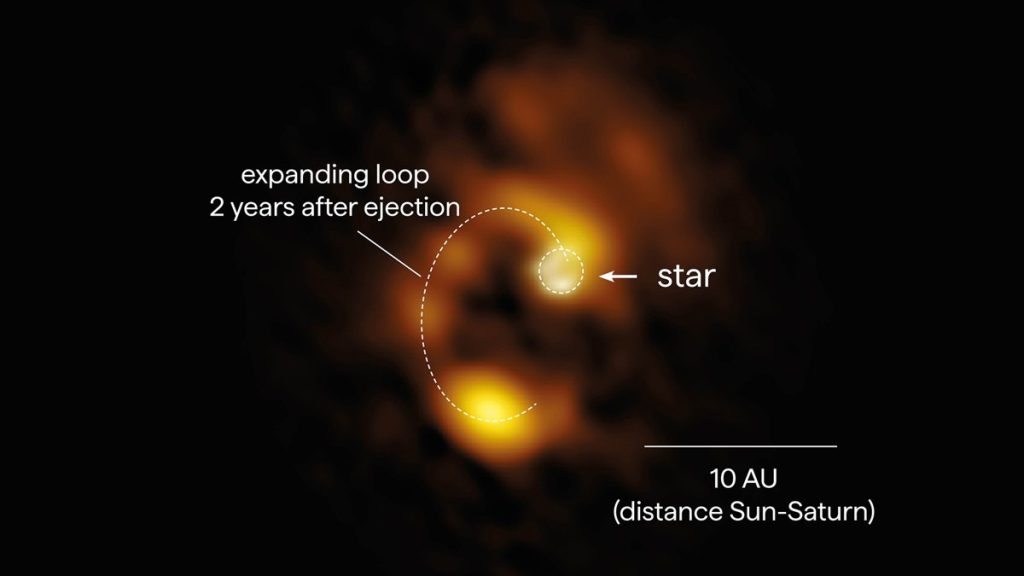
The loop around Mira two years after the ejection, with a scale bar of 10 AU, about the Sun-Saturn distance. Image: Chalmers / W. Vlemmings et al., ALMA (ESO/NAOJ/NRAO)
The record flare on Mira A
Mira A lies about 330 light-years away in the constellation Cetus. Its brightness rises and falls as the star pulsates. Across 19 observing sessions between 2017 and 2025, astronomers looked for changes within the stellar disk. Near the brightest part of several cycles, compact patches stood out against their surroundings. Some remained visible for weeks. Over longer intervals, the brightest regions changed position and intensity.
One patch appeared on the southwestern side of Mira in June 2023. Its radio brightness corresponded to a temperature more than 4,200 degrees above the surrounding surface. For the team at Chalmers University of Technology, the hotspot’s position provided a specific place to look for evidence of what the flare had done.
How far did Mira’s magnetic eruption reach?
In the 2025 ALMA image, Mira occupies a small, uneven patch near the center. The loop reaches about ten astronomical units from the star’s surface. In our solar system, that span would take an observer from the Sun to the vicinity of Saturn’s orbit. Seen at Mira’s distance, most stellar flares register as a brief change in brightness. Here, astronomers could pick out the shape of the gas itself.
The image also held clues to when the gas left Mira. From the motion of the material, the team inferred a launch speed of about 35 kilometers per second. They then calculated how long the gas would take to reach its observed position as Mira’s gravity slowed it down. That placed the likely departure between mid-2023 and early 2024.
The June hotspot appeared near the inferred starting point. Its position and timing therefore make it a plausible source for the loop. Even so, the observations leave some room around the launch date because ALMA caught separate stages of the event. Between those snapshots, the gas had traveled about 1.5 billion kilometers.
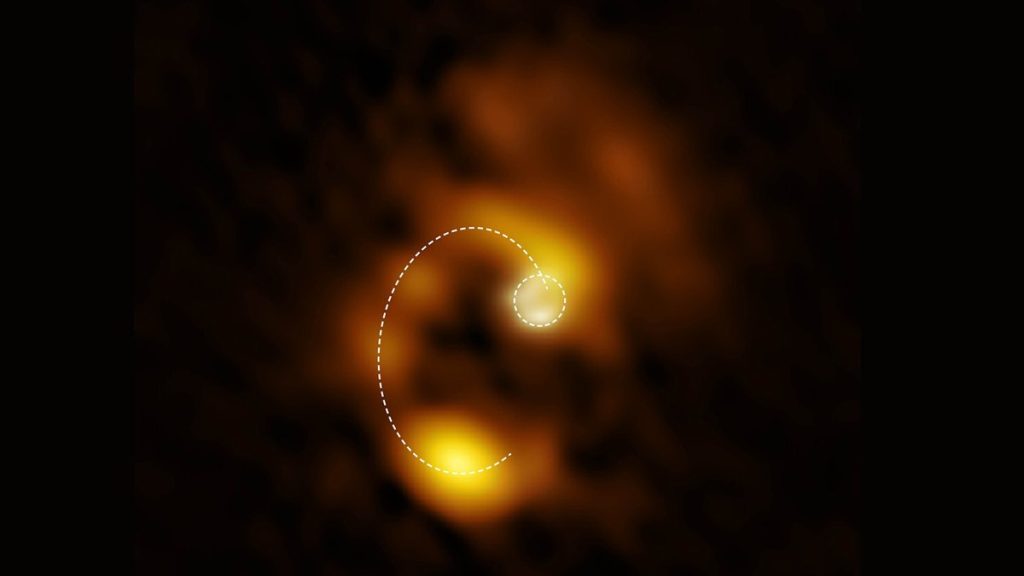
The dotted line traces the loop that grew out of the 2023 flare on Mira’s surface. Image: Chalmers / W. Vlemmings et al., ALMA (ESO/NAOJ/NRAO)
A magnetic field shows up in the gas
Silicon monoxide molecules helped bring the loop into view. Under the right conditions, these molecules amplify radio waves at a particular frequency. They act as bright markers within the gas, allowing astronomers to trace an arc that would otherwise be difficult to see. The orientation of the radio waves, a property called polarization, also carries information about the magnetic field where the signal originates.
The location of the brightest radio signal surprised the team. At that distance from Mira, the surrounding gas should be too thin for silicon monoxide to shine so strongly. An outward-moving shock offers an explanation. As it sweeps up gas, it squeezes molecules into a denser layer. The direction of polarization follows the curve of the loop. That pattern suggests the magnetic field runs along the compressed edge, where the molecules produce their strongest signals.
Using the polarization measurements, the team inferred a field of at least 0.7 gauss. They then asked whether it held enough energy to account for the gas in motion. Their estimates put the magnetic energy and the energy of the moving gas on a similar scale. That makes a magnetic launch physically plausible, even against the pull of the giant star’s gravity.
How much of the gas can escape?
The researchers estimated that Mira’s magnetic eruption lifted at least a third of Earth’s mass in gas. Its fate depends partly on speed. From the loop’s shape and motion, the team calculated that about 30 percent of the expelled material could fall back toward Mira. Even within a single eruption, some gas can escape while slower material makes a return journey.
An earlier outflow offers a clue about dust
For decades, astronomers have explained red giant winds through the interaction of dust and starlight. Light pushes on grains in the star’s outer atmosphere. As the grains move outward, they carry gas along. Mira raises a question about the order of events. Could an eruption lift the gas first and give dust a place to form afterward?
An older outflow offers a way to test that idea. Astronomers traced two lobes of material around Mira to an episode in the early 2010s. Gas filled the lobes, while most of the visible dust lay along their edges. The distribution fits a sequence in which gas moves outward, encounters surrounding material and creates conditions favorable for dust to form.
The older observations lack the polarization measurements that revealed the magnetic field in the 2025 loop. Each episode therefore contributes a different piece of evidence. One shows where dust collected after an outflow. The other shows that a magnetic field can carry enough energy to help launch one. Models of Mira’s wind now have to account for both processes.
What Mira sends back into the galaxy
Mira’s magnetic eruption gives astronomers a way to study how aging stars return material to the Milky Way. Gas that escapes can eventually mix with clouds that supply future stars and planets. The amount that makes that journey depends on how much each eruption lifts, how often eruptions occur and how much gas the star pulls back.
Mira already offers a starting point for answering those questions. Bright patches recur across several pulsation cycles, and astronomers now have one case with a likely surface origin and a measurable outflow. Following another hotspot from its first appearance could show whether this record flare was exceptional in brightness alone, or also in how much of the star it carried away.
Main sources
Chalmers University of Technology — https://www.chalmers.se/en/current/news/fa-star-s-record-eruption-shows-how-key-elements-can-spread-through-space/
ALMA Observatory — https://www.almaobservatory.org/en/audiences/mira-lives-up-to-its-name/
Magnetic eruption study — https://arxiv.org/abs/2608.23695
Surface hotspot study — https://arxiv.org/abs/2608.23724
Earlier outflow study, Astronomy & Astrophysics — https://doi.org/10.1051/0004-6361/202557159
You Might Also Like:
Black Hole Magnetic Eruptions Reveal a Solar Connection
G1 Geomagnetic Storm: Aurora Chances Rise November 17–18
Sun’s Magnetic Field Revealed in 3D Without a New Telescope