
BY:SpaceEyeNews.
Bennu samples are offering a fresh look at how the Solar System assembled its earliest building materials. Their chemical fingerprints suggest a mixture of dust from different regions around the young Sun. Researchers now propose that Jupiter helped shape this mixture as the giant planet grew.
The findings connect Bennu with asteroid Ryugu and a rare family of meteorites. They also point toward a possible birthplace near the boundary where water could freeze. Together, these clues offer a clearer picture of how ancient dust became the ingredients of larger worlds.
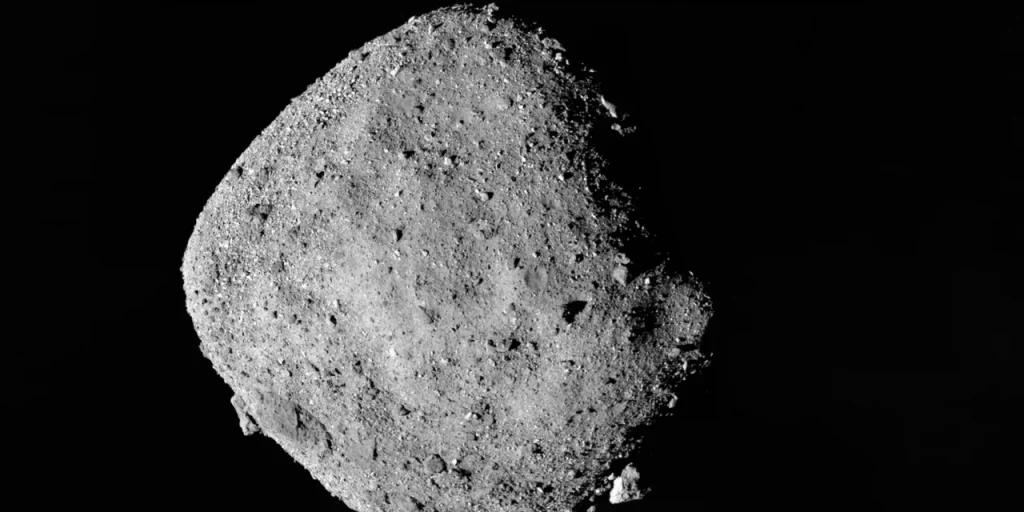
Bennu Samples Reveal Clues to the Asteroid’s Origins.
What Bennu Samples Reveal About Ancient Dust
A chemical fingerprint with a story
Researchers at ETH Zurich examined isotopes of iron, titanium, and chromium in material returned by NASA’s OSIRIS-REx mission. Their study appeared in Science Advances.
These measurements provide chemical fingerprints that researchers can compare across different objects. Here, the goal was to trace the source material behind Bennu’s formation.
Iron and titanium isotope measurements showed a consistent pattern across the analyzed material. That consistency suggests thorough mixing of the dust that supplied Bennu’s parent body.
Chromium showed small variations, which the researchers associate with alteration involving water inside that earlier body. This distinction matters: ancient material can preserve its origins while also recording later changes. www.research-collection.ethz.ch
A small sample with lasting value
OSIRIS-REx delivered its sample capsule to Utah on September 24, 2023. Laboratory access allows scientists to investigate details that spacecraft observations alone cannot resolve.
Rather than simply identifying familiar minerals, this research compares subtle differences in their atomic makeup. Those differences help reconstruct relationships across the early Solar System.
Bennu and Ryugu Share a Chemical Connection
Bennu’s isotopic pattern closely resembles material from Ryugu and CI carbonaceous chondrites, a rare meteorite group.
The connection suggests that their parent bodies gathered ingredients from a common reservoir of cosmic dust. However, it does not establish that Bennu and Ryugu came from one original asteroid.
Instead, the results link their source materials. Different bodies could have accumulated similar dust within the same broader environment.
This makes the discovery relevant beyond Bennu. Researchers can use the comparison to investigate how an entire family of primitive objects formed.
Their shared chemistry also poses a question: what process produced such similar material across these separate bodies?
A Possible Birthplace Near the Water-Ice Line
Where materials could meet
The researchers propose a formation region near the young Solar System’s water-ice line, inside the growing Jupiter’s orbit.
At this boundary, temperatures allowed water vapor to freeze. Conditions there could bring together dust with different origins while ice helped particles stick together.
According to the proposed scenario, the mixture included material associated with both the inner and outer Solar System.
That combination challenges a simple picture in which Bennu’s ingredients came exclusively from a distant, isolated outer region. Its chemistry instead points toward exchange between different parts of the developing planetary system.
Tracing the parent body
The distinction between Bennu and its ancient parent body is essential. The research concerns the early assembly of source material, rather than the formation of Bennu’s present shape.
Its ingredients preserve a history reaching back roughly 4.5 billion years. Yet that does not mean today’s asteroid remained intact and unchanged throughout that time.
Scientists therefore interpret the samples as records of several stages, including dust accumulation and later water-related alteration.
How Jupiter May Have Filtered Cosmic Dust
Larger particles faced a barrier
Jupiter provides a possible explanation for how this unusual mixture developed.
As the planet grew, its influence changed how material moved through the surrounding disk. The researchers suggest that this process restricted the inward drift of larger particles.
In that sense, Jupiter acted as a selective filter. It affected which ingredients could continue traveling toward regions closer to the Sun.
Fine dust could keep mixing
Smaller particles behaved differently. Fine dust could remain mobile and mix more efficiently, helping create a comparatively uniform reservoir.
The proposed process offers a connection between Jupiter’s growth and the chemical similarities among Bennu, Ryugu, and CI meteorites.
It may also explain why these materials preserve an elemental mixture broadly resembling the Sun’s. Efficient mixing could produce a representative blend of the disk’s fine dust.
However, scientists did not directly observe this ancient sequence. The isotope measurements support the scenario, while Jupiter’s exact role remains an interpretation that further evidence can test. ethz.ch
What Bennu Samples Mean for Earth’s Origins
Bennu’s value extends beyond locating an asteroid’s birthplace. Its material helps researchers investigate the ingredients available while rocky planets were taking shape.
The comparison with the Sun concerns broad chemical composition. It does not mean asteroid rock has the same physical properties as solar material.
Water-bearing minerals and carbon-rich compounds add another dimension. They help scientists explore where potentially important ingredients existed before Earth developed its familiar environment.
Nevertheless, this study does not establish that Bennu delivered Earth’s water. Nor does it explain how life began.
Its contribution is more specific: it helps trace how ancient materials mixed, moved, and accumulated. Understanding those processes can improve models of planetary composition.
What Researchers Still Need to Test
Further sample comparisons could reveal whether other asteroids share this distinctive fingerprint. Scientists also need to examine how effectively Jupiter could separate particles of different sizes.
Each comparison offers a chance to strengthen or revise the proposed history. A successful explanation must account for chemistry, minerals, and evidence of later alteration together.
Bennu Samples Open a Window Into Planet Formation
Bennu samples preserve evidence of a Solar System still organizing its ingredients. Their chemical links support a shared dust reservoir, while Jupiter offers a plausible mechanism for shaping it.
The emerging picture connects tiny grains with planetary growth. Continued analysis will help determine how closely that picture matches the history recorded inside these ancient rocks.
Main sources:
- ETH Zurich — Mystery surrounding the formation of asteroid Bennu solved
- Science Advances — Nucleosynthetic constraints on the origin of Bennu and CI-like asteroids
- NASA — OSIRIS-REx mission
- NASA — Bennu asteroid sample contains carbon and water
You Might Also Like:
Bennu samples reveal clues to a fire-and-ice origin
Laboratory-Made Cosmic Dust Reveals Life’s Chemical Origins
Sugar Found in Interstellar Space Reveals Chemistry Before Stars