
BY:SpaceEyeNews.
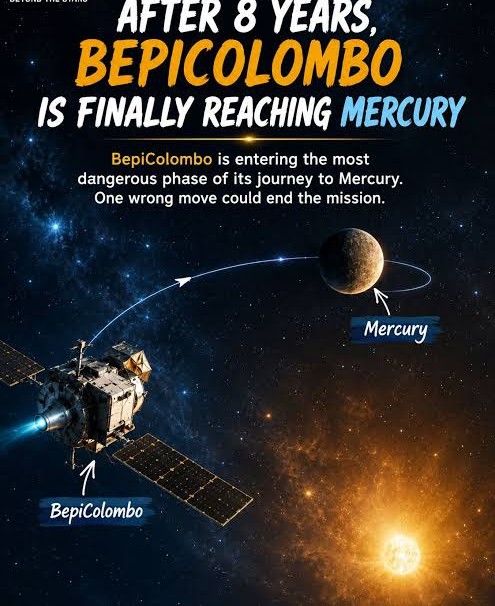
The last time BepiColombo swept past Mercury, its cameras could pick out individual craters, yet orbit was still almost two years away. On November 21, 2026, the European and Japanese space agencies have a different encounter on their schedule. Four thrusters must slow the two spacecraft enough for Mercury’s gravity to keep them close. The prospect of BepiColombo at Mercury brings an old question from NASA’s MESSENGER mission back into focus. When a spacecraft detects a change in the planet’s magnetic field, how much of that change comes from Mercury itself?
The 165-kilometer flyby that changed the route
When BepiColombo left Earth in October 2018, it carried Earth’s motion around the Sun with it. Falling inward gave the spacecraft plenty of speed. The difficulty lay in arriving alongside Mercury slowly enough to stay. Mission planners chose a route with nine planetary encounters. One pass by Earth, two by Venus and six by Mercury gradually reshaped the spacecraft’s path around the Sun.
In April 2024, the transfer module developed a power problem. Its electric thrusters could still run, but they could no longer deliver the thrust the original route required. Engineers traded time for a workable path. They moved the planned arrival from December 2025 to November 2026 and adjusted the fourth Mercury flyby.
On September 4, 2024, BepiColombo skimmed roughly 165 kilometers above the surface. Its monitoring cameras caught the first clear views the mission had obtained of Mercury’s south pole. For the navigation team, the important result lay in the trajectory. Mercury’s gravity helped bring the spacecraft’s year around the Sun close to the planet’s own 88 days.
Two encounters remained. During the last one, in January 2025, the spacecraft passed just 295 kilometers above Mercury. That close view illustrates how little altitude alone says about arrival. A spacecraft can photograph individual craters on the ground in detail and still have enough speed to head back into orbit around the Sun.
BepiColombo at Mercury begins with a joint orbit
On September 3, 2026, the transfer module separated after nearly eight years of service. ESA’s Mercury Planetary Orbiter took over steering with Japan’s Mio still riding on top. Later that month, controllers tested the four thrusters that would guide both spacecraft through the November maneuver.
ESA’s flight plan calls for the pair to approach on Mercury’s night side and brake near the south pole. The target orbit ranges from about 590 kilometers above the surface to 11,640 kilometers at its farthest point. Both spacecraft would travel that same long loop at first. Only after separation can each take up the position its instruments need.
NASA’s MESSENGER became the first spacecraft to orbit Mercury in 2011. Its measurements revealed a striking feature that gives the new mission a starting point. Mercury has a global magnetic field, and its magnetic center lies north of the geographic equator. Understanding that offset requires scientists to disentangle signals that overlap in every reading.
What two Mercury orbiters can see at once
Consider a spacecraft crossing the boundary where Mercury’s magnetic field meets the solar wind. Its instruments register a sudden change. Perhaps the spacecraft simply crossed into a different region. Equally, a shift in the solar wind might have pushed the boundary past the spacecraft. A single reading fits either explanation.
Mio will travel far enough from Mercury to sample conditions beyond that boundary during parts of its orbit. Meanwhile, the European orbiter will stay closer to the planet. When their positions line up favorably, scientists can compare what the solar wind does outside with what the European spacecraft records closer in.
Timing gives that comparison its value. Suppose Mio measures a change in the incoming flow and the inner spacecraft then records a magnetic disturbance. Researchers can check whether the timing and direction agree with a solar influence. Over many orbits, such comparisons should sharpen the picture of the field that Mercury generates deep inside.
Clues to Mercury’s core
Mercury’s unusually large iron core poses a related puzzle. How did so much metal end up inside such a small rocky planet? Some of the best clues lie within reach of instruments looking down at the surface. MESSENGER found potassium and sulfur there. Both can escape at high temperatures, yet Mercury retained surprising quantities. Any account of the planet’s early history must explain how it kept those elements.
The European orbiter carries an instrument called MIXS, short for Mercury Imaging X-ray Spectrometer. When solar X-rays strike the ground, atoms in the surface material emit X-rays at energies characteristic of particular elements. MIXS can use those energies to map how the chemistry varies across the landscape. Two plains that look alike in sunlight may have different compositions.
With the X-ray map, researchers can lay a chemical boundary over a camera image and see where the two coincide. A change in composition along the edge of a lava plain, for example, could help them trace the extent of an ancient eruption.
Gravity measurements offer an independent check. Scientists can track small changes in the orbiter’s motion as it passes over different regions. Those changes reveal how Mercury distributes mass beneath its surface. A model of the planet’s origins must therefore fit two kinds of evidence: the rocks visible today and the material hidden below them.
When the orbiters separate
ESA schedules Mio’s release for December 9–10, 2026. The Japanese spacecraft will keep its elongated orbit. Its European partner will discard Mio’s sunshield and use a series of thruster firings to descend. ESA expects it to reach its science orbit in March 2027, ahead of routine observations scheduled for April 6.
For researchers awaiting BepiColombo at Mercury, the decisive moment may come on an otherwise ordinary pass. Mio could register a shift in the solar wind while its companion measures the response below. After eight years of keeping two spacecraft together, the mission’s most revealing evidence may come from the distance between them.
Main sources:
- ESA — BepiColombo’s arrival updates
- ESA — Why engineers changed the fourth Mercury flyby
- ESA — How BepiColombo enters orbit around Mercury
- JAXA — Mio and the science of observing Mercury from two orbits
- NASA — What MESSENGER found in Mercury’s surface chemistry
- ESA — BepiColombo mission and instrument factsheet
- IFLScience — Original coverage of BepiColombo’s arrival
You Might Also Like:
BepiColombo Mercury Arrival Enters Its Final Phase
BELA Laser Awakens to Map Mercury in 3D
Mercury’s Volcanic History Reveals a Hotter Interior