
BY:SpaceEyeNews.
“Black hole inside black hole” sounds like a description of one object swallowing another. Black Saturn offers a stranger geometry. A spherical black hole sits in the open center of a ring-shaped black hole. The gap between them remains part of the outside universe. In a November 2026 preprint, physicist Jay Armas traced how the two horizons influence each other across that gap. His five-dimensional solution leads to a puzzle at absolute zero. Both horizons can reach the same temperature, yet their rotations still fall out of step.
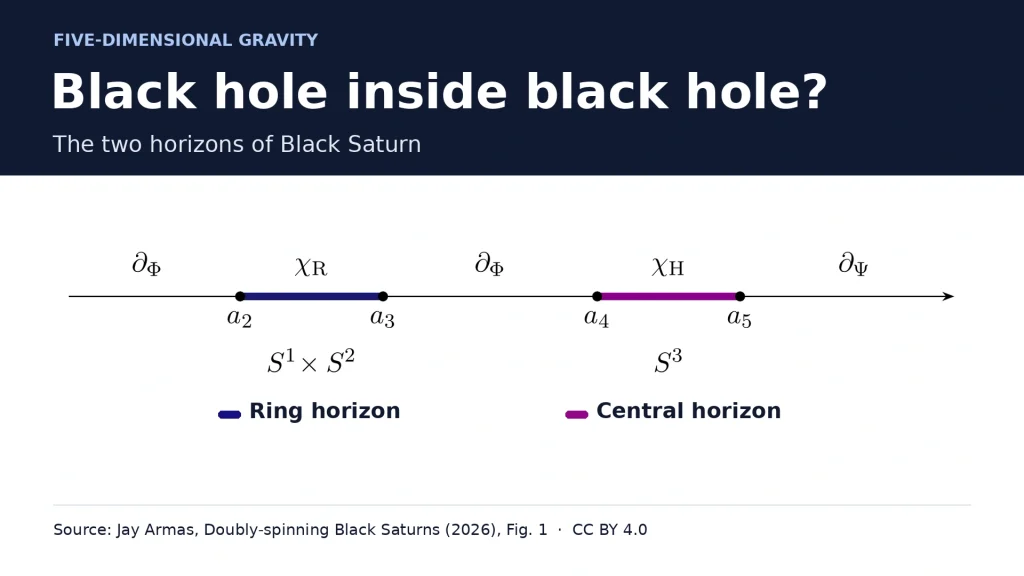
The two colored segments identify distinct horizons in the Black Saturn model. Figure 1 from Jay Armas’s Doubly-spinning Black Saturns (2026), adapted for SpaceEyeNews with plain-language labels.
What does “black hole inside black hole” mean?
The name borrows its silhouette from Saturn. Picture the planet at the center, then exchange its many bands of ice and rock for a single black ring. The ring itself has an event horizon that follows its curved shape. The central black hole occupies the opening, in the space outside that horizon. An observer in the gap could face the central horizon, then turn around and face the ring’s inner edge. Light from the gap can, in principle, travel outward without crossing either horizon.
Henriette Elvang and Pau Figueras first described this arrangement in 2007. Rotation helped the ring maintain its shape against its own gravity. Their calculations even allowed the two components to turn in opposite directions. In one striking case, their angular momenta canceled exactly. A distant observer measuring the system’s total spin would get zero, even though both components turned.
Two spins in the Black Saturn model
What did the 2007 solution leave out? Its black holes could reverse their direction of rotation, but they shared just one plane of rotation. A clockwise turn and a counterclockwise turn both trace circles on the same page. Reversing the arrow around a circle gives no hint of the extra freedom Armas wanted to explore.
That freedom comes from adding one spatial dimension to the familiar three, while keeping one dimension of time. A circle on a page uses two spatial directions. In four spatial dimensions, a second circle can use the remaining two. The geometry allows rotation in both planes at once, with a separate rate for each. Armas gave that freedom to both the ring and the central black hole.
The extra spin also provided a check on the calculation. By removing the central object from the equations, Armas recovered a known solution for a ring spinning in two planes. Removing the ring instead left the familiar five-dimensional solution for a single rotating black hole.
How the outer ring turns the inner horizon
Consider a central black hole with zero angular momentum of its own in one plane. How fast does its horizon turn in that plane? Zero sounds like a reasonable answer until the surrounding ring enters the calculation. As the ring rotates, it drags nearby spacetime along. Even across the gap, the ring can set the central horizon turning in a plane where the hole carries no spin of its own.
Physicists call this effect frame dragging. It draws a distinction between two quantities we often treat as interchangeable. One describes how much angular momentum belongs to the central object. The other describes how fast its horizon turns relative to a distant observer. In a Black Saturn, the neighbor helps determine the second quantity. That distinction matters when asking whether the two horizons rotate in step.
Can both horizons survive at absolute zero?
Each horizon has a Hawking temperature. Physicists can calculate it from a property of the horizon called surface gravity. When that quantity falls to zero, the corresponding temperature does too. A black hole at this limit is extremal. Rotation makes the limit especially interesting here because both horizons must keep a finite area as their temperatures fall to zero.
Earlier calculations had pointed toward such a pair by treating the outer ring as very thin compared with its radius. The approximation gave physicists a reason to expect a doubly extremal Black Saturn. An exact solution could answer a harder question. Would both horizons survive when the calculation accounted for the full geometry between them?
Armas found configurations in which they do. Both horizons retain finite areas, and a gap still separates them at zero temperature. The result describes a limit among possible configurations. It gives no cooling time or sequence of events that would bring an astronomical object there.
The space outside the ring matters as much as the gap within it. The equations describe a vacuum around the pair, and spacetime approaches flatness far from both objects. Within those conditions, Armas identifies the first exact example with two separate extremal horizons. The shared temperature belongs to those horizons. A thermometer somewhere in the gap would answer a different question about its local surroundings.
Why the rotations cannot match
To check for full thermodynamic equilibrium, start with three comparisons. Do the two temperatures match? Do the horizons turn at the same rate in the first plane? And do their rates also match in the second? At temperatures above zero, some configurations pass all three tests.
At absolute zero, the first match comes automatically. The difficulty lies in satisfying the remaining two conditions while preserving a regular ring and central horizon. Armas showed that the rotation rates cannot match in both planes under those conditions. Both objects can therefore share the lowest possible temperature while retaining a measurable difference in how their horizons turn.
Would a Black Saturn keep its shape?
A stationary solution leaves open what happens after a disturbance. In separate work, a University of Cambridge team and its collaborators simulated an isolated, thin black ring. Small variations grew into bulges around its circumference. The central black hole and second spin in Armas’s solution change the problem, so that simulation leaves the fate of this particular pair open.
No telescope has identified a Black Saturn. For now, the “black hole inside black hole” idea gives physicists a precise question to test. If a small disturbance changes the shape of the outer ring, does the central horizon help it recover, or does the distortion grow? The new solution gives them a starting geometry for that calculation.
Main sources
Jay Armas, Doubly-spinning Black Saturns (2026 preprint)
https://arxiv.org/abs/2611.20701
Henriette Elvang and Pau Figueras, Black Saturn (2007)
https://arxiv.org/abs/hep-th/0701035
University of Cambridge, Five-dimensional black hole could ‘break’ general relativity (2016)
https://www.cam.ac.uk/research/news/five-dimensional-black-hole-could-break-general-relativity
You Might Also Like:
Black Holes Inside Stars: A 40-Ton Possibility
NGC 1850 BH1: A Spinning Star Exposes a Black Hole Impostor
Three Black Holes Reveal an Early Galaxy’s Growth Secrets