
BY:SpaceEyeNews.
NGC 1850 BH1 once seemed to hide a black hole. Now, new observations reveal a rapidly spinning star where astronomers expected an unseen compact companion. The system sits in the Large Magellanic Cloud, inside a crowded stellar cluster.
The surprise goes beyond correcting a label. Two interacting stars can create a convincing black hole disguise, especially when their history changes their brightness and mass. By separating their blended light, researchers have uncovered evidence of that history. Yet one important mismatch remains, giving this discovery a second mystery.
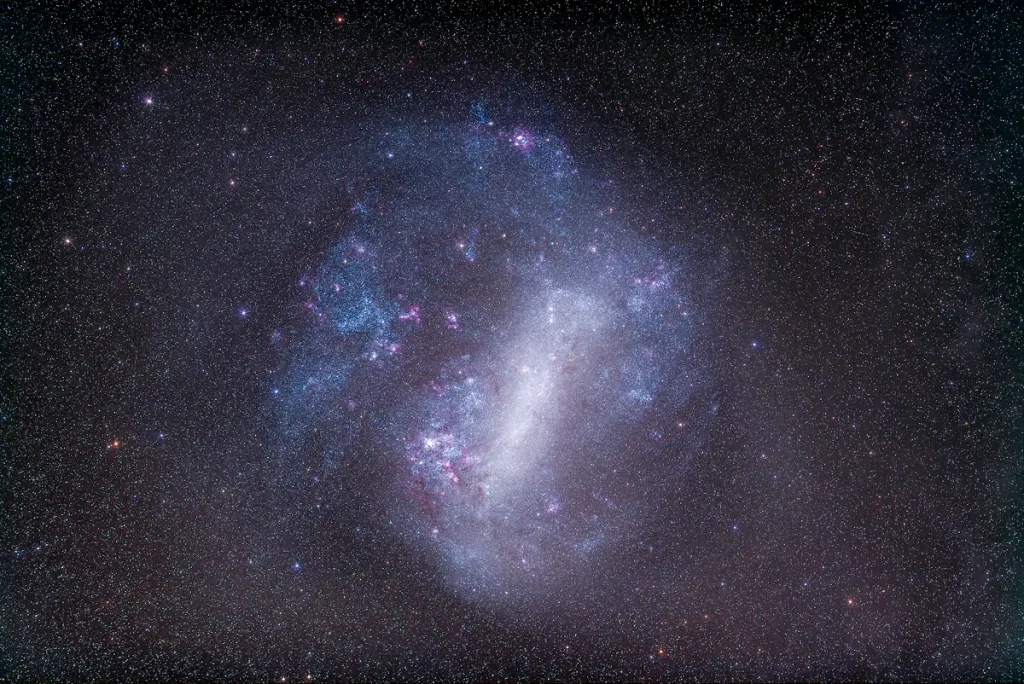
Depth of Detail in the Large Magellanic Cloud.
Why NGC 1850 BH1 Looked Like a Black Hole
The clue in a moving star
Astronomers first announced the suspected discovery in November 2021. The original research appeared in a 2022 journal volume. Using the European Southern Observatory’s Very Large Telescope, they tracked a star whose motion suggested a substantial companion.
Their initial model paired a visible star of roughly five solar masses with an unseen object of around eleven solar masses. A normal star that massive should have contributed conspicuous light. Its apparent absence therefore supported the black hole interpretation.
The setting made the discovery especially interesting. NGC 1850 lies roughly 160,000 light-years away, and its main cluster population is approximately 100 million years old. Finding a quiet black hole there promised insight into young stellar remnants.
A convincing explanation with a vulnerable assumption
However, the argument depended partly on correctly estimating the visible star’s mass. Brightness alone cannot reliably settle that question after two stars exchange material.
A star that loses much of its outer envelope can remain swollen and unusually luminous for its reduced mass. Treating it as an ordinary star can distort estimates for both members of the system.
The Earlier Challenge to the Black Hole Claim
Other researchers soon proposed exactly that alternative. Perhaps the visible object was a stripped star, while a luminous companion hid within the combined spectrum.
That possibility changed the interpretation of the system’s motion. A lower donor mass could allow a less massive companion, weakening the original argument for a black hole.
However, earlier observations did not clearly reveal a second stellar spectrum. A 2023 reassessment supported a stripped donor but left the companion’s identity unresolved.
The debate therefore concerned more than whether astronomers had missed some light. Researchers needed to distinguish between competing explanations that could reproduce important features of the same observations. The decisive advance would require a clearer view of the companion itself.
New Spectra Reveal the Hidden Star
Separating overlapping stellar signatures
The new investigation used FLAMES-ARGUS observations from the Very Large Telescope. These spectra offered higher resolution and reached bluer wavelengths than the original MUSE data.
That combination matters because different wavelengths can expose stellar features that remain difficult to recognize elsewhere. Researchers applied spectral disentangling to recover the individual signatures within the blended light.
The analysis revealed two luminous components. One is comparatively cool and swollen. Its companion is hotter, more massive, and rapidly rotating.
The team concludes that this stellar companion rules out the proposed black hole interpretation. Importantly, no black hole physically changed into a star. Better evidence changed the identification.
What the rotation measurement means
The companion’s projected rotation speed is approximately 275–280 kilometers per second. This describes its spin as measured from our viewing angle, rather than its orbital speed.
Rapid rotation broadens stellar absorption lines. Those wider features can become harder to distinguish in overlapping spectra, helping explain why identifying the companion required better observations and careful analysis.
How Mass Transfer Reshaped NGC 1850 BH1
The revised model gives the swollen donor an estimated mass of 1.7 solar masses, with an uncertainty of 0.4. Its companion has an estimated mass of 5.2 solar masses, with a larger uncertainty of 2.6.
Those uncertainties matter. The new measurements describe a plausible, consistent system, but they do not establish every property with equal precision.
Previous mass transfer offers the most straightforward explanation for this unusual pairing. In that scenario, one star expanded and passed material to its neighbor.
The receiving star gained both mass and angular momentum, which increased its rotation. Meanwhile, the donor lost substantial material but retained a swollen appearance.
Consequently, the star that now has less mass could once have been the heavier partner. Their present appearance preserves clues to an earlier exchange, rather than a simple history of independent evolution.
This distinction explains why the original interpretation proved vulnerable. Stellar brightness, current mass, and evolutionary history do not always follow the relationships expected for isolated stars.
The Light Discrepancy Researchers Still Cannot Explain
One unresolved detail prevents the story from ending with a completely settled model.
Earlier work limited the companion’s contribution to less than 10% of the light in a particular wavelength range. The new analysis implies approximately 30–50% in that same range.
This mismatch does not erase the recovered stellar signature. However, it shows that the available observations and models still need reconciliation.
The stars’ precise mass ratio also remains uncertain. Better measurements could sharpen the reconstruction of their interaction and clarify how much material changed hands.
What better observations could resolve
Follow-up spectroscopy faces practical obstacles. The system is relatively faint, and nearby stars crowd the field.
The researchers identify several possible routes forward, including Hubble spectroscopy and suitable instruments on large ground-based telescopes. These are observational options, rather than confirmed scheduled campaigns.
Sharper spectra could improve the mass estimates and help explain the conflicting light measurements. They would also strengthen tests of how binary stars exchange material.
The lesson also reaches beyond this individual system. Searches for quiet black holes depend on interpreting indirect clues accurately. Interacting stars can complicate that process because their appearance reflects earlier exchanges of material. Recognizing these impostors helps researchers evaluate future candidates more carefully. It also prevents unusual stellar systems from disappearing behind an incorrect classification. Each corrected identification can improve both the search methods and our understanding of stellar evolution.
Why This Stellar Impostor Still Matters
NGC 1850 BH1 now offers a different scientific opportunity. Its cluster provides useful constraints on age, composition, and distance, making the system valuable for testing stellar interaction models.
The latest study appeared as an October 2026 preprint, listed as submitted to the Open Journal of Astrophysics. Its conclusions should retain that publication context.
For astronomers, NGC 1850 BH1 illustrates how improved evidence can overturn an attractive explanation while opening a better research question. The focus now shifts from a hidden black hole to the shared history of two unusual stars.
Main sources:
European Southern Observatory — Original discovery announcement:
https://www.eso.org/public/news/eso2116/
Liverpool John Moores University — Original institutional coverage:
https://www.ljmu.ac.uk/about-us/news/articles/2021/11/11/stars-odd-behaviour-gives-up-hidden-black-holes
Seeburger and colleagues — Revealing the companion of NGC 1850-BH1, October 2026 preprint:
https://arxiv.org/abs/2610.37262
Saracino and colleagues — Updated radial velocities and new constraints, 2023:
https://arxiv.org/abs/2303.07369
You Might Also Like:
Early Black Hole Pairs: New Limits on Cosmic Giants
Black Hole Magnetic Eruptions Reveal a Solar Connection
Wandering Black Hole Revealed by a Star’s Final Glow