
BY:SpaceEyeNews.
The Euclid cosmic map has reached a remarkable milestone: a data release containing more than 900 million galaxies. Across this enormous collection, astronomers can search for patterns that individual images could never reveal. Those patterns could sharpen our understanding of dark matter, dark energy, and the growth of cosmic structure.
On November 12, 2026, the European Space Agency and the Euclid Consortium released DR1 Foundation. It opens a major new stage in the mission. The challenge now is turning this extraordinary volume of observations into reliable measurements of the Universe.
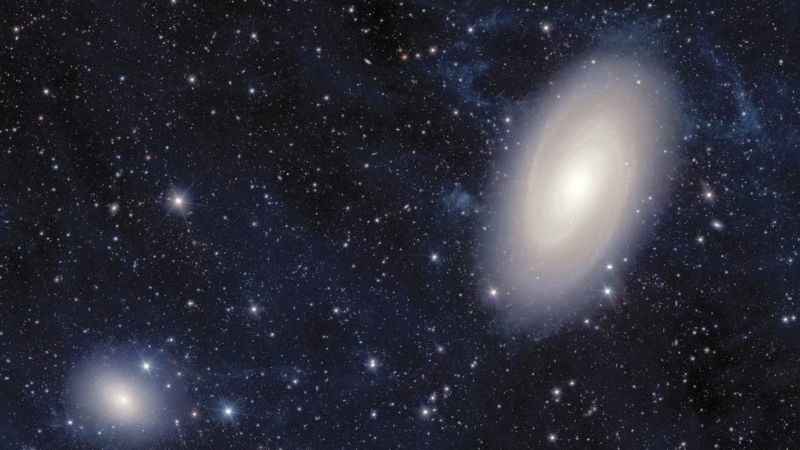
The core of the M81 group, showing NGC 3077 and Messier 81. Source: Leiden University.
What the Euclid cosmic map contains
DR1 Foundation brings together roughly 13 months of observations. Its wide survey covers 1,900 square degrees, an area equivalent to approximately 9,500 full Moons. The complete release amounts to 1.7 petabytes, or 1.7 million gigabytes, of information.
Alongside the galaxies, researchers have identified more than 60 million quasar candidates. That distinction matters: candidates require further assessment before scientists can treat every entry as a confirmed quasar.
The release also includes spectra from more than 160 million sources. These measurements add information that photographs alone cannot provide, helping researchers investigate distances and physical properties.
A foundation, not a finished atlas
Despite its scale, this release covers about 14% of Euclid’s planned survey area. That figure does not mean 14% of the entire sky.
Nor does the announcement mark the completion of a precise three-dimensional map of every detected galaxy. Instead, researchers now have a substantial collection of observations from which to build that deeper picture.
Turning galaxy images into cosmic structure
A beautiful panorama shows where objects appear in the sky. Understanding their relationships also requires knowing how far away they lie. Two galaxies that appear close together may occupy very different depths.
Spectroscopy helps bridge that gap. By examining features in a galaxy’s light, astronomers can measure its redshift and estimate its distance within a cosmological model.
Euclid collects many spectra simultaneously. This approach allows researchers to investigate large populations instead of selecting every target individually. However, detection in an image does not automatically provide a precise spectroscopic distance.
Visible and near-infrared observations provide complementary information. Together, they let astronomers compare objects using more than a single view of their brightness. Spectra can also reveal clues about star formation and the conditions inside galaxies. Consequently, the same survey can support studies of individual galaxy populations alongside its broader cosmological goals.
Why depth changes the story
Adding distances helps reveal the cosmic web: the enormous arrangement of galaxies, clusters, and surrounding regions. Researchers can then compare structures across different periods of cosmic history.
The scientific value lies in those relationships. Where do galaxies gather? How does their clustering change over time? Which patterns match theoretical expectations?
The Euclid cosmic map will help scientists address these questions through measurements across a vast survey.
Cosmic lenses expose hidden mass
One striking result involves approximately 15,000 strong gravitational-lens candidates. These systems offer an additional way to investigate matter that does not reveal itself through emitted light.
A foreground galaxy can bend and magnify light from a more distant object. The resulting arcs, rings, or multiple images carry information about the foreground mass.
Researchers can model these distortions to estimate how mass spreads through a galaxy. That includes contributions from both visible material and dark matter.
The Euclid team combined artificial intelligence, citizen science, and expert checks to identify promising systems. Such a large sample also creates opportunities to study unusual configurations that smaller surveys might miss.
Strong lenses and subtle signals
These dramatic examples differ from weak gravitational lensing. Weak lensing produces much smaller distortions, which scientists analyse statistically across many galaxies.
Both approaches offer useful evidence. However, the spectacular lens candidates in this release should not be confused with completed weak-lensing cosmology results.
What the cosmic survey could reveal about dark energy
Euclid’s larger goal connects the distribution of matter with the history of cosmic expansion. Researchers want to understand how structures grew while the Universe expanded.
Dark matter influences that growth through gravity. Meanwhile, dark energy describes the component associated with accelerating expansion in the standard cosmological model. Its physical nature remains unresolved.
By studying galaxy clustering alongside lensing, scientists can compare different views of the same evolving Universe. One traces the positions of visible galaxies. The other helps reveal the distribution of mass along the paths their light travels.
Testing the predictions of gravity
These observations also create opportunities to test gravity across enormous distances. Researchers can ask whether the observed growth of structure agrees with predictions from existing models.
Agreement would strengthen those models within the precision of the measurements. A persistent mismatch could motivate closer investigation of assumptions, measurement effects, or alternative explanations.
For now, Euclid has not identified dark energy or demonstrated that current gravity theories fail. The release supplies evidence for future tests. Its importance comes from the scale and quality of those opportunities.
Why the next Euclid release matters
Large numbers alone cannot guarantee accurate cosmology. Researchers must also understand how instruments, image processing, and object selection affect their measurements.
For example, a small instrumental distortion could complicate measurements of subtle galaxy shapes. Teams therefore calibrate observations and check for systematic effects before drawing conclusions about the wider Universe.
This work explains why a major public dataset and definitive cosmological results do not necessarily arrive together. Scientific analysis requires more than detecting objects and counting them.
More measurements in mid-2027
The full DR1 release, expected in mid-2027, will build on the current foundation. It will add important products involving weak lensing and galaxy clusters.
Those additions should help connect the existing images and spectra with the mission’s central cosmological investigations. Researchers will gain further tools for examining how matter gathers and how cosmic structures evolve.
The schedule marks another stage of the programme. It does not promise a final answer to dark energy on a particular date.
Euclid cosmic map: The discoveries are only beginning
The Euclid cosmic map offers something more valuable than an impressive collection of distant galaxies. It creates a shared observational foundation for investigating how the Universe developed its present structure.
Much of the planned survey still lies ahead. Meanwhile, astronomers can already explore rare lenses, compare galaxy populations, and refine methods for the next release.
The central question remains open: how closely will this expanding cosmic picture match our expectations? Euclid’s contribution will emerge through careful measurements, tested explanations, and discoveries that turn an immense dataset into deeper understanding.
Main sources:
European Space Agency — Euclid mission overview: https://www.esa.int/Science_Exploration/Space_Science/Euclid
Euclid Consortium — DR1 Foundation press release: https://euclid-ec.net/dr1-f-press-release/
Caltech / Euclid — Euclid lays the foundation for its best-ever 3D map of the Universe: https://euclid.caltech.edu/news/euclid-lays-the-foundation-for-its-best-ever-3d-map-of-the-universe
Caltech / Euclid — Data release timeline: https://euclid.caltech.edu/page/data-release-timeline
You Might Also Like:
Euclid Quasar Discovery Reveals Earliest Known Quasars
Euclid Ancient Quasars Reveal Hidden Early Universe
Dark Energy Challenged: Is Cosmic Expansion Slowing?