
BY:SpaceEyeNews.
Euclid’s first comet gave itself away in a patch of sky full of distant galaxies. On September 17, 2026, the European Space Agency’s telescope took three images about 18 minutes apart. The galaxies held their positions. A faint streak shifted across the frame. It belonged to C/2026 S1 (Euclid), a previously unknown comet some 1.3 billion kilometers from Earth at the time of ESA’s announcement. One clue revealed its motion. Another, barely visible around the streak, helped astronomers identify what they had found.
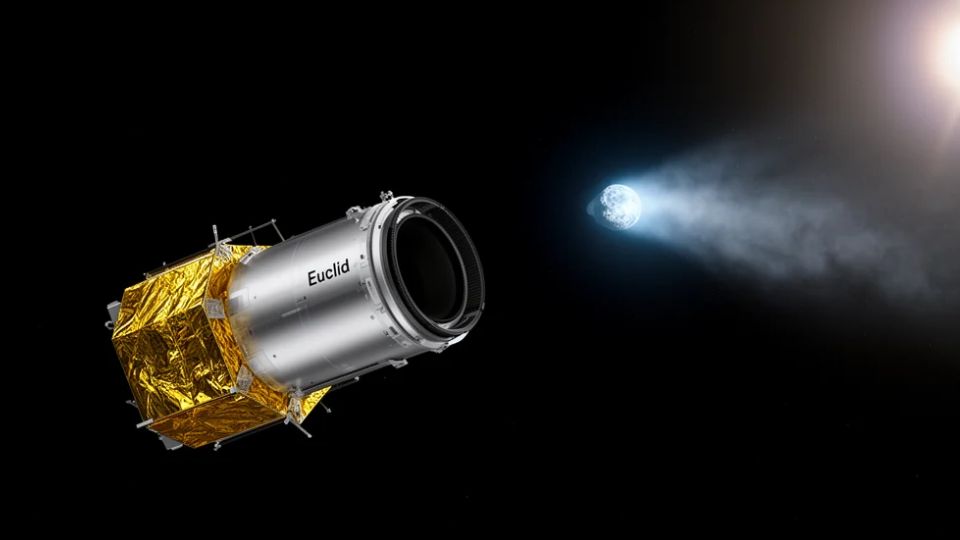
Euclid space telescope discovers its first previously unknown comet
Tracing Euclid’s first comet
The September 17 sequence shows the value of a long exposure. Euclid’s visible-light camera collected light for more than nine minutes per image. That gave faint galaxies time to register on the detector. It also gave the comet time to travel an appreciable distance across the image. The short line marks the path the object covered while the camera collected its light.
Mikko Pöntinen, a doctoral researcher at the University of Helsinki, had written software to find moving objects in Euclid’s survey. When the software flagged the streak, he used its motion to predict where else it should appear. The search took him across five fields of view in a survey region called Euclid Deep Field North. In all, the telescope caught the object in 16 exposures between September 16 and 24.
Eight shorter exposures reveal a cloud
A second view brings out a detail that the long streak makes harder to see. The team selected eight exposures of about 90 seconds each and aligned them on the moving comet. In each exposure, the comet traveled a shorter distance. Combining the images and removing background sources revealed a bright center surrounded by a diffuse cloud.
ESA’s wide image from September 20 gives a sense of how easily the discovery could escape notice. Stars and galaxies fill the frame. Even with the comet in view, it takes a magnified inset to pick out the light around the streak. The close-up shows what drew the team’s attention once the software had located the moving object.
That cloud, or coma, supplied the evidence of cometary activity. The moving streak alone could also have come from an asteroid. Next came a different question. Had anyone seen this object before? Pöntinen checked catalogs of known asteroids and comets and found no match. He sent the positions to the Minor Planet Center, which alerted observers on Earth. Ground telescopes followed up, and the center confirmed the discovery on October 8.
A comet far above the planets’ orbits
To picture where Euclid found the comet, start with the distance from the Sun to Saturn. ESA put the comet’s distance from Earth on a similar scale, somewhere between the Sun–Jupiter and Sun–Saturn distances. A conventional overhead map of the solar system, however, misses the most interesting part of its location.
Viewed from the Sun, the comet lay almost directly above the plane where the planets orbit. An edge-on view makes the geometry easier to see. The planets occupy a narrow band across the middle of the picture. Euclid’s comet would appear high above that band. This helps explain how a survey that deliberately avoids much of the solar system’s busiest sky encountered it at all.
The orbit also raises a question that a week of images cannot settle. How long does the comet take to circle the Sun? ESA described a journey spanning thousands of years. Astronomers can measure the comet’s position closely on any given night, yet each measurement samples only a tiny part of that journey. Observations farther apart in time give them a better basis for calculating its orbit.
Why Euclid looks for movement in galaxy images
For a telescope investigating dark matter and dark energy, a passing comet presents a practical problem. Euclid measures the shapes of distant galaxies. If a moving object leaves a trail across one, its light can interfere with that measurement. Finding those trails helps researchers decide which parts of an image they can use for galaxy science.
The survey plan makes a new comet discovery particularly unlikely. Dust near the plane of the solar system scatters sunlight, adding a foreground glow to deep exposures. Euclid generally looks away from that region. It also follows a preset sequence, pointing at one field, taking its exposures and moving on. Researchers cannot count on another look whenever an intriguing object appears.
This time, the comet crossed several fields just as Euclid was due to photograph them. The telescope had seen familiar comets before. The repeated sightings gave Pöntinen enough information to connect the images. Other observatories on the ground could then take up the search.
What Euclid’s first comet means for Comet Interceptor
Early notice matters to ESA’s Comet Interceptor mission. Its spacecraft will wait near a gravitational balance point about 1.5 million kilometers from Earth until the team selects a reachable target. The aim is to visit a long-period comet on its way into the inner solar system. During the flyby, three spacecraft will observe it from different directions at the same time.
ESA has ruled out C/2026 S1 as a destination. What the September observations offered was a chance to test the alert process on a real discovery. A space telescope picked up a distant object during a scheduled survey. Astronomers on the ground then knew where to point their instruments. For a future candidate, that handoff could give mission planners more time to assess a possible encounter.
Following C/2026 S1
Euclid’s first comet left a trail that lasted just over nine minutes in a single exposure. Astronomers could already see its position change by the start of the next image. Predicting its return takes a different kind of patience. A telescope observing C/2026 S1 months after those September sightings adds something that even the clearest discovery image cannot supply on its own. It places the comet at a later point on its long path around the Sun.
Main sources
Caltech, Euclid mission discovery announcement
https://euclid.caltech.edu/news/euclid-discovers-new-comet
ESA, September 17 image sequence
https://www.esa.int/media/comet-c-2026-s1-euclid-streaks-across-the-sky
ESA, the September 20 image in context
https://www.esa.int/media/comet-c-2026-s1-euclid-observations-in-context
ESA, composite image of the coma
https://www.esa.int/media/a-composite-of-eight-euclid-vis-exposures-of-comet-c-2026-s1-euclid
ESA, Comet Interceptor factsheet
https://www.esa.int/Science_Exploration/Space_Science/Comet_Interceptor/Comet_Interceptor_factsheet
ScienceDaily, original coverage
https://www.sciencedaily.com/releases/2026/11/261124055852.htm
You Might Also Like:
Euclid cosmic map: 900 Million Galaxies, Hidden Clues
Euclid Quasar Discovery Reveals Earliest Known Quasars
Euclid Ancient Quasars Reveal Hidden Early Universe