
BY:SpaceEyeNews.
The NASA Moon Base Challenge puts a practical question before students: how can astronauts live and work on the Moon reliably? With up to $1 million in awards available, the competition invites fresh ideas for the systems behind a lasting lunar presence.
Teams will tackle challenges ranging from electricity storage to astronaut safety. Their proposals must account for real operating constraints, rather than simply present an appealing vision. For readers following NASA’s lunar plans, the competition offers a useful window into the everyday engineering that future exploration will require.
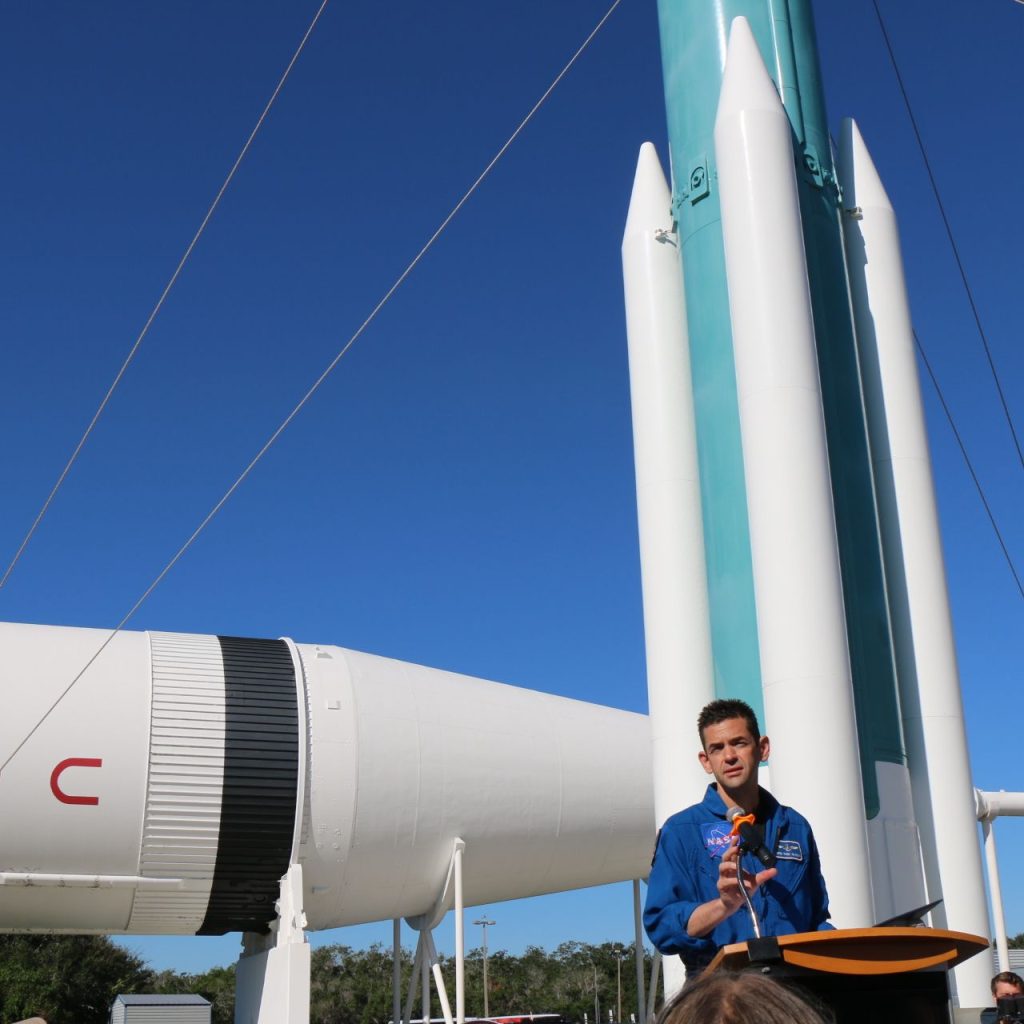
NASA Administrator Jared Isaacman unveils the Moon Base Student Challenge to a crowd gathered in the rocket garden at the KSC visitor center on Nov. 8, 2026. (Image credit: Chelsea Gohd)
What the NASA Moon Base Challenge Offers
NASA announced the competition on November 8, 2026, during an event at Kennedy Space Center Visitor Complex in Florida. It invites teams from U.S. high schools and post-secondary institutions to develop concepts for its planned Moon Base.
The headline figure covers up to $1 million in total monetary awards. Organizers will distribute prizes through finalist recognition, runner-up awards, and grand prizes across technical categories and student divisions.
That distinction matters. The money supports a competition for promising concepts; it does not represent the budget for constructing a lunar settlement.
Similarly, winning would recognize a proposal’s quality without guaranteeing its use on a mission. The published competition information makes no promise that NASA will send successful designs to the Moon.
Six Priorities for Future Lunar Living
The challenge divides lunar operations into six technical categories. Each addresses a different need, although successful systems must ultimately work together.
Power Generation and Storage
Reliable electricity underpins almost every base activity. Teams can explore how to generate, store, and distribute energy while limiting equipment weight and complexity.
A useful concept must also account for interruptions. The competition’s power resources encourage students to consider essential loads, storage requirements, and failures. Producing electricity is only part of the problem; delivering it when needed matters equally.
Habitat Construction
Construction proposals address the facilities that future crews will need. The challenge includes interest in using lunar materials, which could reduce dependence on imported building supplies.
However, local resources introduce their own engineering questions. A proposed building method must account for processing equipment, energy demand, and deployment. Students need to explain the process behind the structure, not just its appearance.
Life-Support Systems
Life support concerns the systems that sustain astronauts inside their habitats. This category gives students room to explore more efficient ways to manage essential resources.
The practical focus is reliability with limited resupply. A concept’s value depends on how well it supports daily operations while keeping maintenance manageable.
Surface Mobility
Moving people and equipment requires designs suited to lunar conditions. Mobility proposals must balance useful capability with power consumption, equipment mass, and reliability.
For example, a transport concept could offer greater carrying capacity while demanding more energy. Explaining that trade-off would make the proposal more credible.
Communications Networks
Surface operations also need dependable connections. Students can examine networks that support coordination between crews, equipment, and facilities.
The rules discourage concepts that depend on constant communication with Earth. That requirement pushes teams to consider how their systems would continue operating with greater local independence.
Astronaut Safety
Safety proposals address the hazards surrounding lunar work. Radiation, abrasive dust, and extreme temperatures create demanding conditions for crews and equipment.
This category brings the human consequences of technical decisions into focus. A helpful concept should reduce operational risk without adding excessive complexity or workload.
Why Lunar Designs Must Survive Practical Scrutiny
The NASA Moon Base Challenge asks for compact, lightweight, energy-efficient solutions. Its rules also emphasize high reliability and minimal demands on crew time.
These requirements force students to weigh competing benefits. Consider a hypothetical construction machine that uses local material but consumes substantial electricity. It might reduce imported supplies while increasing the base’s power needs.
Likewise, a complicated mechanism could perform well in principle yet require too much maintenance. A simpler design might offer greater practical value.
The rules favor concepts suited to autonomous or robotic operation. They also exclude approaches that rely on continuous human supervision or unsuitable Earth-based infrastructure.
The larger lesson is clear: a promising lunar technology must fit into an operating system. Its demands on energy, transport, maintenance, and people matter alongside its individual performance.
How the Student Competition Works
Project Phase: Explain the Concept
Teams begin by selecting one technical category. They then prepare a Concept Overview Paper explaining their proposed solution.
The submission includes a visual diagram and an account of how the design handles lunar conditions. Participants can also attend webinars with NASA experts as they develop their ideas.
Organizers can select up to 100 finalist teams across all categories and divisions. Those teams receive monetary awards and advance to the next stage.
Final Phase: Present the Case
Finalists refine their concepts and prepare a recorded pitch video with a presentation slide deck. They explain how the system operates, how crews or robots would deploy it, and which technical problems they addressed.
This process rewards clear communication as well as creative thinking. A strong presentation must connect the proposed benefit with a convincing explanation of how the design works.
Who Can Enter and When
NASA encourages students from technical, vocational, and varied academic backgrounds to participate. Previous specialized engineering experience is not required.
Teams must register through NASA STEM Gateway by January 25, 2027. The official schedule then lists February 22 as the deadline for concept papers.
Organizers plan to announce finalists on March 11. Final pitch videos and slides are due April 19, with the closing symposium and award announcements scheduled for May 6, 2027.
Interested participants should review the official eligibility rules before registering. Those requirements provide the details needed to form an eligible team and prepare a valid entry.
NASA Moon Base Challenge: Value Beyond the Awards
The NASA Moon Base Challenge connects student creativity with the practical demands of sustained lunar exploration. Its strongest contribution could come from ideas that make future systems easier to operate, maintain, or integrate.
NASA also intends the competition to develop skills for the future aerospace workforce. That educational purpose gives the initiative value beyond individual prizes.
Participants practice comparing options, explaining assumptions, and presenting technical decisions. Those habits can help them contribute to larger projects, even when their original concept never reaches the lunar surface.
For the agency’s wider ambitions, lunar operations provide experience relevant to future crewed Mars missions. This competition contributes at an earlier stage: helping students turn ambitious ideas into technical proposals that others can assess.
Main Sources:
NASA — Official challenge announcement: https://www.nasa.gov/news-release/nasa-announces-1-million-to-students-for-moon-base-challenge/
Official competition — Prizes: https://moonbasechallenge.org/prizes/
Official competition — Rules and eligibility: https://moonbasechallenge.org/rules/
Official competition — Phases: https://moonbasechallenge.org/phases/
Official competition — Timeline: https://moonbasechallenge.org/timeline/
Official competition — Power generation and storage: https://moonbasechallenge.org/power-generation-storage/
Official competition — Habitat construction: https://moonbasechallenge.org/habitat-construction/
Official competition — Life-support systems: https://moonbasechallenge.org/life-support-systems/
You Might Also Like:
NASA Moon Base Plans Begin With Lunar “Perimeter” System
Blue Origin Moon Missions Begin NASA’s Lunar Base Era
Marius Hills Pit: NASA’s Search for a Hidden Moon Shelter