
BY:SpaceEyeNews.
The NASA Swift telescope reentered Earth’s atmosphere on November 4, 2026, ending almost 22 years in orbit. Its return followed an unsuccessful commercial mission to lift the observatory into a higher orbit. NASA had hoped that intervention would preserve an instrument that still offered valuable science.
Swift’s final chapter combined an ambitious rescue, a shrinking window for action, and a brief return to observations. The spacecraft ultimately ran out of usable orbital altitude. Yet its scientific archive remains, alongside practical lessons from an effort to extend its working life.
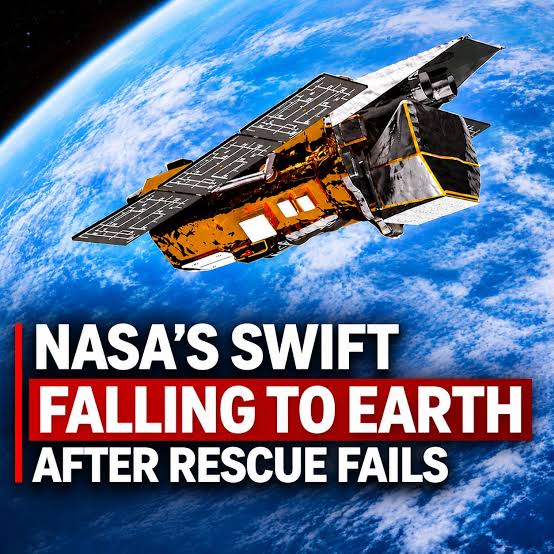
NASA Confirms the Swift Telescope’s Final Descent
NASA confirmed that Swift reentered at 7:39 a.m. EST, or 12:39 UTC, on November 4. The agency cited U.S. Space Force confirmation and placed the event over Indonesia’s North Sumatra region.
Most of the spacecraft was expected to burn up during its passage through the atmosphere. However, NASA said some components may have survived reentry. That distinction matters: the confirmed reentry location does not identify where any remaining fragments reached the surface.
The event ended a mission that launched on November 20, 2004. Originally, NASA planned a two-year primary mission. Swift instead continued producing observations for more than two decades, becoming a dependable resource for astronomers studying rapidly changing objects.
NASA’s confirmation provides a firmer account than early predictions about when the spacecraft might return. The final timing also separates the observed event from forecasts issued while Swift remained in orbit.
Its long service helps explain why NASA pursued a rescue rather than simply waiting for the orbit to decay.
Why the NASA Swift Telescope Could Not Stay in Orbit
Increased solar activity accelerated Swift’s decline by strengthening atmospheric drag. Without onboard propulsion to restore its altitude, the observatory depended on operational adjustments to slow its descent.
The immediate problem eventually became scientific as well as orbital. Swift needed steady pointing to observe its targets. Stronger drag at lower altitudes made that increasingly difficult.
On October 20, the spacecraft reached approximately 275 kilometers above Earth and entered safe mode. Its control system could no longer compensate for the growing disturbance. Operators then sent a command that effectively ended operations and prepared Swift for reentry.
The mission therefore had two distinct endings. Its ability to collect science ended in October, while its physical return followed in November. A productive history could not overcome the conditions at its final orbital altitude.
Inside the Commercial Rescue Attempt
A Short Deadline for an Ambitious Mission
In September 2025, NASA awarded Katalyst Space $30 million to attempt an orbital boost. The company faced a demanding schedule: develop, test, and launch a servicing spacecraft before Swift descended too far.
Its LINK vehicle would approach Swift, capture the observatory, and raise its orbit. Three robotic arms offered flexibility in where the servicing craft could take hold.
LINK launched on July 3, 2026, aboard a Pegasus XL rocket. Reaching orbit gave the project an opportunity to demonstrate commercial servicing while potentially preserving years of additional astronomy.
The investment supported both a specific rescue objective and a test of servicing capabilities. Success would have required completing each stage while the target observatory continued losing altitude, leaving little room for lengthy delays.
However, launching the spacecraft represented only one stage. The mission still required reliable control, a successful approach, and safe capture before any boost could begin.
Control Problems Ended the Boost Plan
LINK developed orientation-control problems after launch. NASA and Katalyst worked through recovery efforts, but persistent difficulties forced them to scale back the mission in August.
Capture and boosting would no longer proceed. Instead, the partners pursued demonstrations intended to inform future servicing operations. The rescue therefore failed before LINK attached to Swift or attempted to lift it.
NASA formally ended its involvement on September 3. LINK itself reentered Earth’s atmosphere on September 25.
That outcome left Swift without the planned route to a higher orbit. The observatory’s remaining time would depend on how long its declining altitude allowed useful operations.
Swift’s Final Weeks Still Delivered Science
Buying Time for the Rescue
Before the rescue attempt ended, Swift’s operators had changed how the observatory pointed. They favored orientations that reduced drag, helping keep it above the altitude needed for a feasible servicing attempt.
This approach required a compromise. Pointing choices that protected orbital lifetime limited the telescope’s normal observing program. Teams also had to protect its instruments while choosing those orientations.
The changes bought time, but they could not replace the missing orbital boost.
Returning to Astronomical Targets
After the rescue plan changed, Swift resumed science observations. NASA reported hundreds of targets during this final observing period, including stellar remnants, active galaxies, and comets.
Returning to those targets increased drag compared with the earlier conservation strategy. Nevertheless, the decision allowed Swift to gather additional data before stable pointing became impossible.
Those final weeks gave the mission a useful closing chapter. Even after the servicing attempt fell short, the observatory continued contributing to astronomy until October’s shutdown.
What Astronomy Loses With Swift
Fast Observations Made the Difference
Swift’s value extended beyond the number of objects it observed. Its speed helped astronomers capture events whose most revealing features could fade quickly.
The spacecraft could detect a gamma-ray burst, locate it, alert other facilities, and turn its telescopes toward the source. That sequence typically took about a minute. Coordinated follow-up then allowed other observatories to examine the same event.
Across its career, Swift observed more than 2,000 gamma-ray bursts and more than 1,400 supernovas. Its data contributed to about 7,000 scientific papers.
An Archive With More to Offer
The observatory also studied black holes, active galaxies, comets, and asteroids. This range made its archive useful across several areas of astronomy.
Ending new observations does not end the value of those records. Researchers can revisit earlier measurements, compare events, and develop new questions from existing data.
NASA is exploring how existing telescopes and future capabilities can support rapid observations after Swift. That effort reflects the importance of preserving timely follow-up across the wider astronomical community.
NASA Swift Telescope Leaves a Lasting Legacy
The NASA Swift telescope completed far more science than its original mission required. Its unsuccessful rescue adds a separate lesson about the difficulty of extending spacecraft lifetimes under tight deadlines.
NASA says the servicing effort provided experience for future missions. That assessment sits alongside a clear result: LINK did not save Swift. Meanwhile, the observatory’s accumulated measurements remain available for scientific work. Its time in orbit has ended, but the questions researchers can ask of its data continue.
Main Sources:
NASA — Swift reentry confirmation, updated November 4, 2026:
https://science.nasa.gov/blogs/swift/2026/11/02/nasas-swift-observatory-to-re-enter-atmosphere/
NASA — Swift operations end, October 23, 2026:
https://science.nasa.gov/blogs/swift/2026/10/23/nasas-swift-mission-ends-ahead-of-re-entry/
NASA — Commercial boost mission award:
https://www.nasa.gov/news-release/nasa-awards-company-to-attempt-swift-spacecraft-orbit-boost/
NASA — Commercial boost mission update:
https://www.nasa.gov/news-release/nasa-updates-next-steps-for-commercial-swift-boost-mission/
NASA — Lessons from the Swift boost mission:
https://science.nasa.gov/missions/swift/nasa-highlights-lessons-learned-from-swift-boost-mission/
NASA — Swift’s scientific legacy:
https://science.nasa.gov/missions/swift/nasas-swift-mission-ends/
You Might Also Like:
NASA Swift Rescue Mission: A Robot Races to Save a Telescope
Swift Observatory Nears Its End After Stunning Galaxy Reveal
NASA Swift Rescue Mission Ends Without Orbit Boost