
BY:SpaceEyeNews.
Look just below and to the right of the bright center of NGC 1433. In an older photograph, the spiral galaxy’s faint structure fills that patch of sky. In a November 2026 view, a distinct point of light draws the eye. That point is SN 2026ahvu, a Type Ia supernova in a galaxy roughly 50 million light-years away.
The two pictures reveal where the supernova appeared. The surprise lies in the measurements between discovery and the new portrait. Within days, the source climbed from about magnitude 17 to 13.5. Astronomers had found it early enough to ask what its first light could tell them about the star that produced it.
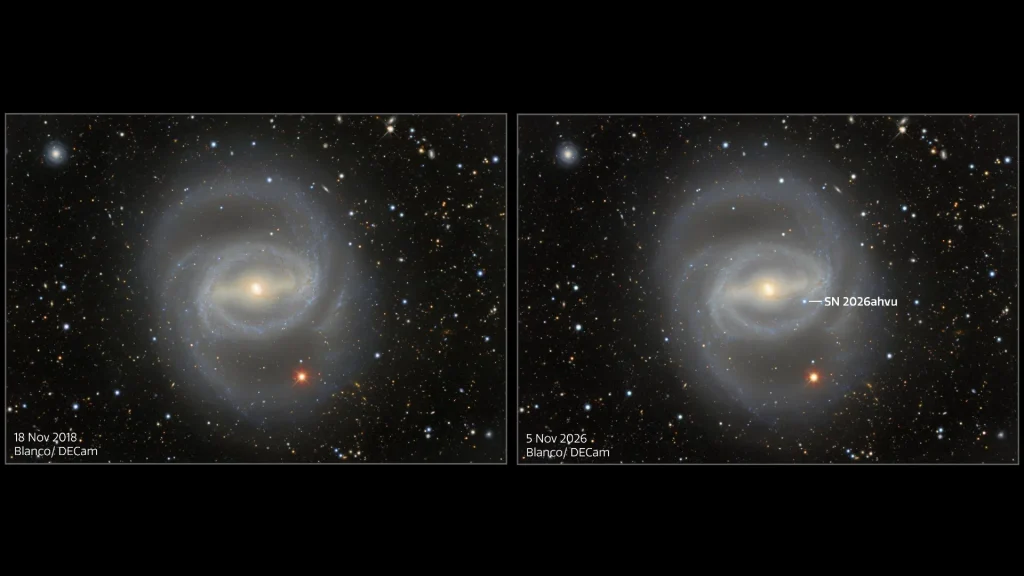
Two views of spiral galaxy NGC 1433 show SN 2026ahvu appearing as a bright point below and to the right of the galaxy’s center.Image credit: Dark Energy Survey/DOE/FNAL/DECam/CTIO/NOIRLab/NSF/AURA. Acknowledgment: G. Narayan and T. Murphey. Image processing: M. Zamani and D. de Martin. Resized and converted to WebP under CC BY 4.0.
How an asteroid survey found SN 2026ahvu
On November 2, the Asteroid Terrestrial-impact Last Alert System, or ATLAS, detected the new source. Its telescopes repeatedly scan the sky for approaching asteroids. An asteroid changes position against the stars from one exposure to the next. A supernova can catch the same survey’s attention by growing brighter at a single position. In this case, that position fell within the outline of a familiar barred spiral galaxy.
At first, astronomers gave the source the provisional name AT 2026ahvu. A point in a photograph reveals little about the object producing the light. For an identification, observers at Keck spread the light into a spectrum. The pattern matched a young Type Ia supernova, and the object gained its SN designation.
That classification narrowed the story to a white dwarf undergoing a thermonuclear event. It also gave other observers a reason to turn their telescopes toward NGC 1433 promptly. Each clear night offered a chance to measure a phase that would soon pass.
How quickly did the supernova brighten?
The magnitude scale runs backward, so the drop from 17 to 13.5 represents a substantial gain in brightness. For measurements in the same filter, a change of 3.5 magnitudes corresponds to roughly 25 times as much light. The discovery figures give a sense of how quickly the faint source became easier to study, even against the glow of its host galaxy.
The timing matters as much as the size of that change. A single exposure near maximum light can give astronomers a good brightness measurement. It leaves open how the supernova got there. With several earlier observations, researchers can plot the rise and compare its shape with predictions. Two events could reach a similar peak after following different paths during their opening days.
In its November 12 update, NSF NOIRLab placed the expected maximum between November 18 and 23. That forecast gave observers a window for planning their work. To establish when the light actually peaked in a particular filter, they need measurements on both sides of the high point.
The galaxy already had a “before” photograph
Years before the ATLAS discovery, the Dark Energy Survey had photographed NGC 1433 with the Dark Energy Camera, or DECam. The camera sits on the Víctor M. Blanco 4-meter Telescope in Chile. Between 2013 and 2019, the survey gathered images to study the universe on much larger scales. One practical result was a record of how this patch of the galaxy looked long before November 2026.
That older view serves a purpose beyond making a striking picture. Even before the supernova appeared, stars elsewhere in NGC 1433 contributed light at its apparent position. An archival exposure gives astronomers a reference for that background. It also lets readers compare the same patch of sky across years, using the galaxy’s bright center as a landmark.
The host galaxy also introduces an uncertainty of its own. Published distance estimates for NGC 1433 differ, so the often quoted 50 million light-years is approximate. That matters when astronomers convert the light reaching Earth into the total light the star emitted. They can still measure how quickly it brightened in our sky while researchers refine the distance to its home galaxy.
Gemini South supplied a sharper view of the supernova and its surroundings. In the image, the new light stands apart from the central glow. Yet even this detailed portrait leaves the original stellar system unresolved. For clues about the white dwarf’s surroundings, researchers can turn to other wavelengths.
What the early light can reveal about the white dwarf
As material expands from a Type Ia supernova, its spectrum carries information about the elements present and how fast they move. Images through different filters track changes in color over the same period. Together, those measurements let astronomers look for an early contribution from material encountering a companion star or nearby gas. Any proposed explanation must account for both the timing and the character of the light.
NOIRLab coordinated follow-up with Blanco, Gemini South, and the Southern Astrophysical Research Telescope in Chile. The scientific advantage comes from pairing observations. A change in color on one night becomes easier to interpret if a spectrum also shows what the expanding material was doing around that time.
A clue from Chandra’s archives
One team approached the companion question from the opposite end of the timeline. In a November 16 preprint, researchers examined two observations from NASA’s Chandra X-ray Observatory, taken in 2015 and 2024. Together, the exposures covered more than 26 hours. Chandra recorded no X-ray photons within the small region the team examined around the future supernova’s position.
That absence helps narrow the possibilities. A hot, compact white dwarf steadily burning hydrogen supplied by a companion could have emitted soft X-rays bright enough for Chandra to detect. The team’s analysis disfavors that scenario if little intervening material absorbed the signal. A cooler source or one hidden by denser gas could still fit the observations. The companion’s identity remains an open question.
Why the first sighting of SN 2026ahvu matters
Astronomers use Type Ia supernovae to measure cosmic distances. That work benefits from understanding why individual events differ, especially when two look similar near maximum light. SN 2026ahvu offers several ways to investigate those differences. The old galaxy images establish the setting, Chandra limits what could have shone there beforehand, and the optical measurements trace the rise.
Of all those observations, the faint ATLAS detection may be the easiest to overlook. By the time Gemini South captured its clearer portrait, the source had already changed. The November 2 measurement preserves something even the sharpest later photograph cannot recover. It records how faint the supernova looked when astronomers first found it.
Main sources:
- Space.com, November 18 photo feature — https://www.space.com/astronomy/a-newfound-supernova-explodes-50-million-light-years-away-space-photo-of-the-day-for-nov-18-2026
- NSF NOIRLab and International Gemini Observatory, Gemini South image and observing notes — https://www.astropix.org/image/noirlab/noirlab2628a
- Observatory announcement with brightness measurements and follow-up plans, via Phys.org — https://phys.org/news/2026-11-gemini-decam-showcase-young-ia.html
- Transient Name Server, discovery and Keck classification notices — https://www.wis-tns.org/object/2026ahvu
- Original Chandra archival analysis, November 16 preprint — https://arxiv.org/abs/2611.21342
You Might Also Like:
Cosmic Reionization May Have Begun Before the First Supernovae
Supernova Athena: Hubble Awaits Its Return
Neutrino Flavor Conversion May Explain Missing Supernovas