
BY:SpaceEyeNews.
Some worlds beyond Neptune formed closer to the Sun than their present orbits suggest. The giant planets shifted position early in solar system history, sending small icy bodies outward. Billions of years later, a little of that early geography may still show up in the sunlight they reflect. Astronomers found the clue by comparing some of the faintest objects Webb has ever spotted in our solar system with their larger neighbors.
Webb discovered 27 new trans-Neptunian objects in a small patch of sky. Hubble helped astronomers measure colors for 13 of them. Together, those observations uncovered a curious contrast. Two groups with different histories retained distinct color patterns, yet the relative numbers of small and large bodies looked remarkably similar.
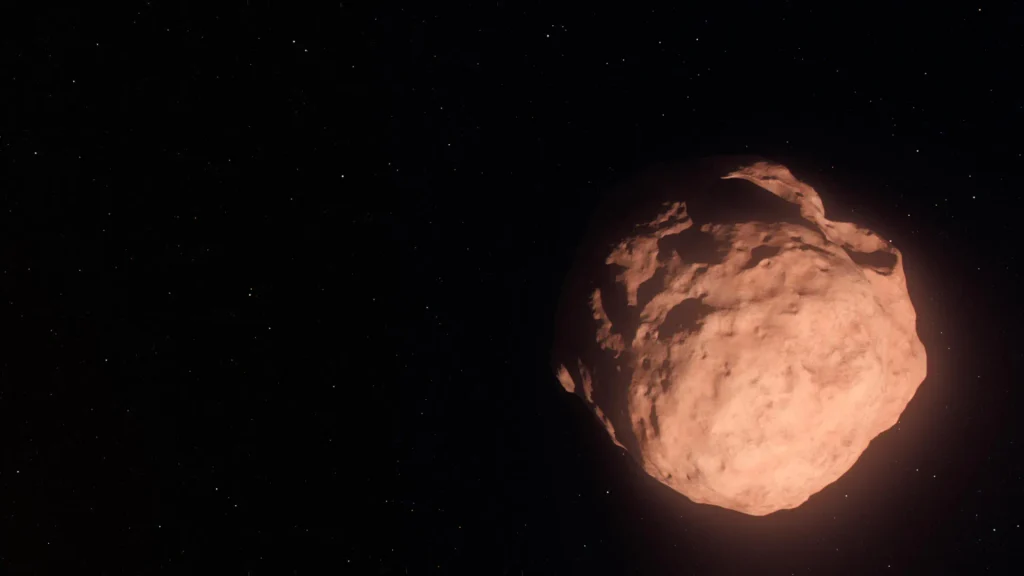
This artist’s concept depicts a Trans-Neptunian Object (TNO), a small, faint, icy body orbiting the Sun beyond the orbit of Neptune. Often more than 100 million times dimmer than objects visible to the unaided eye, TNOs are so small that even with NASA’s Hubble and Webb space telescopes, they appear only as tiny points of light. Credit: NASA, ESA, Leah Hustak (STScI)
How Webb spotted tiny worlds beyond Neptune
In a single exposure, an icy body near the edge of Webb’s sensitivity can disappear into the background noise. Combining exposures gathers more light, but there’s a catch. During the observations, a solar system object moves against the distant background. Line up the stars in every frame, and the faint object spreads out along its path.
The researchers tried a different alignment. They shifted each exposure by the distance an object would move along a trial path, then added the images together. When the path matched the object’s motion, its light landed in the same place repeatedly. An automated search helped the team sift genuine candidates from patterns that noise alone could produce.
What Hubble added to the discovery
Hubble observed the same field at nearly the same time, recording visible light while Webb collected near-infrared light. Once researchers knew where to look, they could pick out 13 of Webb’s discoveries in Hubble’s images. Comparing brightness across wavelengths gave them a color measurement even though the telescopes saw each object as a point. That measurement let them ask whether small bodies reflect sunlight in the same proportions as larger members of their group.
The timing helped, too. An uneven object can brighten or fade as it turns, bringing different surfaces into view. Take two measurements far enough apart, and rotation can complicate the comparison between colors. Observing close together reduced that ambiguity. The team also checked how brightness varied during the observations and found modest changes among the newly discovered objects.
Two orbital families carry different colors
One group, the cold classical population, follows nearly circular paths close to the plane of the planets. Astronomers think these bodies stayed near the region where they formed. Their larger members show a narrow range of surface colors. When researchers examined the much smaller objects, they found that those colors fell along the same sequence.
The other group has a more complicated history. Its members follow orbits with a wider range of tilts and shapes. Many likely formed closer to the Sun before the shifting giant planets scattered them outward. Astronomers call this population dynamically hot. Both “hot” and “cold” describe how the objects move.
Among the small members of the hot group, researchers found a broader palette. Larger members of that population also span a wider range of colors. So an object’s family still tells astronomers something about its surface, even at sizes where they had little previous evidence. Color alone can’t pinpoint an individual object’s birthplace. Across a population, however, the pattern can reveal differences in the material available where its members formed.
How could an ancient color pattern survive?
Consider what happens when a piece separates from a larger icy body. Material once buried beneath the surface can begin reflecting sunlight directly into space. If that interior looks different from the old exterior, the fragment’s color could change. Across billions of years, repeated collisions might give smaller objects a different color pattern from their larger relatives. science.nasa.gov
Instead, the familiar family patterns extend down to the sizes Hubble and Webb could study together. One possibility is that these objects experienced fewer collisions than astronomers expected. Another is that fragments expose material with much the same color as the parent surface. Either explanation allows a group to retain a recognizable signature even as individual members follow very different paths.
Why Webb found fewer small icy bodies than expected
Webb’s full set of 27 discoveries let a second team investigate a different question. As the survey reached fainter objects, how quickly did their numbers rise? Some models of planet formation predict a larger population of very small bodies than the team’s counts suggest. Reaching that faint end matters because models can agree on the abundance of large objects while predicting quite different numbers of small ones.
To interpret the count, the team had to know what the search might miss. Near the survey’s limit, even real objects sometimes vanish into noise. The researchers measured how often their search recovered faint signals. That gave them a way to account for incomplete detections when comparing Webb’s tally with theoretical predictions.
Why brightness complicates the count
Two objects at the same distance can look equally bright for different reasons. A small body with a reflective surface can return as much sunlight as a larger, darker one. Astronomers therefore need an assumption about reflectivity to turn a brightness measurement into a diameter. For the faintest detection, the discovery team calculated a diameter of roughly 10 kilometers if the surface reflects 15 percent of incoming light.
The researchers also compared how rapidly the counts rose toward fainter brightness levels in each orbital family. Within the uncertainties, the two groups followed the same trend. That leaves room for an intriguing possibility. Regions at different distances from the young Sun could supply different surface materials while producing a similar spread of sizes among the first planetary building blocks.
What the next discoveries could reveal
A wider survey could test both findings at once. More faint objects would give astronomers a better count at the smallest sizes they can reach. Visible and infrared measurements of those same objects would show whether the cold population keeps its narrow color range. They would also reveal whether the hot population still spans a broader palette as the sample grows.
The most intriguing question is where either pattern begins to change. A shift in color among still smaller worlds beyond Neptune could point to a size at which surface changes matter more. A difference in the counts could show where two birth regions started producing different outcomes. For now, even a moving point of light can tell astronomers something about the material a world inherited and the population it belongs to.
Main sources:
- NASA Science — NASA’s Hubble, Webb Find Far-out Solar System Objects ‘Remember’ Past
- Anastasia Morgan and colleagues — Combined JWST and HST Deep Imaging to Characterize the Smallest Known Trans-Neptunian Objects
- Marielle Eduardo and colleagues — The Luminosity Function of Ultra-Faint Trans-Neptunian Objects Detected by JWST
You Might Also Like:
Hidden Water on Mini-Neptunes May Escape JWST
Neptune’s Rings: Strange Arcs and Uncertain Origins
Voyager 2 Neptune Navigation: A 7-Billion-km Feat