
BY:SpaceEyeNews.
The sun may have uncovered a deeper chapter in the history of interstellar comet 3I/ATLAS. New calculations suggest solar heating removed meters of material during its passage through our solar system. That erosion could have exposed ingredients that retain clearer clues about the comet’s birthplace.
However, scientists have not confirmed that untouched material reached the surface. The answer depends largely on how much dust escaped alongside the gas. Understanding that difference could help astronomers separate the comet’s original chemistry from changes accumulated during its journey between stars.
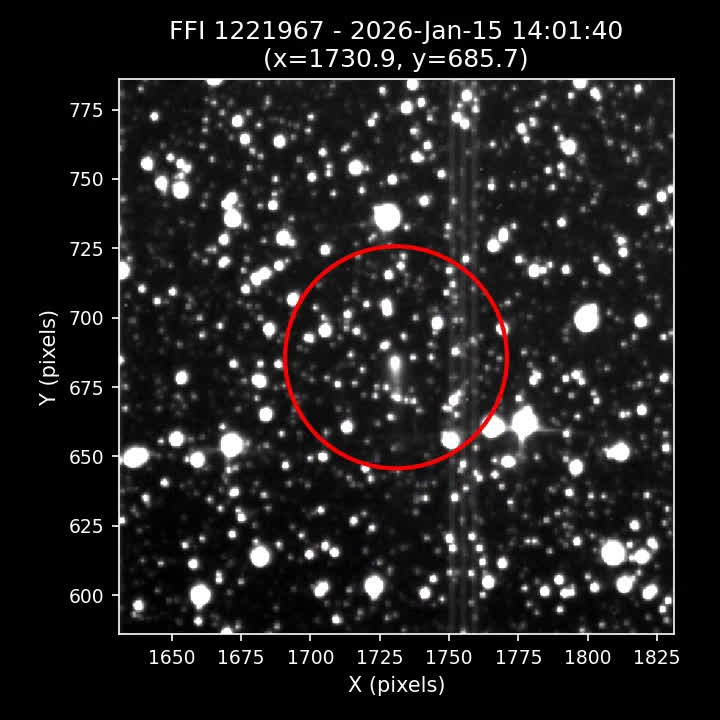
TESS Reobserves 3I/ATLAS Jan. 15, 18–19, 2026. Credit: NASA.
How much material did interstellar comet 3I/ATLAS lose?
Researchers Tessa Frincke and Darryl Seligman examined published measurements of material escaping from the comet. Their accepted manuscript appears in Monthly Notices of the Royal Astronomical Society.
They combined observations from before and after the comet’s closest approach to the sun. These measurements tracked escaping substances, mainly water, carbon dioxide, and carbon monoxide.
Next, the researchers modeled how gas production changed along the comet’s trajectory. Adding those losses together gave an estimated gas loss of roughly 18–58 billion kilograms.
That sounds enormous, but mass alone does not reveal how deeply the surface changed. To estimate erosion, the team needed assumptions about the nucleus’s dimensions and density.
Turning gas loss into surface depth
The calculation treated the nucleus as a sphere with an initial radius of 1.3 kilometers. It also assumed a density typical of solar system comets.
Under those conditions, gas loss alone corresponds to removing a layer approximately 1.7–5.2 meters thick.
Crucially, this is an equivalent thickness spread across the entire surface. It does not mean every location lost the same amount. Some regions could have changed more substantially than others. academic.oup.com
Why dust changes the erosion estimate
Gas tells only part of the story. Comets also release solid particles, which add to the total mass leaving their nuclei.
Including dust therefore increases the calculated erosion. The researchers explored several dust-to-gas ratios to assess how much that contribution might matter.
Three scenarios, three different ranges
Gas alone gives an estimated erosion depth of 1.7–5.2 meters. With equal masses of escaping dust and gas, the range rises to approximately 3.4–10.5 meters.
If dust accounts for four times the gas mass, the estimate reaches approximately 8.6–26.7 meters.
These scenarios do not establish how much dust escaped throughout the entire passage. Instead, they demonstrate how strongly that uncertain quantity affects the answer.
The ranges also reflect different assumptions about the duration of activity. Conservative calculations cover observed intervals. Broader calculations extend activity into unobserved periods when particular ices could have started releasing gas.
Consequently, the largest number should not become a claim that the sun definitely removed nearly 27 meters.
What could lie beneath the altered exterior?
The deeper question concerns chemistry. During its interstellar journey, energetic particles may have changed the comet’s outer material.
Earlier research proposed that irradiation converted some carbon monoxide into carbon dioxide. That process could help explain the unusually carbon-dioxide-rich gas detected before the comet’s closest solar approach.
The earlier modeling suggested an altered zone extending roughly 15–20 meters beneath the surface. Scientists have not directly measured such a layer inside the nucleus. arxiv.org
Could sunlight reach the original ingredients?
The gas-only erosion estimates fall short of removing that entire proposed zone. Some scenarios that include dust, however, reach comparable depths or exceed them.
This overlap makes exposure of less-altered material possible. It does not demonstrate that exposure actually happened.
The distinction matters because astronomers want to learn about the environment where interstellar comet 3I/ATLAS formed. Material closer to its original condition could offer a clearer chemical record of that distant planetary system.
What NASA observed after the solar approach
NASA’s SPHEREx observations provide useful context for this possibility. In December 2025, the telescope observed a much more active comet than during its earlier campaign.
NASA reported a substantial increase in brightness around two months after the closest solar approach. The observations traced dust, water, carbon dioxide, and organic molecules around the nucleus.
These findings show that the comet’s activity continued changing after peak solar heating.
Why deeper activity can arrive later
Heat needs time to move through a comet’s outer layers. As a result, subsurface ice can begin releasing gas after the nucleus has passed its closest point to the sun.
NASA linked the later activity to heating below the surface. That interpretation fits the possibility that solar energy accessed material beneath an altered exterior. science.nasa.gov
Nevertheless, SPHEREx did not directly measure the erosion depths in the new study. Its observations offer complementary evidence about activity and composition.
Why changing gases do not settle the question
Several uncertainties prevent a definitive conclusion. The inferred erosion depends on nucleus size, density, dust production, and the intervals covered by observations.
Moreover, the comet may contain different mixtures of ice in different locations. A changing gas mixture could therefore reflect uneven composition rather than exposure of an untouched interior.
Researchers must also distinguish heating below the surface from physically removing every overlying layer. Those processes can contribute differently to what telescopes detect.
Comparing earlier and later measurements can help narrow the possibilities. The erosion calculations add a potential depth context to those chemical changes, giving researchers another way to interpret the observations.
Interstellar comet 3I/ATLAS offers a deeper chemical puzzle
Solar heating may have removed enough material to reveal a less-altered part of interstellar comet 3I/ATLAS. Yet the strongest conclusion remains conditional: dust loss could make the difference between shallow erosion and access to deeper layers.
The scientific opportunity lies in connecting those depths with changing chemical signals. Together, they could help distinguish the comet’s original ingredients from the effects of its long journey through interstellar space.
Main sources:
- Original article, Phys.org: The sun may have stripped away meters of interstellar comet 3I/ATLAS
- Research paper, Monthly Notices of the Royal Astronomical Society: Assessment of the Mass Loss and Radius Change of 3I/ATLAS Based on Observed Production Rates
- Official NASA reporting: NASA’s SPHEREx Mission Tracks Brightening of Interstellar Comet
- Earlier research, author manuscript: Interstellar Comet 3I/ATLAS: Evidence for Galactic Cosmic Ray Processing
You Might Also Like:
Interstellar Comet 3I/ATLAS Was Hidden in Rubin Observatory Images Before Discovery
Interstellar Comet 3I/ATLAS Reveals a Frozen Origin Older Than the Sun
Interstellar Comet 3I/ATLAS Transformation Reveals Hidden Chemistry
Interstellar Comet 3I/ATLAS Composition Change Reveals Hidden Structure