
BY:SpaceEyeNews.
The Beta Pictoris Cat’s Tail stands out in one telescope image and almost disappears in another. In Webb’s infrared view, a slender trail of dust curves up from a disk around a star 63 light-years away. In Hubble’s new view, only a faint stretch of that curve breaks through. Astronomers had long wanted to know why the two telescopes saw such different scenes. Now the first detection of starlight glinting off the tail gives them a way to investigate what the dust contains. The clue lies in just how little light reaches us.
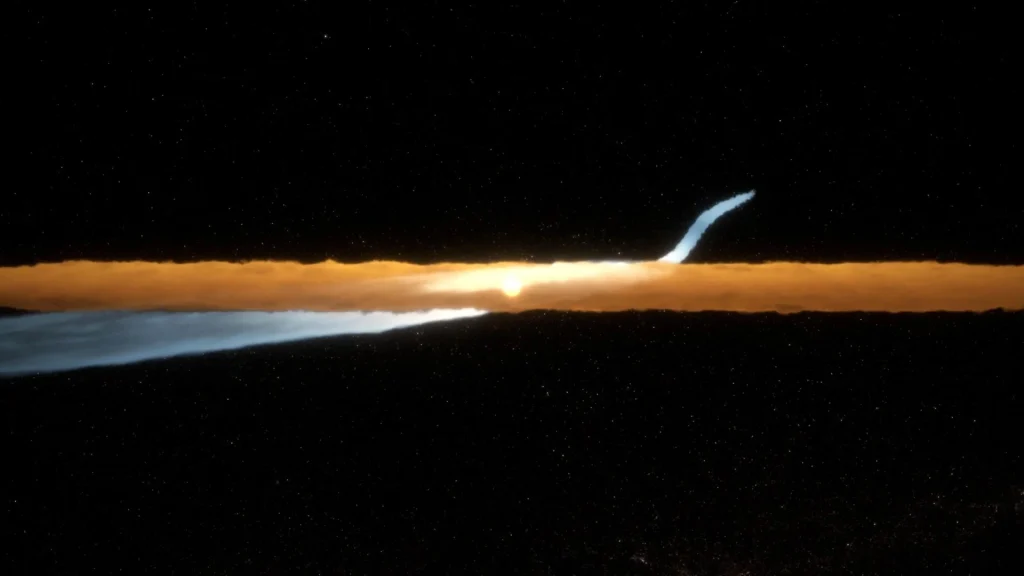
Beta Pictoris Cat’s Tail Arcs Above Its Dusty Disk.
How Hubble picked out the Beta Pictoris Cat’s Tail
The search started with a bend on the southwest side of the star. In 2024, NASA released Webb images showing a narrow branch rising from the system’s secondary debris disk. It appeared in data from Webb’s mid-infrared instrument, which picked up heat from the grains. That gave astronomers a precise place to look for a much fainter trace in Hubble’s images.
A University of Arizona-led team brought together six sets of Hubble observations taken between 2012 and 2025. The researchers used images in which an instrument blocked the central star’s glare. Even then, finding the disk and finding the tail were two different tasks. Hubble could trace the broader disk out to 500 times the Earth–Sun distance. The much narrower tail faded from view well before that point.
The reason becomes clearer toward the tip. Farther from the star, less light falls on each grain. Less still scatters in Earth’s direction. In Hubble’s image, the trail slips below the telescope’s detection limit while Webb can still trace its curve.
What the faint signal says about the dust
The team compared the light Hubble gathered from the tail with Webb’s measurement in one mid-infrared band. Hubble’s signal amounted to just 0.1% to 0.4% of Webb’s in those observations. That ratio compares what reached two instruments at particular wavelengths. It gives researchers a way to test which materials could produce both readings.
Carbon-rich dust offered the best match in the team’s models. It absorbs much of the visible light that strikes it and gives off energy as heat. That combination helps explain how Webb picked out a distinct curve where Hubble saw such a faint one.
The grains also appear surprisingly airy. Each measures roughly a micron across, yet much of the space inside it may be empty. Here the two telescopes offer complementary clues. The brightness measurements favor porous grains, and the way such grains respond to starlight could help explain the curve itself.
Where the 93-billion-mile figure comes from
The Beta Pictoris Cat’s Tail has attracted attention for a figure that sounds unusually precise. Yet 93 billion miles can describe something quite different from the length of the streak in a photograph.
NASA’s original Webb coverage put the span of the infrared feature at about 10 billion miles. The larger figure arose from efforts to reconstruct the dust trail in three dimensions. In one early model, the outer grains could reach nearly 1,000 astronomical units from the star. That distance translates to roughly 93 billion miles.
Consider the view from Earth. A trail pointing partly away from us can look short because much of its length lies along our line of sight. Turn that same trail sideways and more of its length appears across the image. Combining the Hubble and Webb data, the Arizona team found that the dust may run mostly sideways from our perspective. The images establish where the curve appears on the sky. Its depth, and therefore its full length, still depend on the model.
How starlight could draw a curved tail
One explanation begins with two large bodies crossing paths in the debris disk. A collision could release grains that initially follow their source’s orbit. As the grains spread, light from Beta Pictoris would push the smallest, fluffiest particles outward more readily than larger ones. Over time, those different paths could draw out the curved trail Webb sees.
The estimated amount of carbon-rich material offers a clue to the scale of the original bodies. Researchers used objects in our own Kuiper Belt to estimate how much of that material each body might supply. Under those assumptions, even the minimum masses approach those of objects such as Pluto’s moon Charon and the dwarf planet Makemake. No telescope witnessed the encounter. The estimate works backward from the dust that remains.
An independent observation also makes a recent encounter worth considering. Radio astronomers found a pocket of carbon monoxide near the tail. The star’s radiation should break down that gas in roughly a century. Its presence gives the idea of a recent dust-producing event a timing clue, although the gas alone cannot establish what happened.
One detail still puzzles the team. How could such an event produce tiny grains with so much empty space inside? The researchers suggest that heat may have turned solid carbon into vapor. As the vapor cooled, fresh grains could have formed. The observations give astronomers a grain structure to explain, but the cooling process remains an open question.
A separate bend in the outer dust halo
Away from the narrow tail, Hubble picked up a broader bend in the halo of dust surrounding Beta Pictoris. One side of the halo also looks brighter than the other. Here astronomers have a different suspect in view. Beta Pictoris b, a giant planet with roughly ten times Jupiter’s mass, orbits inside the disk.
Its gravity could gradually alter the orbits of larger bodies that supply dust to the halo. That offers a possible explanation for a distortion far beyond the planet’s own orbit. The distinction matters because the two shapes could preserve different histories. A single episode may have supplied dust for the tail, while a planet’s repeated gravitational influence may have shaped the wider halo. lpl.arizona.edu
What the Cat’s Tail still holds
For the Beta Pictoris Cat’s Tail, the faintest part of the story has proved especially revealing. Astronomers now have a measurement that any explanation must fit. The same grains must scatter very little visible light toward Earth, glow in the infrared and follow paths that make a narrow curve. Carbon-rich, porous particles bring those clues together. What remains hardest to explain is how bodies on the scale of small worlds could leave behind grains so delicate that starlight can redraw their paths.
Main sources:
- University of Arizona — Research team’s announcement of the Hubble detection
- NASA — Webb discovers a dusty Cat’s Tail in the Beta Pictoris system
- Avsar and colleagues — Hubble study of scattered light from the Cat’s Tail
- Rebollido and colleagues — Original Webb study and three-dimensional dust models
You Might Also Like:
Fermi Dark Matter Signal Reveals a Mysterious 43 GeV Line
Second-generation planet: Hubble’s Surprising New Clues
Hubble Smiley Face: The Science Behind a Cosmic Grin